

fbpx

Please wait...


BLOG

No more posts

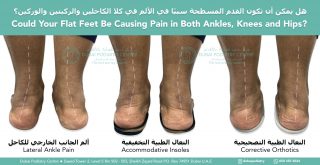
Illustration showing flat feet causing lateral ankle pain, knee pain and hip pain, comparing accommodative insoles with corrective orthotics to improve lower limb alignment


Many people think flat feet only cause tired or aching feet. However, the effects of flat feet often extend much further up the body. When the feet do not provide a stable foundation, the ankles, knees and hips must compensate, which can eventually lead to pain in multiple joints.

At Dubai Podiatry Centre, we frequently see patients whose symptoms begin in the feet but gradually progress higher up the legs.

Flat Feet Affect More Than Just Your Feet

Your feet are the foundation of your body. Every step you take begins with the way your feet contact the ground.

In people with flat feet, the arches collapse more than they should during walking, causing the feet to roll inwards a movement known as overpronation.

As the feet roll inward, the rest of the leg follows.

This can lead to:

  • Increased inward rotation of the lower leg
  • Changes in knee alignment
  • Altered hip mechanics
  • Increased stress on muscles, tendons and joints

Rather than one isolated problem, it becomes a chain reaction affecting the entire lower limb.

Why Does the Outside of the Ankle Hurt?

Many people expect flat feet to cause pain on the inside of the ankle, but pain on the outside is actually very common.

As the foot collapses inward, the heel tilts and the structures on the outside of the ankle are forced to work harder to stabilise the foot.

This may place excessive strain on:

  • The peroneal tendons
  • The lateral ankle ligaments
  • The muscles that support balance during walking

Over time, these structures become overloaded, resulting in persistent pain on the outside of the ankles.

How Flat Feet Can Lead to Knee Pain

The feet and knees work together with every step.

When the feet overpronate excessively, the shin bone rotates inward. This alters the normal movement of the knee and increases stress across the joint.

Patients commonly experience:

  • Pain during walking
  • Discomfort when climbing stairs
  • Knee fatigue after standing for long periods
  • Gradually worsening symptoms with activity

If the underlying foot mechanics are not addressed, the knee continues to compensate with every step.

Why Hip Pain Often Develops

The inward rotation that begins at the foot doesn’t stop at the knee.

It continues into the hips, affecting the muscles that stabilise the pelvis and changing the way the hip joint functions.

This can lead to:

  • Hip muscle fatigue
  • Pain around the outside of the hips
  • Reduced walking endurance
  • Difficulty standing for prolonged periods

Many patients are surprised to discover that their hip pain may actually begin with poor foot alignment.

Not All Insoles Work the Same Way

Many patients tell us they have already tried insoles but still have pain.

This is because there are two very different types of insoles.

Accommodative insoles are designed to cushion the feet and improve comfort by redistributing pressure. They can be very helpful for reducing discomfort but do not significantly change foot alignment.

Corrective orthotics, on the other hand, are designed to control excessive foot movement, improve heel position and restore better lower limb alignment. By addressing the underlying biomechanics, they may reduce abnormal loading through the ankles, knees and hips.

The most appropriate option depends on a thorough biomechanical assessment and the specific cause of the patient’s symptoms.

Why a Biomechanical Assessment Is Important

Pain in multiple joints is often treated one area at a time. However, unless the underlying cause is identified, symptoms may continue to return.

A comprehensive biomechanical assessment allows the podiatrist to evaluate:

  • Foot posture
  • Walking pattern (gait)
  • Heel alignment
  • Lower limb biomechanics
  • Muscle function and joint movement

This helps determine whether abnormal foot mechanics are contributing to pain higher up the body.

Early Treatment Can Prevent Further Problems

Flat feet do not always require treatment. However, when they are causing pain in the ankles, knees or hips, early intervention can improve function and help prevent further joint overload.

Treatment may include:

  • A comprehensive biomechanical assessment
  • Custom corrective orthotics where clinically indicated
  • Footwear advice
  • Stretching and strengthening exercises
  • Ongoing monitoring to optimise lower limb alignment


If you have flat feet and are experiencing pain on the outside of both ankles, followed by aching knees and hips, the problem may not be isolated to each joint. Instead, your symptoms could be the result of altered foot mechanics affecting the entire lower limb.

Rather than simply treating the painful area, identifying and correcting the underlying cause can help improve movement, reduce abnormal stress and provide longer-term relief.

At Dubai Podiatry Centre, we assess the body as a connected system because healthy movement starts with a stable foundation.

For more information or to book an appointment please call our clinic +971 4 3435390 or WhatsApp +971 50 3553024


One of the most common questions patients ask at Dubai Podiatry Centre is:

“Am I too old to treat my flat feet?”

The simple answer is no.

Many people believe that flat feet can only be treated during childhood and that once you become an adult, nothing more can be done. Fortunately, this is one of the biggest misconceptions we hear in clinic.


Not Everyone Diagnosed with Flat Feet Actually Has Flat Feet

There are several different types of flat feet, but the most common condition we see is not a true flat foot at all.

In many cases, the ankle leans inwards, causing the arch to collapse under body weight. The arch then appears flat, even though the foot itself still has the ability to regain its natural shape once the ankle is correctly aligned.

Rather than thinking of the foot as permanently flat, it is often more accurate to think of it as an arch that has collapsed because the ankle is no longer supporting it correctly.


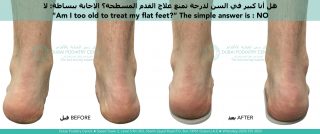
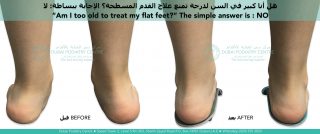
Adult flat feet before and after custom orthotics showing improved heel alignment and foot posture

Child with flat feet before and after podiatry treatment using custom orthotics showing corrected heel alignment


Adult Treatment Can Actually Be Faster

Many people are surprised when we explain that correcting this type of flat foot can actually progress faster in adults than in children.

Children have high levels of human growth hormone, which keeps their ligaments soft, flexible and easy to manipulate. This makes repositioning the bones relatively straightforward and usually very comfortable.

However, because the ligaments are constantly growing and remodelling, they often take longer to adapt and stabilise in their new position. For this reason, children commonly progress through each stage of treatment over approximately three to six months.

Adults are different.

Adult ligaments are firmer and less elastic, so there can be slightly more resistance when repositioning the foot. For this reason, we usually make smaller adjustments at each stage.

Once the bones have been repositioned, however, the adult foot often adapts surprisingly quickly. Instead of waiting three to six months between stages, many adults can progress every one to three months, allowing treatment to advance more rapidly.

Similar to Orthodontic Braces

A useful comparison is orthodontic braces for the teeth.

Most people understand that braces are not just for children. Adults successfully wear braces every day to gradually reposition their teeth into better alignment.

Corrective orthotics work on a similar principle.

Instead of moving teeth, they gently reposition the bones of the feet and ankles in carefully planned stages. As the alignment improves, the arch is supported more effectively and, in suitable cases, the foot can gradually regain a healthier arch shape.

Each new stage builds upon the previous one, allowing gradual correction rather than trying to make one large adjustment all at once.


It’s Never Too Late to Have an Assessment

If you have been told you have flat feet, it does not necessarily mean your feet are permanently flat.

The first step is determining why your arch has collapsed. For many patients, the underlying issue is ankle alignment rather than the shape of the foot itself.

With the correct diagnosis and a staged treatment plan, adults can often achieve significant improvements in foot alignment, comfort and function.

So if you’ve been wondering whether you’ve left it too late to treat your flat feet, the answer may be much more encouraging than you expected.

At Dubai Podiatry Centre, we regularly assess both children and adults and develop personalised treatment plans based on the specific cause of each patient’s foot alignment, because no two cases of flat feet are exactly the same.


For more information or to book an appointment please call our clinic +971 4 3435390 or WhatsApp +971 50 3553024


Young children with flat feet tend to fall down quite easily and have difficulty running quickly

غالبًا ما يقع الأطفال ذوي الاقدام المسطحة بسهولة أو يصعب عليهم الركض بسرعة

‏The reason for that is when the arches are flat the ankles lean in and the child finds it very difficult to run and walk in that position.

وهذا لأن الأقواس مستقيمة فيميل الكاحلين ويصبح من الصعب على الطفل الركض أو المشي في هذه الوضعية

‏So, they find a better way to run with their feet pointed outwards.

لذا يصبح من الأسهل لهم الركض وأقدامهم موّجهة للخارج

‏When that happens it tends to tilt the upper body forward so in turn they can fall forward quite easily.

عند الركض بهذه الطريقة، يميل الجزء العلوي من الجسد إلى الأمام فيزداد احتمال الوقوع

‏So, we would put something inside their school and sports shoes that lifts the arches and tilts the ankles back to straight giving the child better confidence when running.

لذلك نقوم بوضع شيء داخل الحذاء المدرسي و الرياضي ليرفع الأقواس ويعيد الكاحلين للوضع المستقيم وبالتالي إعادة الثقة للطفل خلال الركض


For more information or to book an appointment please call our clinic +971 4 3435390 or WhatsApp +971 50 3553024

Copyright Dubai Podiatry 2026. All rights reserved.

WhatsApp us