

Thank Goodness for Corns: Your Body’s Hidden Defence System
Thank goodness for corns on your feet – and here’s why.
It may sound strange, but a corn is actually a sign that your body is trying to protect you.
The body’s first job is always to protect the skin, the tissues underneath, and even the bone. When there is too much pressure or friction on one area of the foot, the body responds by building up a layer of hard skin. If that pressure continues, the hard skin thickens further and becomes a callus. If the pressure becomes even more concentrated over a small area, the body can then form a dense plug of keratin, which we call a corn.
A corn is made of almost pure keratin, similar to the material in a fingernail or toenail, but formed as a small plug. It often has the shape of an upside-down diamond, pointing inward, which is why it can become so painful to walk on.
Although corns are uncomfortable, they are actually part of the body’s natural defence system. They act like a protective plug, helping to prevent deeper tissue damage and protecting the area from excessive pressure that could otherwise lead to skin breakdown.
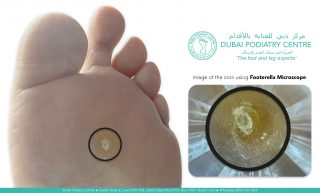
This is especially important because when the body cannot produce this protective hard skin response, it may be a sign of an underlying problem. Some people do not develop enough protective hyperkeratinisation, which is the medical term for thickened hard skin. Others may have neuropathy, where sensation is reduced, so the body does not properly detect the ongoing pressure or friction. In these cases, the skin may break down instead of defending itself, which is one reason why neuropathic ulcers and diabetic wounds can develop on the feet.
So in many ways, hard skin, callus, and corns are not the enemy. They are the body’s attempt to shield itself.
Calluses work in the same way elsewhere in the body. For example, weightlifters and athletes often develop calluses on their hands. These are not a bad thing. They are protective. If you peel them away aggressively, the skin underneath may become sore, raw, or even bleed. The same principle applies to the feet.
The problem is that simply removing a corn or callus does not solve the cause. As fast as it is removed, it often returns within days or weeks unless the underlying pressure is properly addressed.
That is why corns keep coming back.
To prevent a corn long term, the pressure has to be redistributed. This may involve:
- relieving pressure from a dropped metatarsal bone beneath the foot
- correcting foot function with orthotics
- lifting and redistributing load away from overloaded areas
- wearing wider footwear so the toes are not being squeezed
- avoiding shoes that are too narrow across the forefoot or small toes
For example, a corn under the foot may be caused by excess pressure from a prominent bone. A corn on the side or top of a toe is often caused by tight footwear rubbing repeatedly against the skin.
So yes, a corn may be painful, but it is also your body’s way of defending itself. The alternative can be much worse.
If you have a corn, the answer is not just to keep having it removed every month. The real solution is to find out why it is there in the first place and correct the underlying cause.
Corns are not the cureless problem. Repeated pressure is.
If you have a painful corn, visit a podiatrist to identify the cause and treat it properly. Addressing the underlying issue is the long-term cure.
For more information or to book an appointment please call our clinic +971 4 3435390 or WhatsApp +971 50 3553024
#Corns #FootCorns #Callus #Calluses #HardSkin #Hyperkeratosis #FootConditions