

fbpx

Please wait...


BLOG

No more posts

Plantar Fasciitis and the Role of Custom Orthotics

Heel pain is one of the most common foot complaints seen in clinics, and plantar fasciitis remains a leading cause. Patients often describe sharp pain during the first steps in the morning or discomfort after sitting for long periods before standing again. These symptoms can significantly affect mobility, comfort, and overall quality of life.

A Typical Patient Presentation

A recent patient attended the clinic with persistent left heel pain that was especially noticeable in the morning and after periods of rest. Despite trying home remedies such as stretching exercises and alternating hot and cold foot baths, the symptoms continued without meaningful improvement.

These signs strongly suggested a mechanical heel pain condition, most commonly plantar fasciitis.

Clinical Assessment and Findings

To identify the root cause of the problem, a full biomechanical assessment was performed, including:

  • Clinical observation and photographic documentation
  • Foot impression and gypsum casting
  • Gait and posture analysis

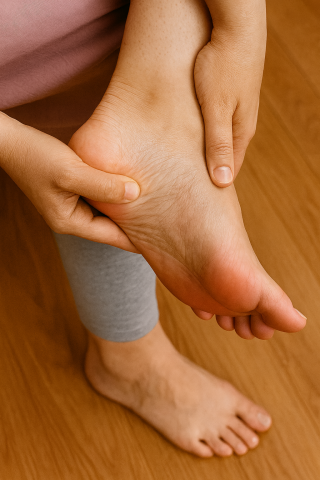
The assessment revealed excessive inward rolling of the ankles (overpronation), particularly on the left side. This abnormal foot movement places increased strain on the plantar fascia, the thick connective tissue supporting the arch of the foot, leading to irritation and heel pain.

Based on these findings, the patient was diagnosed with plantar fasciitis affecting the left foot.

What Is Plantar Fasciitis?

Plantar fasciitis occurs when the plantar fascia becomes inflamed or degenerative due to repetitive stress and poor foot mechanics.

Common symptoms include:

  • Sharp heel pain during the first steps in the morning
  • Pain after prolonged sitting or rest
  • Discomfort after long periods of standing or walking

Biomechanical factors such as flat feet, overpronation, reduced arch support, and poor alignment are often major contributors to the condition.

Why Custom Orthotics Matter

Since the patient did not improve with basic self-care methods, custom orthotic insoles were recommended as the primary treatment approach.

Custom orthotics are individually designed to match the patient’s foot structure and walking pattern. Unlike generic over-the-counter insoles, they are created using precise measurements and molds taken during assessment, ensuring optimal support and correction.

Benefits of Custom Orthotics

Custom orthotics help by:

  • Correcting excessive pronation and improving foot alignment
  • Reducing stress on the plantar fascia
  • Redistributing pressure more evenly across the foot
  • Supporting the arch during walking and standing
  • Improving overall biomechanics and comfort

By addressing the underlying mechanical issue rather than only masking symptoms, orthotics can provide both short-term relief and long-term prevention.


Conclusion

This case highlights how plantar fasciitis is often linked to underlying biomechanical dysfunction. When stretching and home remedies fail to resolve symptoms, custom orthotic therapy can play a vital role in recovery and long-term foot health.

Early diagnosis, proper biomechanical assessment, and personalized treatment are essential for preventing chronic heel pain and restoring normal movement. For many patients, custom orthotics remain one of the most effective solutions for managing plantar fasciitis and improving daily comfort.


For more information or to book an appointment please call our clinic +971 4 3435390 or WhatsApp +971 50 3553024
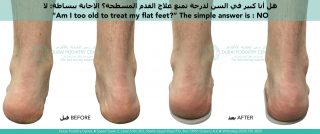


One of the most common questions patients ask at Dubai Podiatry Centre is:

“Am I too old to treat my flat feet?”

The simple answer is no.

Many people believe that flat feet can only be treated during childhood and that once you become an adult, nothing more can be done. Fortunately, this is one of the biggest misconceptions we hear in clinic.


Not Everyone Diagnosed with Flat Feet Actually Has Flat Feet

There are several different types of flat feet, but the most common condition we see is not a true flat foot at all.

In many cases, the ankle leans inwards, causing the arch to collapse under body weight. The arch then appears flat, even though the foot itself still has the ability to regain its natural shape once the ankle is correctly aligned.

Rather than thinking of the foot as permanently flat, it is often more accurate to think of it as an arch that has collapsed because the ankle is no longer supporting it correctly.


Adult flat feet before and after custom orthotics showing improved heel alignment and foot posture

Child with flat feet before and after podiatry treatment using custom orthotics showing corrected heel alignment


Adult Treatment Can Actually Be Faster

Many people are surprised when we explain that correcting this type of flat foot can actually progress faster in adults than in children.

Children have high levels of human growth hormone, which keeps their ligaments soft, flexible and easy to manipulate. This makes repositioning the bones relatively straightforward and usually very comfortable.

However, because the ligaments are constantly growing and remodelling, they often take longer to adapt and stabilise in their new position. For this reason, children commonly progress through each stage of treatment over approximately three to six months.

Adults are different.

Adult ligaments are firmer and less elastic, so there can be slightly more resistance when repositioning the foot. For this reason, we usually make smaller adjustments at each stage.

Once the bones have been repositioned, however, the adult foot often adapts surprisingly quickly. Instead of waiting three to six months between stages, many adults can progress every one to three months, allowing treatment to advance more rapidly.

Similar to Orthodontic Braces

A useful comparison is orthodontic braces for the teeth.

Most people understand that braces are not just for children. Adults successfully wear braces every day to gradually reposition their teeth into better alignment.

Corrective orthotics work on a similar principle.

Instead of moving teeth, they gently reposition the bones of the feet and ankles in carefully planned stages. As the alignment improves, the arch is supported more effectively and, in suitable cases, the foot can gradually regain a healthier arch shape.

Each new stage builds upon the previous one, allowing gradual correction rather than trying to make one large adjustment all at once.


It’s Never Too Late to Have an Assessment

If you have been told you have flat feet, it does not necessarily mean your feet are permanently flat.

The first step is determining why your arch has collapsed. For many patients, the underlying issue is ankle alignment rather than the shape of the foot itself.

With the correct diagnosis and a staged treatment plan, adults can often achieve significant improvements in foot alignment, comfort and function.

So if you’ve been wondering whether you’ve left it too late to treat your flat feet, the answer may be much more encouraging than you expected.

At Dubai Podiatry Centre, we regularly assess both children and adults and develop personalised treatment plans based on the specific cause of each patient’s foot alignment, because no two cases of flat feet are exactly the same.


For more information or to book an appointment please call our clinic +971 4 3435390 or WhatsApp +971 50 3553024
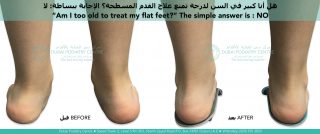


Before and after treatment of adult flat feet using custom corrective orthotics, showing improved heel alignment and foot posture from the rear view at Dubai Podiatry Centre.

Flat feet are commonly associated with inward rolling of the ankles, a condition known as overpronation. When the ankles tilt inward, the body’s weight is distributed unevenly across the feet, which can lead to foot pain, poor posture, and increased strain on the knees, hips, and lower back.

Custom corrective orthotics are designed to address the root cause of the problem by improving foot and ankle alignment. Rather than simply raising the arch, the primary objective is to reposition the heel and ankle into a more neutral and balanced position. Once proper alignment is restored, the arch often begins to improve naturally as the foot functions more efficiently.

Many people assume that treating flat feet means forcing the arch upward. However, excessively elevating the arch without correcting the underlying ankle alignment can make orthotics uncomfortable and difficult to wear. Effective orthotic therapy focuses on stabilising the heel, controlling overpronation, and supporting the foot in its optimal position.

A properly prescribed custom orthotic provides both arch support and heel correction, creating a stable foundation for standing, walking, and everyday activities. Improved alignment can enhance comfort, reduce strain on the lower limbs, and promote healthier movement patterns.

The photographs above demonstrate the effect of corrective orthotics on foot posture. By restoring proper heel and ankle alignment, the feet become more balanced, allowing for improved arch function and overall biomechanical efficiency.


For more information or to book an appointment please call our clinic +971 4 3435390 or WhatsApp +971 50 3553024


Why Plantar Fasciitis Isn’t Really About a “Tight” Fascia

By Michelle Champlin, Chief Podiatrist – Dubai Podiatry Centre

Plantar fasciitis is one of the most common and painful foot conditions we see in clinic. It causes sharp, stabbing heel pain—especially when getting out of bed in the morning or after sitting for a while. But the name plantar fasciitis can actually be misleading.


Understanding the Plantar Fascia

The plantar fascia is a thick, collagen-like band that runs from the heel bone to the toes. It acts like a suspension bridge to keep the foot’s arches intact and to stabilise every step you take.

Because the plantar fascia is made of densely woven collagen fibres, it’s extremely strong but not very stretchy. Many articles suggest “stretching” the fascia, but in truth, it doesn’t tighten—it becomes pulled taut when the foot’s structure begins to collapse.

Why It Happens

When you have healthy arches, the plantar fascia works quietly in the background to keep your foot stable. But when one or more of your foot’s three main arches—

  • the medial arch (inside edge of the foot),
  • the lateral arch (outer edge), or
  • the transverse arch (across the ball of the foot)—
  • start to flatten or your ankle leans inward or outward, the fascia is forced to work overtime.

That constant tension at its attachment into the heel bone causes tiny micro-tears in the outer casing of the bone, leading to inflammation and pain.

Why the Pain Comes and Goes

When you sit or sleep, inflammation builds up in the casing around the heel bone. The moment you stand up, pressure on that area causes intense pain. After walking a few minutes, your calf muscles begin to pump blood through the foot, draining the inflammation and easing the discomfort—until you sit again.

That’s why many people describe their first steps out of bed as agonising, but feel somewhat better once they “get moving.”


Who Gets Plantar Fasciitis—And Who Doesn’t

Interestingly, people with genuinely flat feet rarely get plantar fasciitis, because their fascia never needs to engage—it’s already at rest. The condition typically affects those whose arches are collapsing under load, not those whose arches are already fully flat.

The Real Solution: Structural Correction

Treating the heel pain directly—ice, massage, or anti-inflammatory creams—only addresses the symptom. The long-term solution is to correct the structure of the foot so that the fascia no longer has to overwork.

This might involve:

  • Custom orthotics to lift the medial and transverse arches
  • Supporting the ankle to stop it leaning in or out
  • Strengthening the calf and intrinsic foot muscles


Once the arches are properly supported, the fascia relaxes and the inflammation at the heel naturally subsides.


Healing Time: 12–14 Weeks

True healing takes time. The recovery process for plantar fasciitis typically spans 12 to 14 weeks.

You can imagine the heel bone where the plantar fascia attaches as a large window that has had a stone thrown at it, causing tiny micro-fractures across the glass.

  • During the first six weeks, the outer edges of the “window” begin to self-heal.
  • Over the next six weeks, the centre, or the “bull’s-eye” where the impact was greatest, gradually repairs.
  • The final two weeks allow for complete healing and realignment.

This is why genuine corrective orthotic therapy, which lifts and supports all three arches of the foot and stabilises the ankle, requires this full 12–14 week period—to give the plantar fascia the rest it needs for complete recovery.

A Helpful Analogy

Imagine the plantar fascia like a strong sticker on a wall. If you start to peel it off, some paint and plaster may come away, but the concrete beneath is still intact. That’s similar to what happens when the fascia pulls on the heel bone—micro-damage occurs, but the structure can heal once tension is reduced.

Another way to picture it: think of the heel bone as a ceiling with a hidden water bubble. When you sleep, fluid builds up in that bubble, and when you stand, it’s suddenly compressed—painful until movement drains it away.

In Summary

Plantar fasciitis isn’t simply inflammation of a “tight” band. It’s a structural response to stress in the foot’s architecture. Correct the mechanics, and the pain goes away naturally.

If you suffer from heel pain, especially first thing in the morning, book a biomechanical assessment with our podiatrists. By identifying which arch is collapsing, we can design a treatment that targets the cause—not just the symptom.


#PlantarFasciitis #HeelPain #HeelPainRelief #DubaiPodiatryCentre #FootPain #FlatFeet #ArchSupport #OrthoticsDubai #Podiatry #FootCare #Biomechanics #HealthyFeet #Footerella #PodiatristDubai #DubaiHealth


For more information or to book an appointment please call our clinic +971 4 3435390 or WhatsApp +971 50 3553024



‏

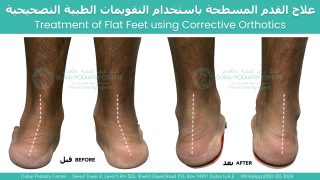
For flat feet we want to lift the foot arch and make the ankle straight

للأقدام المسطحة، نريد رفع قوس القدم وجعل الكاحل مستقيماً

‏We do that with a series of corrective orthotics to realign the ankles from leaning in back to straight again

نقوم بذلك عبر سلسلة من التقويمات التصحيحية لإعادة محاذاة الكاحلين ومنعهما من الانحناء للداخل ليعودا الى الوضع المستقيم مجددًا 

‏Also, we would ask you to do a lot of walking with your ankles and feet in the new position so the muscles are working differently

أيضًا ، نطلب منك المشي كثيرًا بكاحليك وقدميك في الوضعية الجديدة حتى تعمل العضلات بشكل مختلف 

‏We would ask you to do some electro muscle stimulation for your feet at home to tighten the 19 foot muscles

نطلب منك القيام ببعض التحفيز الكهربائي لقدميك في المنزل لشد عضلات القدم التسعة عشر

‏Then, we would also ask you to put some stickers and binding on your forefoot to pull the bones together to get the ligaments to contract in to the new shape

بعد ذلك، نطلب منك أيضًا وضع بعض الملصقات والأربطة على مقدمة قدمك لسحب العظام معًا لتنقبض الأربطة بشكلها الجديد 

‏Finally, we would ask you to do all your walking and foot exercises which are important to get your feet as strong as your hands

أخيرًا ، نطلب منك القيام بكل تمارين القدم والمشي التي تعتبر مهمة لجعل قدميك قوية كما يديك


‏For more information or to book an appointment please call our clinic +971 4 3435390 or WhatsApp +971 50 3553024 
لمزيد من المعلومات أو لحجز موعد يرجى الإتصال بعيادتنا على الرقم : ٠٠٩٧١٤٣٤٣٥٣٩٠ أو التواصل على الواتساب على الرقم  ٠٠٩٧١٥٠٣٥٥٣٠٢٤


Copyright Dubai Podiatry 2026. All rights reserved.

WhatsApp us