
fbpx

Please wait...


BLOG

No more posts

Most people wear conventional socks without giving much thought to what happens between their toes.

However, the spaces between our toes are one of the areas of the feet most likely to trap moisture, sweat and dead skin cells.

This is particularly common in hot climates such as Dubai, in people who sweat excessively, and in those whose toes are naturally positioned very close together.

At Dubai Podiatry Centre, we recommend considering five toe socks as a simple way to improve daily foot hygiene, particularly for patients who experience excessive moisture between their toes.


1. Why Is Hygiene Between the Toes So Important?

When toes are pressed together, the skin surfaces remain in constant contact.

During the day, perspiration can become trapped in these small spaces, particularly when wearing enclosed shoes for long periods.

This can create an environment where moisture accumulates, the skin becomes softened, and dead skin cells collect.

Warm, damp conditions encourage the growth of fungi and bacteria.

One of the most common infections affecting the spaces between the toes is athlete’s foot, also known as tinea pedis.

Symptoms can include itching, peeling skin, white softened skin, cracking, redness and an unpleasant odour.

Keeping the skin between the toes clean and dry is an important part of reducing the risk of these problems.


2. What Makes Toe Socks Different?

Unlike conventional socks, toe socks have five individual compartments, one for each toe.

This simple design creates a fabric barrier between neighbouring toes.

Rather than allowing the skin of one toe to remain pressed directly against the next, each toe is individually covered.

This can provide several benefits.

Improved moisture management

Moisture wicking toe socks can help absorb and move perspiration away from the skin between the toes

Reduced skin contact

The fabric separates neighbouring toes and reduces direct skin contact

Reduced friction

Individual toe compartments may help reduce rubbing between adjacent toes, particularly during walking, running and hiking

Improved hygiene

The fabric may collect some shed skin cells and moisture, which are then removed when the socks are taken off and washed

Greater comfort

For people with closely positioned toes, a correctly fitted toe sock can provide a comfortable barrier between the skin surfaces

The most important benefit is the potential to maintain a drier environment between the toes.

Although toe socks may help reduce moisture and friction, clinical evidence that they dramatically reduce fungal infection rates is limited. Good foot hygiene, properly fitting footwear and changing damp socks remain essential.


3. Toe Socks in Hot Weather

Living in a hot climate can make it particularly difficult to keep feet dry.

In Dubai, many people spend the day moving between hot outdoor temperatures and air conditioned indoor environments.

Feet can perspire inside enclosed shoes, particularly during walking, exercise or long working days.

For patients who experience excessive sweating, toe socks made from breathable, moisture wicking fabrics can be particularly useful.

By placing fabric between each toe, moisture can be absorbed and transferred away from the skin more effectively than when damp skin surfaces remain directly in contact.

However, socks must be changed when they become damp. No sock can keep the feet completely dry if perspiration is excessive.


4. Toe Socks and Athlete’s Foot

Athlete’s foot is a fungal infection that commonly develops between the fourth and fifth toes, although other spaces can also be affected.

Fungi thrive in warm, moist environments.

When toes remain pressed together, the skin between them can stay damp for prolonged periods.

Toe socks may help by reducing direct skin contact and managing moisture between the toes.

For patients who repeatedly develop athlete’s foot, we recommend paying particular attention to daily hygiene.

Wash your feet regularly, dry carefully between every toe, wear clean moisture wicking socks and allow shoes to dry between uses.

Toe socks can be part of this routine.

Important: Toe socks do not treat an existing fungal infection. If you have athlete’s foot, appropriate antifungal treatment may still be required.


5. Learning to Put On Toe Socks

One of the most common comments we hear is that toe socks take longer to put on than conventional socks.

This is completely normal.

With regular socks, you simply slide your foot inside.

With toe socks, each toe needs to be guided into its own compartment.

Initially, this can feel a little awkward.

However, after approximately two to four weeks of regular use, many people develop a technique that makes the process much easier.

It may take a minute rather than a few seconds, but the additional effort can be worthwhile for the comfort and hygiene benefits.

A useful technique is to sit comfortably, gather the sock towards the toe compartments, guide each toe into position and then pull the remaining fabric gently over the foot.

Make sure that the fabric is not tightly stretched between the toes.


6. Toe Socks Can Encourage Flexibility and Agility

There is another interesting benefit to putting on toe socks.

The process encourages you to bend comfortably towards your feet, coordinate your hands and toes, and maintain a degree of flexibility.

As we get older, maintaining the ability to reach our feet is important for personal hygiene, toenail care and independence.

If you notice that reaching your feet is becoming increasingly difficult, it may be worth considering whether changes in mobility, flexibility or body weight are contributing.

Gradual weight gain around the abdomen can sometimes make it more difficult to reach the toes.

However, difficulty putting on socks is not a reliable measure of obesity. Joint stiffness, back pain, reduced flexibility and other conditions can also affect this movement.

If you are concerned about changes in your weight, waist measurement or mobility, a healthcare professional can help you assess these appropriately.

The important point is that maintaining flexibility and the ability to care for your feet is a valuable part of healthy ageing.


7. Toe Socks for Hiking and Long Distance Walking

Toe socks can be particularly useful for hiking, especially when walking for several hours.

During long walks, repeated friction between the toes can cause irritation and blisters.

Some people also experience pressure from their toenails against neighbouring toes, particularly when walking downhill.

A correctly fitted toe sock creates a fabric barrier between the toes and may help reduce this rubbing.

For longer hikes, an additional cushioned outer sock can sometimes provide extra comfort.

Our Recommended Hiking Sock Combination

First layer: Five toe socks

Choose a thin, breathable toe sock that fits comfortably around each individual toe.

This helps separate the toes and manage moisture between them.

Second layer: Cushioned hiking socks

Wear a soft, cushioned hiking sock over the toe socks.

Some diabetic style socks have smooth seams, gentle cuffs and generous cushioning, making them comfortable options for certain walkers.

However, not all diabetic socks are suitable for hiking, so choose a design with appropriate moisture management, fit and durability.

Third layer: Properly fitted hiking boots

The hiking boot must have sufficient space to accommodate both layers of socks without compressing the toes.

This combination may help reduce friction and provide additional cushioning, particularly during long walks.


8. Why Wearing Two Conventional Socks May Cause Problems

Wearing two pairs of conventional socks is not always beneficial.

If the socks are thick or the shoes are too narrow, the additional fabric can compress the toes together.

This may increase pressure and friction, creating discomfort and potentially contributing to blisters.

If moisture becomes trapped, the skin may also remain damp for longer periods.

For people who prefer two layers of socks, using a thin toe sock as the first layer can be a useful alternative.

The individual toe compartments create a barrier between neighbouring toes, while the outer sock provides additional cushioning.

However, double layering is not necessary for everyone. A single well fitted technical hiking sock may work equally well or better.

The best choice is the combination that keeps your feet comfortable, dry and free from excessive pressure.


9. Choosing the Correct Hiking Boot Size

If you decide to wear toe socks underneath a second pair of hiking socks, your hiking boots must accommodate the additional fabric.

A boot that fits perfectly with one thin sock may become too tight when two layers are worn.

This is particularly important around the toes.

Excessive compression can cause pain, blisters, numbness and toenail injuries.

When purchasing hiking boots, take the exact sock combination you intend to wear and try the boots on with both layers.

Check that your toes can move comfortably, your heel remains secure and your toes do not strike the front of the boot when walking downhill.

Some people may need a larger or wider boot, but there is no universal requirement to increase by two and a half shoe sizes.

Increasing the length excessively can create heel movement, instability and additional friction.

The correct boot is the one that fits your foot and chosen socks properly, not simply a predetermined larger shoe size.


10. How Often Should You Change Your Toe Socks?

For good foot hygiene, toe socks should generally be changed every day.

If you sweat excessively, exercise or spend long periods in hot conditions, you may need to change them more frequently.

Wash them according to the manufacturer’s instructions and allow them to dry completely before wearing them again.

Avoid wearing damp socks and make sure your shoes have adequate time to dry between uses.

If you are prone to athlete’s foot, inspect the skin between your toes regularly for redness, peeling, cracks or white softened skin.

People with diabetes, neuropathy or poor circulation should seek professional advice about appropriate socks and footwear, particularly if there are any areas of skin damage.


Our Advice at Dubai Podiatry Centre

Sometimes, improving foot hygiene does not require complicated treatment.

A simple change in the type of socks you wear can make a meaningful difference to comfort and moisture management.

Five toe socks provide a fabric barrier between neighbouring toes, helping to reduce direct skin contact, manage perspiration and minimise friction.

They can be particularly useful in hot climates, for people with closely positioned toes, and during activities such as hiking and long distance walking.

When combined with good daily foot hygiene, appropriate footwear and regular sock changes, they can be a valuable addition to your foot care routine.

Healthy feet begin with simple daily habits, and keeping the spaces between your toes clean and dry is one of them.

Dubai Podiatry Centre

Specialist Foot Care, Foot Hygiene and Biomechanical Assessment

www.dubaipodiatry.com

This article provides general educational information and does not replace an individual clinical assessment.


For more information or to book an appointment please call our clinic +971 4 3435390 or WhatsApp +971 50 3553024


Are you experiencing heel pain when you first get out of bed, after standing for long periods, or towards the end of a busy working day? You may be suffering from plantar fasciitis, one of the most common causes of heel and arch pain.

The good news is that there are several simple treatments you can do at home to help relieve discomfort and support your recovery.

What Is Plantar Fasciitis?

The plantar fascia is a strong band of connective tissue that runs underneath your foot, connecting the heel bone to the front of the foot. It helps support the arches of your foot and distributes pressure when you stand, walk and run.

When the plantar fascia is repeatedly placed under excessive tensile stress (stretching and pulling forces), it can become irritated and painful.

This may cause:

  • Pain underneath the heel, particularly with your first steps in the morning
  • Discomfort along the arch or middle of the foot
  • Pain after prolonged standing or walking
  • Occasionally, discomfort extending towards the inner side of the ankle

Although commonly called plantar fasciitis, persistent cases may involve degenerative changes in the fascia rather than inflammation alone.

Why Does Plantar Fasciitis Develop?

At Dubai Podiatry Centre, we pay particular attention to the structural alignment of the feet and ankles.

Three important factors can contribute to increased stress on the plantar fascia:

1. Excessive pronation (hyperpronation)

When the foot rolls excessively inwards during standing or walking, it may increase the tensile load on the plantar fascia.

2. Collapse of the medial longitudinal arch

When the arch along the inside of the foot lowers excessively under weight-bearing pressure, the plantar fascia may be placed under additional strain.

3. Reduced support through the transverse forefoot arch

Changes in forefoot loading and transverse arch support can alter how pressure is distributed through the foot and may contribute to mechanical stress.

Not every patient with plantar fasciitis has these structural problems. Some patients develop symptoms simply because they have been standing for unusually long periods.

Can Plantar Fasciitis Go Away by Itself?

Yes. Some episodes of plantar heel pain are associated with a temporary increase in activity or prolonged standing.

For example:

  • Soldiers on parade: Standing for extended periods without much movement
  • Hairdressers: Working exceptionally long days during busy seasons
  • Chefs: Standing for 12–16 hours during festive periods or special events
  • Retail and hospitality workers: Spending much longer on their feet than usual.

When symptoms are caused by a temporary increase in physical load, they may improve within a few weeks once normal activity levels resume.

However, plantar fasciitis can also last several months. If symptoms persist beyond four weeks, or are getting worse, a podiatric assessment is advisable.

Where structural misalignment is contributing to ongoing strain, corrective orthotics may be recommended to support the arches and improve foot and ankle mechanics. Many patients improve over approximately 12–14 weeks with an appropriate treatment programme, although recovery times vary.

Six Home Treatments for Plantar Fasciitis

1. Warm and Cool Contrast Foot Baths

Contrast foot baths can be a soothing treatment after a long day of standing.

How to do it:

1. Prepare one basin with warm water at approximately 42°C and another with cool water at approximately 22°C
2. Place your feet in the warm water for one minute
3. Transfer them to the cool water for one minute
4. Repeat this cycle five times

Total treatment time: 10 minutes.

Alternating warm and cool temperatures produces changes in superficial circulation and may provide temporary comfort. However, there is limited evidence that contrast baths accelerate plantar fascia healing or remove inflammatory waste products.

Important: Avoid contrast baths if you have diabetes-related loss of sensation, poor circulation, neuropathy or difficulty sensing water temperature. Always check that the water is comfortable and not excessively hot.


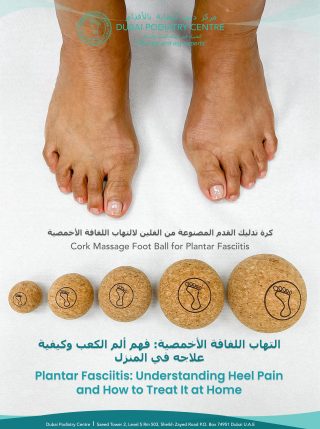
Dubai Podiatry Centre blog image about plantar fasciitis and home care for heel pain, showing feet and five cork massage balls2. Massage Your Feet With Cork Roller Balls
Cork massage balls are a simple way to massage the underside of the foot and relieve muscle tension.

Small cork ball: Use gentle circular movements around the fleshy heel pad, avoiding excessive pressure directly over a painful point.

Medium cork ball: Roll slowly underneath the medial arch to massage the soft tissues.

Large cork ball: Use broader rolling movements along the arch and underside of the foot.

Spend approximately 1–2 minutes on each area, using gentle pressure.

Massage should feel comfortable, not painful. Avoid aggressive rolling if your heel is particularly sensitive.


3. Strengthen Your Feet With Towel-Scrunching Exercises

The small intrinsic muscles underneath your feet contribute to foot stability and arch support.

How to do it:

1. Sit comfortably in a chair with your feet flat on the floor
2. Place a small towel in front of your foot
3. Use your toes to scrunch the towel towards you
4. Continue until you have gathered the towel underneath your foot
5. Repeat 5–10 times on each foot, as comfortable

This exercise helps activate the small muscles that support the foot. Start gently and stop if it increases your heel pain.

4. Roll Your Foot Over a Chilled Water Bottle

After a long day of standing, a chilled water bottle can provide welcome relief.

How to do it:

1. Place a 300 ml plastic water bottle in the refrigerator
2. Sit comfortably in a chair
3. Place the bottle underneath your arch
4. Slowly roll your foot backwards and forwards from the arch towards the heel
5. Continue gently for approximately 3 to 5 minutes

A bottle from the refrigerator is preferable to a frozen bottle because it provides gentler cooling without exposing the skin to extreme cold.

The cooling and gentle massage may temporarily reduce pain after prolonged standing.

5. Support Your Foot With Plantar Fascia Tape

Supportive taping can help reduce strain on the plantar fascia during daily activities.

Footerella plantar fascia support tape is designed as a convenient, single-piece application that can be worn during the day.

When applied correctly, supportive taping may help maintain a more comfortable foot position and reduce excessive mechanical loading.

Apply the tape to clean, dry skin in the morning, following the product instructions. Remove it if you experience itching, redness, irritation, numbness or discomfort.

Taping provides temporary support but does not replace corrective orthotics when a significant biomechanical problem requires longer-term management.

6. Choose the Right Socks and Shoes

Footwear can make a significant difference to plantar heel pain.

Soft, cushioned socks

Thick, fluffy, diabetic-style cushioned socks can provide additional comfort and reduce pressure beneath the heel. Choose socks without restrictive seams or tight elastic.

Soft, cushioned shoes

Shoes with adequate heel cushioning may help reduce discomfort, particularly when standing on hard floors.

However, there is an important distinction between cushioning and structural support.

If your feet are neutrally aligned, a comfortable cushioned shoe may provide sufficient relief.

If you have significant hyperpronation or arch instability, a very soft, flexible shoe may not provide enough support and could allow excessive movement.

In these cases, a more supportive shoe combined with appropriately prescribed corrective orthotics may be beneficial.

When Are Corrective Orthotics Needed?

If plantar fasciitis persists, it is important to identify whether the pain is being maintained by abnormal foot mechanics.

At Dubai Podiatry Centre, we assess:

  • Foot and ankle alignment
  • Medial longitudinal arch function
  • Transverse forefoot loading
  • Excessive pronation and other biomechanical abnormalities
  • Walking patterns and pressure distribution

Where clinically indicated, custom corrective orthotics can be designed to support the medial arch, redistribute forefoot pressure and improve the alignment of the foot and ankle.

The aim is to reduce excessive tensile stress on the plantar fascia so that the irritated tissues have an opportunity to recover.

Orthotics are not necessary for every patient, and treatment may also include targeted stretching, strengthening exercises, footwear modification and activity management.

How Long Does Recovery Take?

Recovery depends on the underlying cause, how long symptoms have been present, and whether excessive mechanical loading continues.

A mild episode associated with unusual standing may improve within several weeks.

For persistent plantar fasciitis, improvement may occur over 12–14 weeks with appropriate treatment, although some patients need considerably longer.

The key is not simply to relieve the pain temporarily, but to address the factors placing repeated stress on the plantar fascia.

Our Advice at Dubai Podiatry Centre

If you are suffering from plantar fasciitis, start with simple home treatments: gentle massage, chilled bottle rolling, foot-strengthening exercises, comfortable footwear and appropriate support.

If your pain persists, returns repeatedly, or interferes with normal walking, arrange a podiatric assessment to identify the underlying cause.

Seek medical attention sooner if you have severe pain, significant swelling, redness, fever, numbness, an injury, or difficulty bearing weight.

Dubai Podiatry Centre

Helping patients understand their foot structure, improve their alignment and walk comfortably.

Website: www.dubaipodiatry.com

This article provides general educational information and does not replace an individual clinical assessment.


For more information or to book an appointment please call our clinic +971 4 3435390 or WhatsApp +971 50 3553024


Choosing the right shoes is especially important for children who wear custom foot orthotics. Orthotic-friendly shoes should provide enough space for the devices while keeping the feet secure, comfortable and properly supported throughout the day.

At Dubai Podiatry Centre, we help parents choose suitable children’s footwear for custom orthotics, flat feet, overpronation and other foot conditions.

Why Are Orthotic-Friendly Shoes Important?

Custom orthotics are designed to support a child’s feet, improve foot function and distribute pressure more evenly. However, the orthotics must fit correctly inside the shoes to work as intended.

Shoes that are too narrow, shallow, soft or unstable may cause the orthotics to move, lift the heel or create pressure and discomfort. The best shoes for kids wearing orthotics should securely accommodate the devices without restricting the feet.

What to Look for in Children’s Shoes for Orthotics

When shopping for supportive kids’ shoes, look for the following features:

Removable Insoles

Shoes with removable insoles create additional space for custom orthotics. The original insoles should normally be removed before inserting the orthotic devices.

A Wide Toe Box

A wide, rounded toe box allows the toes to move naturally without rubbing or being compressed. This is particularly important as children’s feet continue to grow.

Adequate Width and Depth

The shoes must be deep and wide enough to accommodate the orthotics without making the fit too tight or pushing the feet upwards.

A Firm Heel Counter

A supportive heel counter helps hold the heel securely and reduces unwanted movement inside the shoe. This can provide additional stability for children with flat feet or overpronation.

Adjustable Fastenings

Laces, straps or adjustable closures help keep the feet and orthotics securely positioned. They also allow the fit to be adjusted as needed.

A Supportive Sole

Choose shoes with a stable sole that bends naturally near the toes rather than twisting or folding easily through the middle.

Lightweight and Durable Materials

Children need footwear that is comfortable for daily movement while being strong enough for school, sports and everyday activities.

Shoes for Children With Flat Feet and Overpronation

Children with flat feet or overpronation may require extra support to improve stability and reduce excessive inward rolling of the feet. Combining professionally prescribed custom orthotics with appropriately fitted supportive shoes can improve walking comfort and help the orthotics work effectively.

Every child’s feet are different. The best shoe is not simply the most expensive or popular option—it is the shoe that fits the child’s feet and orthotics correctly.

Tips for Finding the Correct Fit

Always take your child’s orthotics when shopping for new shoes. Insert the devices and ask your child to walk in the shoes before making a decision.

Check that:

  • The orthotics sit flat and securely inside the shoes.
  • The heels do not slip while walking.
  • The toes have enough room to move comfortably.
  • There are no areas of rubbing or pressure.
  • The shoes feel secure without being tight.
  • Your child can walk naturally and comfortably.

Do not automatically buy a larger shoe size to create space for the orthotics. A shoe that is too large may allow the feet and orthotics to move excessively. Instead, choose footwear with the correct width, depth and internal shape.

Expert Footwear Advice in Dubai

If your child has flat feet, overpronation, foot discomfort or difficulty finding shoes that fit their orthotics, a professional foot assessment can help.

Watch our video to discover the best supportive shoes for kids wearing orthotics, recommended by Michelle Duffy Champlin, a podiatrist at Dubai Podiatry Centre.

Contact Dubai Podiatry Centre to arrange a children’s foot assessment and receive professional advice about custom orthotics and supportive footwear in Dubai.


For more information or to book an appointment please call our clinic +971 4 3435390 or WhatsApp +971 50 3553024


Warts can occur almost anywhere on the body, but a wart on the sole of the foot behaves very differently from a wart on the hand, finger or top of the foot.

Although they are caused by the same family of viruses human papillomavirus (HPV), their location and the type of skin in which they develop can make a significant difference to how we treat them.

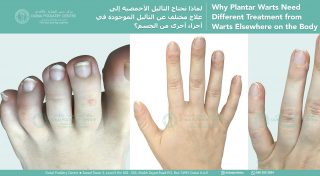
Examples of common warts on the top of the foot, hand and fingers, showing how they differ from plantar warts

At Dubai Podiatry Centre, we often see patients who have already tried traditional wart treatments such as salicylic acid or liquid nitrogen on a plantar wart, sometimes repeatedly, without understanding why a treatment that may work very well on a wart elsewhere on the body can be much less effective on the sole of the foot.

The simplest way to understand this is to think about how much of the wart we can actually reach.

Warts Elsewhere on the Body: Think of a Water Balloon

Imagine a small water balloon sitting on a table.

Most of the balloon is above the table. If you wanted to paint its surface, you could probably cover around 90% of it quite easily. Only the small area touching the table would be difficult to reach.

A wart growing outward from the skin can be thought of in a similar way.

On areas such as the hand, finger or top of the foot, a wart may project outward from the surface. This means that a large proportion of the wart is directly accessible to treatment.

This is one reason why traditional surface treatments can work particularly well in these locations.

Salicylic Acid

One of the simplest and most widely available wart treatments is salicylic acid.

Salicylic acid is a keratolytic, which means that it breaks down keratin and gradually removes the thickened, virus infected skin cells.

It is available from pharmacies in several forms. It may come as a liquid that looks rather like clear nail polish and is painted directly onto the wart, or it may be incorporated into a medicated plaster or padded dressing that keeps the treatment against the affected skin.

When much of the wart is projecting outward, there is a relatively large surface area available for the medication to act upon.

Liquid Nitrogen

Another commonly used treatment is cryotherapy, usually with liquid nitrogen.

The wart tissue is rapidly frozen, damaging the infected cells and encouraging the body’s immune response against the virus.

Again, when the wart projects outward from the skin, the treatment can be applied directly to a substantial proportion of the affected tissue.

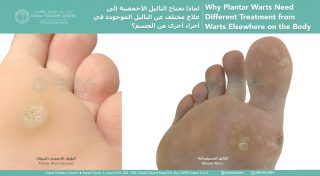
Close-up comparison of a single plantar wart (verruca) and clustered mosaic warts on the soles of the feet

Plantar Warts Are Different

A plantar wart, sometimes called a verruca, develops on the weight bearing skin of the sole of the foot.

Here, the situation is almost the reverse of our water balloon example.

Instead of most of the lesion projecting outward where we can easily treat it, much of the plantar wart can become embedded within thickened plantar skin.

Standing and walking also continually place pressure on the lesion. Rather than being able to expand freely outward, the wart becomes compressed within the thick keratinised layers of the sole.

This means that what we see on the surface may represent only a relatively small part of the affected tissue.

The 90% versus 10% analogy is a useful way of visualising this difference: with an outward growing wart, most of the lesion may be readily accessible to treatment, whereas with a plantar wart, much more of the affected tissue may lie beneath the visible surface.

These percentages are an analogy rather than a literal anatomical measurement, but they help explain why treatment results from warts elsewhere on the body should not automatically be applied to plantar warts.

Why Is the Skin on the Sole So Different?

Another useful way to understand this is to imagine fish scales.

Under magnification, the outermost layer of our skin consists of flattened keratinised cells arranged together to create a protective barrier.

For a simple visual analogy, imagine the delicate scales of a little goldfish. This represents the relatively thinner epidermis found over much of the body.

Now compare those with the much tougher protective scales you might imagine on a very large fish.

That is closer to how we can think about the specialised thick skin on the soles of our feet.

The plantar surface has a particularly thick outer keratin layer because it has to withstand enormous amounts of pressure, friction and repeated loading throughout our lives.

That protection is extremely useful for walking but it presents a challenge when treating a plantar wart.

When HPV infects the skin elsewhere on the body, the resulting wart may be able to proliferate outward relatively easily.

On the sole, however, the combination of the thick stratum corneum and pressure from standing and walking means that the lesion tends to become incorporated into the thickened plantar skin rather than simply projecting outward.

Why We Use Dermojet for Plantar Warts

This difference in anatomy is one of the reasons we use Dermojet treatment for selected plantar warts at Dubai Podiatry Centre.

A Dermojet is a needle free, high pressure jet injection device. Rather than relying purely upon a treatment being placed onto the external surface of the wart, it allows medication to be delivered through the thick plantar skin into the targeted tissue.

This is particularly useful on the sole of the foot, where the thick outer layer of skin can otherwise act as a substantial barrier.

The aim is therefore very different from simply painting or freezing what can be seen at the surface.

Why We Would Not Automatically Use the Same Approach Elsewhere

Treatment should always be chosen according to the location and characteristics of the wart.

If a wart is projecting outward from thinner skin elsewhere on the body, much of the affected tissue is already accessible from the surface. Treatments such as salicylic acid or cryotherapy may therefore be more appropriate.

A high pressure delivery system designed to penetrate thick plantar skin would not automatically be the appropriate choice for an outward projecting wart elsewhere on the body.

This is why there should not be a one treatment fits all approach to warts.

Same Virus, Very Different Environment

The important point is that a plantar wart is not necessarily difficult to treat simply because the virus itself is different.

It is the environment in which the wart is growing that changes.

The sole of the foot has:

  • exceptionally thick keratinised skin
  • repeated pressure from standing and walking
  • friction and compression
  • a substantial protective stratum corneum
  • different accessibility compared with an outward projecting wart elsewhere on the body

Understanding these differences helps us choose a treatment that is appropriate for the anatomy rather than simply treating every wart in exactly the same way.

The Water Balloon Rule

A simple way to remember it is this:

Wart projecting outward:
Think of a water balloon sitting on a table. Most of it is exposed and accessible, so a surface treatment can reach a large proportion of the lesion.

Plantar wart on the sole:
Think of the balloon being pushed down into a thick, tough surface. Much less is visible and accessible from above, so treatment may need to address tissue beneath the superficial keratin.

At Dubai Podiatry Centre, this anatomical difference is an important consideration when assessing plantar warts and deciding which treatment approach is most appropriate for each patient.

Warts should be properly assessed before treatment, particularly if a lesion is painful, bleeding, changing in appearance, persistent, or if there is uncertainty about whether it is actually a wart.


For more information or to book an appointment please call our clinic +971 4 3435390 or WhatsApp +971 50 3553024


Copyright Dubai Podiatry 2026. All rights reserved.

WhatsApp us