

fbpx

Please wait...


BLOG

No more posts

When we think about the arches of our feet, most people immediately picture the large arch running along the inside of the foot.

But there is another, much smaller arch at the front of the foot that we pay very close attention to during a biomechanical assessment at Dubai Podiatry Centre.

It is called the transverse arch.


What is the transverse arch?

The front part of your foot is called the forefoot. It includes the toes and the metatarsal bones, which are the long bones immediately behind your toes.

Across the forefoot, just behind the toes where they connect with the foot, is the transverse arch.

Rather than running from the heel towards the toes like the more familiar medial arch, the transverse arch runs across the foot from side to side.

It is a relatively small arch, but biomechanically it can be extremely important.


What happens when the transverse arch starts to drop?

Over time, the forefoot can begin to spread and the transverse arch can become lowered.

We sometimes describe this to patients as the metatarsal bones beginning to “avalanche” forwards and downwards.

Although this change is occurring in a relatively small area at the front of the foot, it can influence the way the rest of the foot functions.

The metatarsal bones do not work independently from the remainder of the foot. They form part of the interconnected structure of the foot and contribute to its stability and function during standing and walking.

As the forefoot begins to change position, we may also see changes occurring through the larger medial arch, the midfoot and eventually the mechanics around the ankle.

This is why we never look at the transverse arch in isolation.
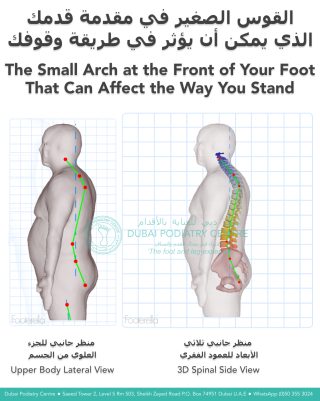
 

3D postural assessment showing how a collapsed forefoot transverse arch may affect standing posture and spinal alignment


Are you beginning to look hunched forwards?

One of the observations that can prompt us to investigate the forefoot is a change in a person’s stature.

Sometimes a patient, or their family, will say that they are beginning to “look hunchbacked” or that they appear to be leaning forwards.

The head may be sitting further forwards, the shoulders may appear more rounded and the person can develop an increasingly stooped appearance.

There are, of course, many different reasons why somebody may develop a forward head position or stooped posture. It should never automatically be assumed that it is coming from the feet.

However, it is one of the physical signs that makes us look more carefully at the person’s overall biomechanics.

We look at the person from the side and assess their stature. We look at the position of the head and shoulders. We observe how they stand and walk.

Then we investigate what is happening underneath them.

In particular, we examine the sole of the foot and the forefoot to see what has happened to the transverse arch.

If that small arch has dropped and the metatarsal bones have moved forwards and downwards, it may be contributing to a chain of biomechanical changes occurring further up the body.

Your feet form the foundation of your posture


The feet provide the foundation for the body when we stand and walk.

Changes in that foundation can sometimes contribute to compensations further up the biomechanical chain.

This is why a person’s posture can give us clues about what we should investigate in their feet.

A forward head, rounded shoulders, a stooped stance or a tendency to shuffle when walking does not diagnose a foot problem. However, these observations can be a reason to include the feet in the assessment rather than concentrating only on the upper body.

Sometimes the clue is visible at the shoulders and head, while part of the biomechanical problem may be much further down, at the sole of the foot.


Why we look for problems early

One of the reasons we pay such close attention to the transverse arch is that it can give us an opportunity to identify biomechanical changes relatively early.

If the transverse arch has started to lower but the remainder of the foot is still relatively well controlled, treatment can be much simpler.

Where appropriate, a custom corrective orthotic can be designed to support and lift the transverse arch and improve the mechanical stability of the forefoot.

The objective is not simply to put something soft underneath a painful area. It is to address the position and function of the forefoot as part of the mechanics of the entire foot.


What if the whole foot has already started to collapse?

More advanced biomechanical changes can also be managed. It simply requires a different approach.

If changes have progressed through the forefoot, midfoot and ankle, attempting to correct everything at once may not be appropriate or comfortable.

Instead, orthotic therapy may need to be carried out step by step and stage by stage.

We may initially need to address the forefoot and transverse arch. As the foot adapts, we can reassess the midfoot, medial arch, rearfoot, heel and ankle mechanics.

This process naturally takes longer than treating an early biomechanical change.

A small arch can give us a big clue

The transverse arch is a relatively small structure, but it can tell us a great deal about what is happening throughout the foot.

This is why we don’t assess feet simply by asking, “Where does it hurt?”

We look at the toes, forefoot, midfoot, heel and ankle. We look at how you stand. We look at the position of your shoulders and head. We watch how you walk.

If somebody tells you that you are beginning to look more hunched over, or you notice that your head is increasingly sitting forwards and your shoulders are becoming rounded, there can be many possible explanations.

But don’t forget to look down.

A biomechanical assessment of the feet, and particularly that small transverse arch underneath the forefoot, may provide another important piece of the puzzle.

The earlier we identify a change in foot biomechanics, the easier it may be to manage before it progresses further.


Dubai Podiatry Centre
Biomechanical Foot Assessment and Custom Orthotic Therapy


For more information or to book an appointment please call our clinic +971 4 3435390 or WhatsApp +971 50 3553024


Written by Michelle Champlin BSc Pod., M.Ch.S., S.R., Ch., (UK)
With the summer heat still to hit, runners in our desert climate are still able to get out and about, whether jogging a couple of laps round Safa Park or Yas Marina Circuit, or keeping up with your running after marathon season. One of the most common injuries to interrupt runners’ training however is knee pain. Let’s look at the most frequent causes and how to treat it.

What is Runner’s Knee?
One of the most common running related issues seen in our Clinic is ‘runners knee’ – irritation of the cartilage underneath the patella (kneecap), advises Dubai Podiatry Centre’s Chief Podiatrist Michelle Champlin. About 40% of running injuries are to the knee, with Mrs Champlin tending to see an increase in running injuries with marathon season in Dubai.
You may notice that the knee pain is worse coming down hills or stairs, after long periods sitting, or during / after a long run.
Commonly, runner’s knee pain is due to the kneecap tracking laterally due to over-pronation (the foot and ankle rolling in) and a weak medial quad, hips or glutes. This lateral tracking causes the kneecap cartilage to wear down, be sore when the quad contracts (going down stairs or down hills) and it may fluid.

What can be done to treat Runner’s Knee?
Unfortunately, no running shoe alone or even trying to coach yourself to alter your running style will correct the issue.
The good news is that if you correct the biomechanics of the tracking, the cartilage in the back of the kneecap will self-regenerate and heal within a month or so. Make an appointment with your Podiatrist if you are experiencing even mild knee pain. A Podiatrist specializing in biomechanics is vital, and here at Dubai Podiatry Centre we understand that any runner is looking to minimize their downtime. Just remember to bring your shorts and running shoes with you to your appointment with us!

The most effective way to address the underlying biomechanical anomaly (the over-pronation) is due to a combination of custom corrective orthotics and strengthening your hip and glute muscles (such as side stepping, squats and stretching your hip flexors).

A period of rest also if the pain is moderate or severe is also advisable – better to have a relatively short time off running now than trying to ‘run through’ the injury, which will ultimately only result in enforced, longer time off later. Even if the pain is only mild, reduce your running program, ice post-run and of course go straight to your Podiatrist.

But the correct orthotic is key! When you run, every step magnifies your biomechanical disadvantage. You must also be very sure to see only a qualified health professional, such as a Podiatrist, to carry out a detailed lower limb biomechanical assessment (find out more about that here), and to make your own specific custom running orthotics, if advised, and carry out reviews thereafter to monitor your recovery. Off-the-shelf insoles can sometimes not correct the over-pronation at all (and definitely not precisely address your specific degree of over-pronation), or actually over-correct and give you a ‘new’ problem. Your Podiatrist will assess your gait in motion (not just static load bearing on a foot plate), analyse your hips, legs, ankles and feet, running style, running shoes (and discuss the best running shoes for you) and so on to provide a comprehensive understanding, diagnosis and treatment plan to get you back on the road.

The good news is runner’s knee pain is easy to get under control, as we see and treat this issue almost every single day. It’s just a case of wearing your custom running orthotics and doing a few strengthening and stretching exercises!
Contact Dubai Podiatry Centre on 04 3435390 for a biomechanical assessment if you’re suffering from any form of knee, hip or ankle pain, or even just for a general runner’s MOT!


For more information or to book an appointment please call our clinic +971 4 3435390 or WhatsApp +971 50 3553024


بقلم ميشيل شامبلين

مع استمرار حرارة الصيف، لا يزال بإمكان العدائين في مناخنا الصحراوي الخروج والتجول، سواء كانوا يركضون بضع لفات حول حديقة الصفا أو حلبة مرسى ياس، أو مواكبة موسم الجري بعد الماراثون. ومع ذلك، فإن إحدى الإصابات الأكثر شيوعًا التي تعطل تدريب العدائين هي آلام الركبة. دعونا نلقي نظرة على الأسباب الأكثر شيوعا وكيفية علاجها.

ما هي ركبة العداء؟

واحدة من أكثر المشاكل المرتبطة بالجري شيوعًا في عيادتنا هي “ركبة العدائين” – تهيج الغضروف الموجود أسفل الرضفة (الرضفة)، وفقًا لما تنصح به ميشيل شامبلين، رئيسة أطباء الأقدام في مركز دبي لطب الأقدام. حوالي 40% من إصابات الجري تكون في الركبة، وتميل السيدة شامبلن إلى رؤية زيادة في إصابات الجري مع موسم الماراثون في دبي.

قد تلاحظ أن آلام الركبة تزداد سوءًا عند نزول التلال أو السلالم، أو بعد الجلوس لفترات طويلة، أو أثناء / بعد الجري لفترة طويلة.

عادةً ما يكون ألم ركبة العداء ناتجًا عن تتبع الرضفة جانبيًا بسبب الإفراط في الكب (تدحرج القدم والكاحل) وضعف الرباعية الوسطية أو الوركين أو الألوية. يؤدي هذا التتبع الجانبي إلى تآكل غضروف الركبة، والشعور بالألم عند انقباض الرباعية (نزول الدرج أو نزول التلال) وقد تسيل.

ما الذي يمكن عمله لعلاج ركبة العداء؟

لسوء الحظ، لن يتمكن أي حذاء جري بمفرده أو حتى محاولة تدريب نفسك على تغيير أسلوب الجري الخاص بك من حل المشكلة.

والخبر السار هو أنه إذا قمت بتصحيح الميكانيكا الحيوية للتتبع، فإن الغضروف الموجود في الجزء الخلفي من الرضفة سوف يتجدد ذاتيًا ويشفى في غضون شهر أو نحو ذلك. حدد موعدًا مع طبيب الأقدام الخاص بك إذا كنت تعاني من ألم خفيف في الركبة. يعد وجود طبيب أقدام متخصص في الميكانيكا الحيوية أمرًا حيويًا، وهنا في مركز دبي لعلاج الأقدام، ندرك أن أي عداء يسعى إلى تقليل وقت التوقف عن العمل. فقط تذكر أن تحضر معك السراويل القصيرة وأحذية الجري إلى موعدك معنا!

الطريقة الأكثر فعالية لمعالجة الشذوذ الميكانيكي الحيوي الأساسي (الكب الزائد) ترجع إلى مزيج من أجهزة تقويم العظام التصحيحية المخصصة وتقوية عضلات الورك والأرداف (مثل الخطوات الجانبية والقرفصاء وتمديد عضلات الورك).

يُنصح أيضًا بالحصول على فترة راحة أيضًا إذا كان الألم معتدلاً أو شديدًا – فمن الأفضل أن تحصل على فترة راحة قصيرة نسبيًا من الجري الآن بدلاً من محاولة “الجري خلال” الإصابة، الأمر الذي لن يؤدي في النهاية إلا إلى إجازة أطول وأطول لاحقًا. حتى لو كان الألم خفيفًا، قلل من برنامج الجري الخاص بك، واستخدم الثلج بعد الجري وبالطبع اذهب مباشرة إلى طبيب الأقدام الخاص بك.

لكن تقويم العظام الصحيح هو المفتاح! عندما تقوم بالجري، فإن كل خطوة تقوم بها تزيد من عيوب الميكانيكا الحيوية لديك. يجب عليك أيضًا أن تكون متأكدًا جدًا من رؤية أخصائي صحي مؤهل فقط، مثل طبيب الأقدام، لإجراء تقييم ميكانيكي حيوي مفصل للأطراف السفلية (اكتشف المزيد حول ذلك هنا)، ولصنع أجهزة تقويم العظام المخصصة الخاصة بك، إذا نُصح بذلك. وقم بإجراء المراجعات بعد ذلك لمراقبة تعافيك. في بعض الأحيان لا يمكن للنعال الداخلية الجاهزة أن تصحح الكب الزائد على الإطلاق (وبالتأكيد لا تعالج بدقة درجة الكب المفرط لديك)، أو في الواقع تبالغ في التصحيح وتعطيك مشكلة “جديدة”. سيقوم طبيب الأقدام الخاص بك بتقييم مشيتك أثناء الحركة (وليس فقط حمل الحمل الثابت على لوحة القدم)، وتحليل الوركين والساقين والكاحلين والقدمين، وأسلوب الجري، وأحذية الجري (ومناقشة أفضل أحذية الجري بالنسبة لك) وما إلى ذلك لتوفير فهم شامل وتشخيص وخطة علاجية لإعادتك إلى الطريق الصحيح.

والخبر السار هو أنه من السهل السيطرة على آلام الركبة لدى العداء، حيث أننا نرى هذه المشكلة ونعالجها كل يوم تقريبًا. إنها مجرد حالة ارتداء جهاز تقويم العظام الخاص بك وإجراء بعض تمارين التقوية والتمدد!

اتصل بمركز دبي لعلاج الأرجل على الرقم ٠٤٣٤٣٥٣٩٠ لإجراء تقييم ميكانيكي حيوي إذا كنت تعاني من أي شكل من أشكال آلام الركبة أو الورك أو الكاحل، أو حتى مجرد اختبار

MOT الخاص بالعداء العام


Written by Michelle Champlin BSc Pod., M.Ch.S., S.R., Ch., (UK)
Anyone following the Rugby World Cup will appreciate the power, skill and athleticism of the game. A physically demanding sport, it’s multi-directional, high contact / impact involving a wide range of motion and forces on the body. Historically dominated by men, women’s rugby is also surging in popularity.

The lower limb – legs and feet – are the most commonly injured part of the body in rugby. Specifically, the joints of the foot and ankle are most at risk, due to either a problem with technique (such as during a scrum or tackle) or unexpected impact with the ground or opponent.

A player’s team position will influence their exposure to different types of injuries, forces and risks. Front row players tend to be more at risk during scrums, rucks and mauls with the joints of the ankle and knee at risk – supporting ligaments and tendons at risk of rupture or injury, the plantar fascia in the foot at risk from extreme strain, as well as calf and glute strains, sesamoiditis and metatarsal stress fractures. Lacerations and bruises from rugby cleats are a constant hazard.
Hookers and flankers overall sustain the most injuries, and in the back, wingbacks fullbacks and centres are at highest risk.
About half of all injuries occur during a tackle, and more injuries occur during matches as opposed to training.

Scrums & tackles are the highest risk times for rugby injury
As the highest risk times are during scrums and tackles, proper training and technique is vital to minimizing injury risk. Various methods such as ‘Depowering the Scrum’ and ‘Sequential Engagement’ can help form stable scrums less at risk of collapse. Pre-season training for tackling can ensure proper foot positioning.

Chief Podiatrist Michelle Champlin offers some other tips for minimizing rugby leg and foot injuries:
• Wear proper rugby boots which have been expertly fitted
• Use the correct length studs for playing surface to ensure correct traction and minimize risk of slipping and twisting
• Use high quality well fitting socks and ankle protectors
• See a podiatrist for a biomechanical assessment. Anomalies such as supination or over-pronation can put you at higher risk of plantar fasciitis, ankle sprains, ITB syndrome and shin splints. An experienced sports podiatrist, such as the team at the renowned Dubai Podiatry Centre make and fit custom corrective rugby orthotics to be worn inside your rugby boots
• Ensure good foot hygiene at all times to avoid ingrown toenails and fungal infections

Contact Dubai Podiatry Centre today on +971 4 3435390 to make sure you’re match ready, whether you’re gearing up for an inter-school tournament, getting back into your Duplays league, or in training for our famous Dubai Rugby 7s.


For more information or to book an appointment please call our clinic +971 4 3435390 or WhatsApp +971 50 3553024


بقلم ميشيل شامبلين

أي شخص يتابع كأس العالم للرجبي سيقدر قوة اللعبة ومهارتها وروحها الرياضية. إنها رياضة تتطلب جهدًا بدنيًا، فهي متعددة الاتجاهات، ذات اتصال / تأثير عالي تتضمن نطاقًا واسعًا من الحركة والقوى على الجسم. تاريخيًا، يهيمن الرجال على لعبة الرجبي للسيدات، كما أن شعبية الرجبي للسيدات تزداد أيضًا.

الطرف السفلي – الساقين والقدمين – هو الجزء الأكثر إصابة في الجسم في لعبة الركبي. على وجه التحديد، تكون مفاصل القدم والكاحل هي الأكثر عرضة للخطر، إما بسبب مشكلة في التقنية (مثل أثناء الاحتجاج أو التدخل) أو التأثير غير المتوقع على الأرض أو الخصم.

سيؤثر موقع فريق اللاعب على مدى تعرضه لأنواع مختلفة من الإصابات والقوى والمخاطر. يميل لاعبو الصف الأمامي إلى أن يكونوا أكثر عرضة للخطر أثناء الاختلاط والصدمات والضربات حيث تتعرض مفاصل الكاحل والركبة للخطر – الأربطة والأوتار الداعمة لخطر التمزق أو الإصابة، واللفافة الأخمصية في القدم معرضة لخطر الإجهاد الشديد، كما وكذلك سلالات ربلة الساق والأرداف والتهاب السمسم وكسور إجهاد مشط القدم. تشكل التمزقات والكدمات الناجمة عن مرابط الرجبي خطرًا دائمًا.

يتعرض لاعبو الأجنحة والأجنحة عمومًا لمعظم الإصابات، وفي الظهر، يكون الظهير والوسط الأكثر عرضة للخطر.

ما يقرب من نصف الإصابات تحدث أثناء التدخل، وتحدث المزيد من الإصابات أثناء المباريات مقارنة بالتدريب.

تعتبر الاختلاطات والتدخلات هي الأوقات الأكثر خطورة لإصابة الرجبي

نظرًا لأن الأوقات الأكثر خطورة تكون أثناء الاشتباكات والتدخلات، فإن التدريب والتقنية المناسبة أمر حيوي لتقليل مخاطر الإصابة. يمكن أن تساعد الأساليب المختلفة مثل “Depowering the Scrum” و“Sequential Engagement” في تشكيل مجموعات مستقرة أقل عرضة لخطر الانهيار. التدريب قبل الموسم على التدخل يمكن أن يضمن وضع القدم بشكل مناسب.

تقدم رئيسة أطباء الأقدام ميشيل شامبلين بعض النصائح الأخرى لتقليل إصابات الساق والقدم في لعبة الرجبي:

• ارتداء أحذية الرجبي المناسبة التي تم تركيبها بخبرة.

• استخدم مسامير الطول الصحيحة لسطح اللعب لضمان الجر الصحيح وتقليل خطر الانزلاق والالتواء.

• استخدم جوارب عالية الجودة وواقي للكاحل.

• قم بزيارة طبيب الأقدام لإجراء تقييم ميكانيكي حيوي. يمكن أن تعرضك الحالات الشاذة مثل الاستلقاء أو الكب الزائد لخطر الإصابة بالتهاب اللفافة الأخمصية والالتواء في الكاحل ومتلازمة ITB وشظايا قصبة الساق. يقوم طبيب الأقدام الرياضي ذو الخبرة، مثل الفريق في مركز دبي لعلاج الأقدام الشهير، بتصنيع وتركيب أجهزة تقويم الرجبي التصحيحية المخصصة لارتدائها داخل أحذية الرجبي الخاصة بك.

• تأكد من نظافة القدمين جيدًا في جميع الأوقات لتجنب ظهور أظافر القدم تحت الجلد والالتهابات الفطرية.

اتصل بمركز دبي للعناية بالاقدام  اليوم على الرقم ٠٤٣٤٣٥٣٩٠ للتأكد من أنك جاهز للمباراة، سواء كنت تستعد لبطولة بين المدارس، أو العودة إلى دوري Duplays الخاص بك، أو التدريب على بطولة دبي للرجبي ٧ الشهيرة.


Written by Michelle Champlin BSc Pod., M.Ch.S., S.R., Ch., (UK)
Traditional ballet shoes can break down and wear out after just one performance. The shoes are handmade of satin and ribbon. The shoe affords some shock absorption by having a stiff cardboard midsole, cotton insole and a stiff cardboard outsole. The tip of the shoe is glued canvas that enables dancing on full pointe. Injuries may occur when the ballet shoes have worn out. Sometimes, the shoe may collapse, causing the dancer’s foot to roll over when en pointe, risking ankle sprain.

Dance surfaces must provide enough shock absorption yet also be firm enough to provide energy return to the dancer to reduce fatigue. Surfaces that are too firm with little or no give (e.g. concrete) may lead to early muscular fatigue. Once this system fails to absorb shock adequately, afflictions of the feet (e.g. stress fractures) may follow. On the other hand, if a dance surface is too soft, this too can lead to early fatigue. In this situation, there is adequate absorption but inadequate energy return to the dancer, thus requiring considerably more effort to perform the desired movements. Early fatigue often leads to injury.

Custom orthotics can also be of benefit, especially to tighten the forefoot, alleviate metatarsalgia, correct ankles rolling in and a range of other biomechanical anomalies. These would be worn in regular footwear, when not dancing. Find out more about ballet dancing related injuries here.

The biomechanics specialist podiatrists at Dubai Podiatry Centre, UK qualified and trained and led by renowned Chief Podiatrist Michelle Champlin, can be contacted on +971 4 3435390.


For more information or to book an appointment please call our clinic +971 4 3435390 or WhatsApp +971 50 3553024


Copyright Dubai Podiatry 2026. All rights reserved.

WhatsApp us