

fbpx

Please wait...


BLOG

No more posts

Many people become frustrated when trying to treat a plantar wart. They may have tried over-the-counter salicylic acid, cryotherapy (freezing), or various home remedies, only to find that the wart stubbornly remains.

The reason is simple: not all warts behave in the same way.


Why Warts on the Feet Are Different

A wart on the back of the hand or another area of the body often appears as a small raised lump. This is because the skin in these areas is relatively thin and flexible, allowing the wart to grow outward.

The sole of the foot is completely different.

The skin on the bottom of the foot is much thicker and stronger because it is designed to withstand the pressure of standing and walking. Instead of growing outward, a plantar wart is compressed by body weight and becomes trapped beneath the thick outer layers of skin.

As a result, much of the wart lies within the skin rather than sitting prominently on top of it. This is why plantar warts often appear relatively flat while extending deeper into the skin layers.


Why Some Treatments Work Better on Hand Warts Than Plantar Warts

Because common warts on the hands are more exposed, superficial treatments such as:

  • Salicylic acid
  • Cryotherapy (liquid nitrogen freezing)
  • Occlusion methods

can often work very well.

However, plantar warts are protected by the thick skin of the sole. Treatments that work primarily on the surface may struggle to reach the full extent of the infected tissue beneath.

This is one reason why treatment of plantar warts can be slower and sometimes less predictable than treatment of warts elsewhere on the body.


Our Approach at Dubai Podiatry Centre

At Dubai Podiatry Centre, our goal is to make the wart more accessible to the body’s natural healing mechanisms.

Rather than aggressively destroying tissue, we focus on improving the quality and softness of the overlying skin. As the thick layers gradually become softer and thinner, the body is better able to recognise and respond to the viral infection.

The tiny black dots often seen within a plantar wart are small blood vessels that have become altered by the wart tissue. These blood vessels are part of the body’s normal circulation and immune surveillance system.


Why We Use Vitamin A

Vitamin A helps regulate normal skin cell turnover and supports healthy skin function.

We recommend applying Vitamin A cream to the plantar wart each evening and covering it with a non-absorbent dressing overnight.

Treatment is usually continued for approximately three skin cycles.

A skin cycle lasts around 28 days, meaning treatment is typically continued for 12–14 weeks.

During this period, the thick overlying skin gradually softens and normalises, allowing the body’s immune system to recognise and clear the viral tissue more effectively.

Many patients notice significant improvement during this timeframe.


What Is Dermojet Treatment?

For stubborn or longstanding plantar warts, we often combine Vitamin A therapy with Dermojet treatment.

The Dermojet uses a high-pressure microjet of local anaesthetic delivered through an opening smaller than a conventional needle.

The medication passes through the skin and disperses within the deeper tissue layers without the need for a traditional injection.

This creates a controlled healing response within the affected tissue while avoiding significant damage to the skin surface.

As healing occurs, the body’s immune system is stimulated within the wart tissue, helping to clear the virus.

In our clinical experience, the combination of Vitamin A therapy and Dermojet treatment provides some of the most successful outcomes for difficult plantar warts.


Why We Do Not Routinely Cut Out Plantar Warts

Many people assume that simply cutting out a plantar wart would solve the problem.

Unfortunately, plantar warts often extend beyond what is visible on the surface.

To completely remove all affected tissue surgically, a large and deep section of skin may need to be excised.

On the sole of the foot, this can result in:

  • Significant scar tissue formation
  • Persistent discomfort when walking
  • Hard callus formation
  • Long-term pressure-related problems

For these reasons, surgical excision is generally not our preferred treatment option.


Why We Do Not Routinely Use Cryotherapy on the Sole of the Foot

Cryotherapy can be effective for some types of warts, particularly those located on thinner skin.

However, on the sole of the foot it often requires multiple treatments and can be quite painful.

In our experience, the success rate is often lower than patients expect, particularly for deeply embedded plantar warts.

We are also cautious when considering cryotherapy around the toes because freezing treatments affect local blood circulation and can occasionally cause unnecessary tissue injury.


Our Recommended Treatment Plan

For most plantar warts, we recommend:

1. Daily Vitamin A application.
2. Occlusion with a non-absorbent dressing overnight.
3. Treatment continued for approximately 12–14 weeks.
4. Dermojet therapy for persistent or resistant lesions.

By helping the skin return to a healthier state and stimulating the body’s natural healing response, many plantar warts can be cleared without aggressive surgery or repeated freezing treatments.

If you are struggling with a plantar wart that simply won’t go away, a consultation with a podiatrist can help determine the most appropriate treatment plan for your particular case.


For more information or to book an appointment please call our clinic +971 4 3435390 or WhatsApp +971 50 3553024
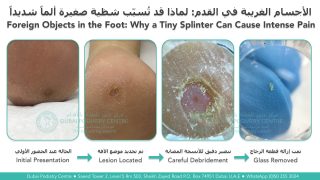


A very small area of sudden, intense and highly localised pain in the sole of the foot can sometimes be caused by a foreign object embedded in the skin.

Because we put our full body weight through our feet, even something incredibly small—a tiny splinter, hair or fragment of glass—can become surprisingly painful. Patients will often describe being able to point to one exact spot that feels extremely sharp or painful when they stand or walk.


Even a Hair Can Become a Foreign Body

One of the more unusual foreign bodies we occasionally encounter is human hair.

For example, when someone shaves in the shower, freshly cut hairs can have extremely sharp ends. At the same time, warm water temporarily softens the outer layers of skin on the feet.

A short, stiff piece of freshly cut hair can occasionally penetrate this softened skin. With continued walking and pressure, it may gradually work deeper into the skin.

This can also occur with cat or dog hairs, particularly short, coarse hairs that can behave almost like tiny splinters.

Initially, the person may notice very little. However, as the foreign material penetrates more deeply and the surrounding tissue becomes inflamed, a very small area can become disproportionately painful.


Glass splinter removed from the sole of the foot following assessment and careful debridement at Dubai Podiatry Centre


Why Does It Become So Painful?


The body recognises an embedded object as something that does not belong there and produces an inflammatory response around it. Occasionally, a small collection of pus may develop around the foreign material.

In other areas of the body, this may eventually drain spontaneously and allow the foreign body to escape.

The sole of the foot, however, has particularly thick, strong skin designed to withstand enormous amounts of pressure and friction. This can make spontaneous drainage more difficult.

Instead, the foreign object may remain trapped while every step continues to push pressure through the affected area.

The result can be intense pain concentrated within a surprisingly tiny area.


Common Foreign Objects We Find in Feet

Foreign bodies can enter the feet in many everyday situations. These include:

  • Tiny wooden splinters from gardening, decking or wooden floors
  • Small fragments of broken glass
  • Human hair following shaving
  • Coarse cat or dog hairs
  • Thorns and plant material
  • Small fragments picked up while walking barefoot outdoors
  • Splinters from harbour or marina decking
  • Sea urchin spines

Walking barefoot around swimming pools, gardens, beaches, marinas and decking areas can increase the opportunity for tiny objects to enter the skin.

Look Closely at the Area

Sometimes there is very little to see from the surface.

You may notice a tiny dark or discoloured area beneath the skin. Occasionally patients describe seeing a greenish or grey shadow, although colour alone cannot confirm that a foreign body is present.

One simple trick is to take a close-up photograph with your mobile phone in good lighting and enlarge the image. Modern phone cameras can sometimes reveal a tiny entry point or object that is difficult to see with the naked eye.

However, if you cannot easily see and grasp the object at the surface, repeatedly digging into the foot at home can make matters worse.

Sea Urchin Spines

Sea urchin injuries are usually much easier for the patient to recognise because they occur immediately after standing on or brushing against a sea urchin.

The difficulty is that sea urchin spines are fragile and can break, leaving fragments embedded beneath the skin.

At Dubai Podiatry Centre, we use careful podiatric techniques to access suitable superficial retained fragments and remove them while trying to avoid breaking the spine or driving it further into the tissues.

Deeply embedded fragments, significant swelling, persistent pain or suspected involvement of deeper structures may require further medical assessment or imaging.

Don’t Keep Digging at the Foot

One of the most important pieces of advice is not to repeatedly cut, squeeze or dig into the sole of the foot yourself.

If a foreign body is clearly protruding from the surface and can be removed easily, that may be straightforward. But when an object has disappeared beneath the skin, trying to find it with needles, blades or other instruments can push it deeper, introduce bacteria and cause additional tissue damage.

If you have a very small, intensely painful area on the foot—particularly after walking barefoot—and you cannot see what is causing it, a podiatrist can examine the area carefully.


When Should You Seek Medical Attention?


Seek professional assessment if the pain is increasing, you cannot comfortably walk, the object appears deeply embedded, or you develop redness, warmth, swelling, pus, bleeding or spreading inflammation.

People with diabetes, poor circulation, reduced sensation in the feet or impaired immunity should avoid attempting to remove embedded foreign bodies themselves and should seek professional assessment promptly.

Sometimes the tiniest object can cause an extraordinary amount of pain in the foot. Finding and safely removing the cause can provide enormous relief.

Dubai Podiatry Centre
Dubai, UAE
Specialist assessment and treatment of foot and lower-limb conditions.


For more information or to book an appointment please call our clinic +971 4 3435390 or WhatsApp +971 50 3553024


Flat feet in children are common, but parents may become concerned when a child’s feet or ankles roll inward while standing or walking. This inward movement is known as overpronation and may affect foot posture, ankle stability, balance and walking comfort.

At Dubai Podiatry Centre, our podiatrists assess children’s flat feet and walking patterns to determine whether additional support, such as custom-made orthotics, may be beneficial.


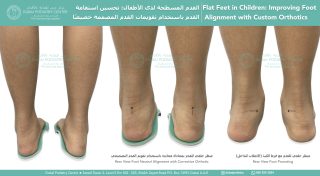
Child’s flat feet showing overpronation and improved neutral foot alignment with custom orthotics in Dubai

What Are Flat Feet in Children?

Flat feet occur when the arches of the feet appear lowered or make increased contact with the ground. In some children, the heels and ankles may also lean inward, causing the feet to overpronate.

Although flat feet do not always cause problems, a podiatry assessment may be recommended if your child experiences:

  • Foot, heel, ankle or knee pain
  • Tired or aching legs
  • Frequent tripping or poor balance
  • Difficulty walking or participating in sports
  • Uneven or excessive shoe wear
  • Ankles that visibly roll inward
  • Changes in posture or walking pattern

Recognising these signs early allows the child’s foot posture, movement and support requirements to be professionally evaluated.

How Overpronation Can Affect Foot Alignment

When a child’s feet overpronate, the heels and ankles lean inward instead of remaining in a more neutral position. This may change how pressure is distributed across the feet and influence the alignment of the lower limbs.

The comparison image demonstrates the rear view of pronating feet and the improved neutral alignment achieved while standing on corrective orthotics. The orthotics provide support beneath the feet and help stabilise the heels and ankles.

Custom Orthotics for Children’s Flat Feet

Custom orthotics are individually made to match the shape, posture and biomechanical needs of each child’s feet. Unlike standard insoles, they are created following a professional foot and walking assessment.

Corrective orthotics may help to:

  • Support the arches of the feet
  • Reduce excessive inward rolling
  • Stabilise the heels and ankles
  • Improve foot and lower-limb alignment
  • Distribute pressure more evenly
  • Support balance and walking comfort
  • Reduce strain on the feet and legs

Every child’s feet are different, which is why orthotics should be designed according to their individual assessment rather than selected as a one-size-fits-all solution.

Children’s Biomechanical Foot Assessment in Dubai

At Dubai Podiatry Centre, a children’s biomechanical assessment examines foot posture, ankle alignment, lower-limb movement and walking pattern. The podiatrist will determine whether custom orthotics are appropriate and explain the recommended treatment plan.

Regular reviews may also be advised to monitor the child’s progress, comfort and changing needs as they grow.

Book a Children’s Flat Feet Assessment in Dubai

If your child’s feet roll inward or you have concerns about flat feet, foot pain, balance or walking, professional assessment can help identify their individual support requirements.

Book a children’s flat feet and overpronation assessment with Dubai Podiatry Centre on Sheikh Zayed Road. Our podiatrists provide personalised foot assessments and custom orthotics for children in Dubai.


For more information or to book an appointment please call our clinic +971 4 3435390 or WhatsApp +971 50 3553024


Copyright Dubai Podiatry 2026. All rights reserved.

WhatsApp us