


When choosing sports footwear, athletes often concentrate on the shoe itself, looking at grip, stability, cushioning and fit.
However, one important detail is frequently overlooked.
The socks you wear inside your sports shoes can influence how comfortably your toes move, how pressure is distributed across the forefoot and how much friction develops between your toes.
At Dubai Podiatry Centre, we recommend considering five toe socks for certain sporting activities, particularly where repetitive movement, perspiration and friction can contribute to foot problems.
Different sports place very different demands on the feet, which is why choosing the correct toe socks and footwear combination is important.
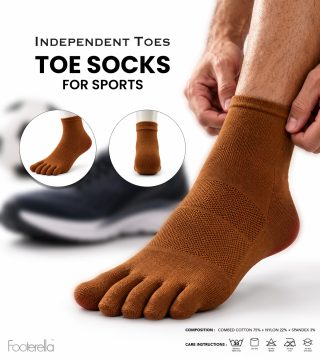
1. Toe Socks for Padel, Tennis, Squash and Badminton
Racket sports require rapid changes of direction, sudden stopping, lateral movement and powerful acceleration.
Players repeatedly push sideways, forwards and backwards as they move around the court.
These movements place considerable demands on the forefoot, toes and ankles.
Why Are Racket Sports Shoes Designed Differently?
Dedicated racket sports shoes are generally designed with a stable platform, secure upper and appropriate lateral support.
Many have a relatively broad forefoot platform to help the player remain stable during rapid sideways movements.
The outsole also needs sufficient grip and a construction suitable for the court surface.
A shoe that is excessively narrow or poorly fitted may compress the toes and reduce comfort during powerful movements.
However, shoe width alone does not determine ankle stability. Heel security, outsole design, traction, ankle control and the player’s movement mechanics are also important.
Why Toe Socks Can Be Beneficial
During racket sports, the toes help with balance, pressure distribution and propulsion.
A properly fitted toe sock allows each toe to sit within its own individual fabric compartment.
Unlike a conventional sock that may bunch or compress the toes, a correctly sized toe sock can provide separation without excessive pressure.
This may help the toes move more comfortably within the available space in the shoe.
The benefits can include:
1. Reduced friction between neighbouring toes
2. Improved moisture management during intense exercise
3. Less direct rubbing between the toes
4. Greater comfort for players who prefer their toes to remain separated
5. Potentially fewer friction related skin problems when the socks and shoes fit correctly
Why Toe Freedom Matters
Think about the way a baseball or cricket player uses their fingers.
The fingers need to move independently to control the ball during gripping and release.
If several fingers were tightly bound together, the player’s normal throwing technique could be affected.
The toes also contribute to movement, balance and control, although their role is different from that of the fingers.
During running, jumping and pushing away from the ground, the toes participate in the final stages of weight transfer and propulsion.
Allowing comfortable toe movement within the shoe is therefore desirable.
Toe socks may help some athletes achieve this, but there is not yet strong evidence that wearing toe socks alone increases pushing force, speed or sporting performance.
Choosing the Correct Socks for Racket Sports
Traditional tennis socks are often designed with additional cushioning, supportive fabric and a comfortable fit around the ankle.
However, even a good tennis sock may allow moisture and friction to develop between closely positioned toes.
For athletes who repeatedly experience blisters or skin irritation between their toes, breathable toe socks may be worth trying.
Choose a design with a comfortable fit, effective moisture management and enough room within the shoe for all five toe compartments.
Avoid excessively thick toe socks if they make your racket sports shoes feel tight.
2. Toe Socks for Football and Rugby
Football and rugby create a very different footwear environment.
Players often wear closely fitted boots designed to provide secure contact between the foot and the playing surface.
Football boots in particular can have a relatively narrow forefoot and a closely fitted upper.
A secure fit is important for comfort, control and minimising excessive movement of the foot inside the boot.
However, tight footwear and socks can create problems for the toes.
Common Foot Problems in Football and Rugby
Players may experience:
1. Blisters between the toes
2. Corns caused by repeated pressure and friction
3. Calluses around the toes and forefoot
4. Toenails rubbing against neighbouring toes
5. Moisture accumulation between the toes
6. Skin irritation after prolonged training or matches
These problems can be particularly troublesome when athletes train frequently and spend long periods wearing enclosed boots.
Why Thin Toe Sock Liners Can Help
For football and rugby players, we recommend considering a very thin toe sock liner underneath the conventional team sock.
The liner should be made from lightweight, breathable fabric and fit comfortably around each toe.
The aim is to create a thin barrier between neighbouring toes without adding unnecessary bulk inside the boot.
A suitable combination may include:
First layer: Thin toe sock liner
A lightweight liner with five individual toe compartments, ideally made from breathable fabric with good moisture management.
Second layer: Football or rugby sock
The regular sports sock is worn over the liner.
Third layer: Properly fitted sports boot
The boot should fit securely without excessive compression of the toes.
The thin toe sock liner may help reduce skin friction between adjacent toes, while the outer sports sock provides the familiar fit and support required for training and competition.
Why Not Simply Wear Two Regular Socks?
Two conventional socks may increase bulk and pressure within an already closely fitted boot.
They also do not provide an individual fabric barrier between neighbouring toes.
A thin toe sock liner can offer this separation while keeping the additional thickness to a minimum.
However, if the boot becomes too tight, adding any second layer can increase pressure and create new problems.
Toe sock liners should only be used when there is sufficient room in the footwear.
Can Toe Socks Prevent Blisters and Corns?
Toe socks may help reduce friction between adjacent toes.
This can be useful for athletes who repeatedly develop blisters or skin irritation in these areas.
However, corns and calluses are also influenced by toe alignment, footwear pressure and repetitive loading.
If a player has recurring painful corns, calluses or blisters, the underlying pressure should be assessed rather than relying on socks alone.
3. Toe Socks for Hiking and Long Distance Walking
Hiking places prolonged demands on the feet.
During several hours of walking, the feet experience repeated loading, perspiration, friction and sometimes swelling.
Walking downhill can also increase pressure at the front of the boot, particularly around the toes and toenails.
For these reasons, choosing the correct socks is especially important.
Why Toe Socks Are Useful for Hiking
Five toe socks provide an individual fabric covering for each toe.
This may help reduce rubbing between neighbouring toes and provide a barrier where toenails repeatedly contact the skin of adjacent toes.
They can also help manage perspiration between the toes when made from suitable moisture wicking materials.
For some hikers, combining a thin toe sock with a cushioned outer hiking sock can provide additional comfort.
Our Recommended Hiking Sock Combination
First layer: Five toe socks
Choose a comfortable toe sock that separates each toe and allows moisture to move away from the skin.
Second layer: Soft cushioned hiking socks
Wear a soft, cushioned hiking sock over the toe socks.
Some diabetic style socks provide generous cushioning, gentle cuffs and smooth seams.
These may be comfortable for hiking, provided they are breathable, appropriately fitted and suitable for prolonged walking.
Third layer: Properly fitted hiking boots
Choose hiking boots with sufficient space for both layers of socks.
The toes should be able to move comfortably without being compressed.
The heel should remain secure, and the foot should not slide excessively inside the boot.
Why Double Layering Can Help
When two suitable layers of socks are worn together, some friction may occur between the fabric layers rather than directly against the skin.
This can help reduce rubbing for certain hikers.
The inner toe sock also provides separation between the toes, which conventional double sock combinations do not.
However, double layering is not essential for everyone.
Some hikers are more comfortable with one well fitted technical hiking sock.
The best option depends on the individual foot, the footwear and the conditions.
4. Choosing Hiking Boots for Toe Socks and Additional Cushioning
When wearing toe socks underneath thicker hiking socks, it is important to account for the extra volume inside the boot.
Feet may also swell during prolonged walking, particularly in hot weather.
For this reason, hiking boots should be fitted while wearing the exact sock combination you intend to use.
You may require a wider or higher volume boot, or occasionally a longer size.
However, increasing by two and a half or three shoe sizes is not routinely recommended.
A boot that is excessively long can allow the foot to slide forwards, increasing friction, instability and the risk of toenail injuries.
Instead, choose a boot that provides sufficient toe room, secure heel positioning and comfortable support.
When trying on hiking boots, walk on an incline if possible and check that your toes do not strike the front of the boot when moving downhill.
5. The Importance of Keeping Toes Dry During Sport
Whether you are playing tennis, football, rugby or hiking, perspiration is an important consideration.
When moisture remains trapped between the toes, the skin can soften and become more vulnerable to friction and irritation.
Warm, damp conditions can also encourage fungal infections such as athlete’s foot.
Toe socks made from breathable, moisture wicking materials may help manage moisture between the toes.
However, they do not guarantee that fungal infections or blisters will be prevented.
Good hygiene remains essential.
After exercise, remove damp socks, wash and carefully dry your feet, particularly between the toes, and allow your sports shoes to dry thoroughly.
6. Which Toe Socks Should You Choose for Your Sport?
Padel, Tennis, Squash and Badminton
Choose lightweight or moderately cushioned toe socks that allow comfortable toe movement within a stable court shoe.
Football and Rugby
- Choose very thin toe sock liners that fit comfortably underneath the regular team socks without making the boots too tight
Hiking and Long Distance Walking
- Consider breathable toe socks with a soft, cushioned outer hiking sock if your boots have sufficient room for both layers
Everyday Sports Training
- Choose breathable toe socks suited to your footwear, exercise intensity and individual comfort
Our Advice at Dubai Podiatry Centre
Different sports require different footwear, but one principle remains important.
Your toes need sufficient room to function comfortably, and your socks should not create unnecessary compression or friction
For racket sports, toe socks may help maintain comfortable toe separation inside a stable court shoe
For football and rugby, thin toe sock liners may reduce friction between the toes inside closely fitted boots
For hiking, toe socks combined with appropriate outer socks and correctly fitted boots may improve comfort during prolonged walking
Toe socks are not a substitute for properly fitted footwear, and they cannot guarantee improved sporting performance or prevent every blister or injury
However, for athletes who experience repeated friction, moisture or discomfort between their toes, they can be a simple and practical addition to their sporting equipment
At Dubai Podiatry Centre, we believe that even small changes to footwear and sock selection can make a meaningful difference to foot comfort during sport
Dubai Podiatry Centre
Sports Podiatry, Foot Biomechanics and Orthotic Therapy
This article provides general educational information and does not replace an individual clinical assessment.
For more information or to book an appointment please call our clinic +971 4 3435390 or WhatsApp +971 50 3553024