

fbpx

Please wait...


BLOG

No more posts

At Dubai Podiatry Centre, we sometimes see teenagers whose toenails look damaged, rough or uneven, but when we examine the nail closely, there is actually nothing wrong with the health of the nail itself.

Recently, a mother brought her teenager to see us because they were repeatedly peeling both their fingernails and toenails. The toenails had been peeled so frequently that they had developed sharp and rough edges, with some edges beginning to irritate the surrounding skin and contribute to ingrown toenails.

However, when we examined the feet, the underlying picture was very reassuring.

The nails were growing extremely well from the nail root and nail bed. The skin underneath was healthy and pink, and the circulation and capillary refill were excellent.

The problem was not that the toenails were unhealthy.

The problem was the repeated picking and peeling of perfectly healthy nails.
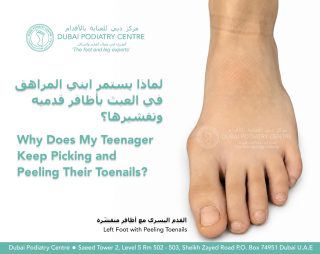
 

Teenager’s left foot with peeling toenails caused by repeated nail picking, assessed at Dubai Podiatry Centre


Why Do Some Teenagers Pick Their Nails Without Realising It?

The teenager’s mother explained that the picking was almost constant, particularly while studying, concentrating or thinking.

Interestingly, the teenager was often not consciously aware that they were doing it.

This is an important distinction. Sometimes repetitive nail picking is less about the nail itself and more about giving the hands something to do while the brain is concentrating.

Some children and teenagers naturally seek movement or tactile stimulation when focusing. Their fingers want to touch, roll, pick or manipulate something while their attention is occupied elsewhere.

If there is nothing else available, the fingernails, skin or toenails can become the target.


Nail Polish Isn’t Necessarily the Answer

Parents understandably ask whether we can put something onto the nail to stop the behaviour.

  • Would a special nail polish help?
  • Would a strengthening lacquer help?
  • Does the nail need a treatment?

If the nail itself is healthy, coating it does not necessarily address the reason the picking is happening.

From a podiatry perspective, our priority is to examine the nail carefully and establish whether there is an underlying nail or skin condition. We can also safely smooth or treat damaged edges and manage an ingrown toenail if repeated peeling has created a sharp nail spike.

But when the nail is healthy and the damage is being caused by repeated picking, it is also important to address the habit itself.

Give the Fingers Something Else to Do

One of the simplest strategies can be to redirect the hands towards something harmless.

A small piece of therapy putty, reusable putty, Blu Tack or Play-Doh can be surprisingly useful.

While studying, reading, watching television or concentrating, the teenager can gently roll and manipulate the putty between their fingers.

The objective isn’t simply to say: “Stop picking your nails.”

Instead, we are giving the fingers an alternative activity.

This can be particularly useful because it is quiet and discreet. The teenager can manipulate a small piece of putty underneath a desk or while reading without disturbing the people around them.

Fidget spinners and other sensory devices can also be helpful for some people. However, they can sometimes become visually or audibly distracting to classmates, siblings or other people nearby. A small piece of putty can provide tactile stimulation much more discreetly.


Keeping Busy Hands Away From Healthy Nails

Some teenagers who enjoy using their hands are wonderful at detailed activities. They may enjoy drawing, crafts, model making, painting miniatures or other projects requiring very delicate hand movements.

Those activities are excellent when there is time to concentrate on the activity itself.

The difficulty comes when the teenager needs their attention elsewhere, particularly during studying.

That is when a very simple tactile object can be useful. The hands can remain gently occupied while the brain concentrates on the information being learned.

Protecting the Toenails While the Habit Changes

While working on reducing the picking habit, it is important to protect the toenails from secondary problems.

Repeatedly peeling a toenail can leave:

  • Sharp or jagged nail edges
  • Very short nails
  • Irritated skin around the nail
  • Nail edges that begin to grow into the surrounding skin
  • Tenderness or inflammation
  • Increased risk of breaking the skin

If an edge has become sharp, painful or ingrown, a podiatrist can examine and manage it appropriately.

It is also important not to assume that every damaged-looking nail is caused by picking. Fungal infections, trauma, skin conditions and other nail disorders can alter the appearance of toenails, so an examination can be helpful when the cause isn’t clear.


When Should Parents Seek Further Advice?

Occasional nail picking can simply be a habit. However, if the behaviour is frequent, difficult for the young person to control, causes bleeding or significant tissue damage, causes distress, or begins to interfere with everyday life, parents may wish to discuss it with their GP, paediatrician or an appropriate behavioural or mental-health professional.

The important thing is not to shame the teenager for doing something they may barely realise they are doing.

Sometimes the first useful question isn’t: “How do we make them stop?”

It is: “What can we give their hands to do instead?”


At Dubai Podiatry Centre, we can assess toenails that have become painful, rough or ingrown as a result of repeated picking and determine whether the nail itself is healthy or whether another nail condition requires treatment.

Dubai Podiatry Centre
Helping to keep growing feet and toenails healthy.


For more information or to book an appointment please call our clinic +971 4 3435390 or WhatsApp +971 50 3553024


Many people assume that when a toenail starts lifting away from the skin underneath, it must be a fungal infection. Surprisingly, this is often not the case.

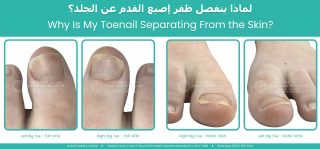
A detached toenail, known medically as onycholysis, can occur for many different reasons. While fungal infections can sometimes cause nail separation, many patients have repeated fungal tests that come back completely clear. In these cases, the cause is often mechanical rather than infectious.

What Does Toenail Separation Look Like?

The nail may begin separating from:

  • The inside (medial) border of the nail
  • The outside (lateral) border of the nail
  • The tip of the nail (distal edge)
  • Multiple borders at the same time


Clinical photographs showing separation of both big toenails from the nail bed (onycholysis), with top and front views illustrating nail detachment caused by repetitive trauma and biomechanical foot abnormalities


In severe cases, the entire nail plate may become detached from the nail bed, leaving the nail attached only at the nail root.

Cause #1 – Repetitive Pressure From Footwear

One of the most common causes of nail separation is repeated pressure from footwear.

This can occur when:

  • Shoes are too short or too narrow
  • The toe repeatedly hits the front of the shoe
  • The toe hyperextends upward and strikes the roof of the shoe

When the toenail is repeatedly compressed, the tissues beneath the nail become irritated and swollen. As the swelling settles, the connection between the nail plate and the nail bed can weaken, causing the nail to lift away from the skin.

A useful clue is the appearance of horizontal ridges across the toenail. These ridges run from side to side and often indicate repetitive trauma from the toe repeatedly striking the shoe.


Cause #2 – Aggressive Cleaning Under The Nail

Many people regularly clean underneath their toenails using nail files, scissors, metal instruments, or other sharp tools.

Unfortunately, this can gradually separate the nail from the skin underneath.

In fact, when podiatrists remove a toenail surgically, one of the techniques involves releasing the nail from the nail bed using specialised instruments. Excessive cleaning under the nail can unintentionally create the same process over time.

The more the nail is lifted and cleaned underneath, the easier it becomes for the separation to progress.

Cause #3 – Abnormal Toe Position and Foot Mechanics

Perhaps the most surprising cause of toenail separation is abnormal toe movement during standing and walking.

This is often the most overlooked cause and, in many cases, the most common.

When the foot collapses inward, the arch flattens, or a bunion develops, the toe is no longer functioning in a neutral position.

The toe may:

  • Rotate inward or outward
  • Drift sideways
  • Move excessively forward
  • Twist during walking

When this happens, the soft tissue beneath the nail is repeatedly pulled and stretched.

Rather than the nail being pushed away by pressure from above, the skin underneath is gradually pulled away from the nail by repetitive micro-trauma.

Over thousands of steps each day, the tissues can slowly detach from the nail plate.

For example:

  • If the ankles lean inward and the big toe rotates, separation commonly develops along the outer border of the big toenail
  • If a bunion causes the toe to drift sideways, tension can develop on one side of the nail bed
  • If the toes spread excessively due to arch collapse, the tissues beneath the nail can be repeatedly stretched and irritated

The result can look very similar to a fungal nail infection, even when no fungus is present.


Why Standing Examination Matters

Many nail problems are missed because the feet are examined only while the patient is sitting.

The position of the toes can change dramatically once a person stands and begins walking.

A proper assessment should include:

  • Standing examination
  • Walking analysis
  • Heel raise testing
  • Observation of toe-off during gait
  • Assessment of foot posture and ankle alignment

Only then can the true cause of the nail separation be identified.


Examining The Shoes

The footwear often provides valuable clues.

We frequently examine:

  • The original insoles
  • Wear patterns inside the shoe
  • Pressure marks from the toes
  • Areas where the toes slide forward

Older shoes are often more useful because they clearly show where pressure has been occurring over time.

One particularly revealing finding is damage to the inner roof of the toe box. In some cases, the fabric lining has been worn away by the toenail repeatedly striking the ceiling of the shoe during walking.

This provides clear evidence that the nail is being traumatised from above.


The Importance Of Finding The Real Cause

Treating a detached toenail successfully requires identifying why the nail is separating in the first place.

If the cause is fungal, antifungal treatment may be required.

However, if the cause is mechanical, treatment should focus on correcting the underlying problem, such as:

  • Footwear modification
  • Orthotic therapy
  • Correction of abnormal foot posture
  • Management of bunions
  • Reduction of excessive toe movement
  • Protection of the nail from repetitive trauma


Without addressing the underlying cause, the nail may continue to separate regardless of how many creams, sprays, or antifungal treatments are used.

At Dubai Podiatry Centre, we assess not only the nail itself but also the biomechanics of the foot and the forces acting on the toe during standing and walking. Understanding these forces is often the key to solving long-standing nail problems that have been mistakenly attributed to fungal infection.


For more information or to book an appointment please call our clinic +971 4 3435390 or WhatsApp +971 50 3553024


Copyright Dubai Podiatry 2026. All rights reserved.

WhatsApp us