

fbpx

Please wait...


BLOG

No more posts

A mother recently brought her young son to Dubai Podiatry Centre because the family had noticed something unusual about the way he was walking.

His mother had noticed that he frequently walked with his feet pointing outwards, while his grandfather had spotted something different: the child’s fourth and fifth toes appeared to be curling and gripping.

When we watched him walking in the clinic, we could see why.

The child alternated between two very distinctive walking patterns. At times he walked with his feet turned considerably outwards. At other times, he went up onto his tiptoes and toe walked.

When he tried to put his whole foot onto the ground and walk in a conventional heel-to-toe pattern, it was surprisingly difficult for him.

The “Slapping” Sound When He Walked

When the child attempted to walk with his feet facing forwards, his feet tended to come down quite flat onto the floor, producing a noticeable slapping sound.

Instead of smoothly contacting the ground with the heel and progressing through the foot towards the toes, he lifted his knees higher and almost marched.

His mother encouraged him to try walking normally from heel to toe, but he found this difficult.

Interestingly, his walking became much easier when he either:

  • turned his feet outwards, or
  • lifted his heels and walked on his toes.

These were not simply habits. His body was finding alternative ways to move around a mechanical difficulty at his feet and ankles.


Why Were His Little Toes Curling?

His grandfather had been particularly concerned about the fourth and fifth toes curling.

This provided us with another clue.

When the child stood, his ankles and subtalar joints rolled significantly inwards. As this happened, the outside of the foot became less stable against the ground.

The smaller toes then tried to compensate by curling and gripping.

What the family could see at the toes was therefore only part of the picture.

The toes themselves were not necessarily the primary problem. They were reacting to what was happening underneath the foot and at the ankle.

His Arches Looked Normal When He Was Sitting

This is something that can surprise parents.

When the child sat on the examination chair with his legs extended in front of him, his feet looked quite different.

His ankles appeared straight and his arches were nicely formed.

But when we asked him to stand and put his body weight through his feet, the picture changed dramatically.

His ankles rolled inwards, his feet flattened and his little toes began to curl.

This distinction between a child’s non-weight-bearing foot and their weight-bearing foot can be extremely important.

A child can have a perfectly good arch while sitting and yet demonstrate significant hyperpronation when standing and walking.

What Is Hyperpronation of the Subtalar Joint?

The subtalar joint sits underneath the ankle and plays an important role in allowing the foot to adapt to the ground.

Some children have softer, more flexible ligaments, allowing considerably more movement through this area.

When excessive inward movement occurs under body weight, we describe this as hyperpronation.

In this child’s case, the inward movement was significant enough to affect the way he was choosing to walk.

Walking on his toes gave him another way of generating momentum and moving forwards.

Turning his feet outwards and adopting a wider stance also gave him another way to negotiate the excessive movement occurring around his feet and ankles.

Rather than repeatedly telling him to “put your heels down” or “keep your feet straight”, we needed to address why he found those positions difficult in the first place.

Correcting the Foundation

We recommended corrective orthotics designed specifically for his feet.

The purpose was to support the foot and ankle in a more neutral position and reduce the excessive inward movement occurring when he stood and walked.

His orthotics were manufactured and fitted into both his school shoes and sports shoes.

Then we asked him to walk again.

The difference was immediate.

With his feet and ankles better supported, he began walking much more easily and naturally. Most noticeably, he no longer felt the same need to rise onto his tiptoes to move forwards.

Don’t Look Only at the Arch

Parents often associate flat feet with simply looking at whether their child has an arch.

But children’s foot mechanics are more complicated than that.

We also look at:

  • the position of the heel and ankle
  • movement through the subtalar joint
  • whether the arch changes significantly under body weight
  • the position of the toes
  • whether the toes grip the ground
  • whether the feet turn inwards or outwards
  • whether the child toe walks
  • how the heel contacts the ground
  • whether the child can comfortably achieve a smooth heel-to-toe walking pattern

Sometimes the smallest observations can be extremely useful.

In this child’s case, his grandfather noticing those curling little toes was an important clue to what was happening throughout the foot.


When Should Parents Have Their Child’s Walking Checked?

Children naturally have considerable variation in the way they learn to stand, walk and run, and not every flat-looking foot or unusual movement requires treatment.

However, if a child consistently walks on their toes, turns their feet markedly outwards, has difficulty walking heel-to-toe, produces a noticeable foot slap, curls or grips their toes, frequently trips, complains of discomfort, or simply appears to be working unusually hard to walk, it can be worthwhile having their gait and lower-limb mechanics assessed.

Sometimes what appears to be a habit is actually the child’s clever way of finding the easiest way to move with the mechanics they currently have.

At Dubai Podiatry Centre, we assess not simply how a child’s feet look while they are sitting, but what happens to those feet when the child stands, walks and moves.

Because ultimately, feet are designed for movement — and that is where their true function can be seen.

This article is for general educational information. Toe walking and altered gait can have a number of causes, including musculoskeletal and neurological causes. Persistent, new, asymmetric or otherwise concerning gait changes should be appropriately assessed rather than assumed to result from flat feet or hyperpronation alone.


For more information or to book an appointment please call our clinic +971 4 3435390 or WhatsApp +971 50 3553024


Children’s foot and ankle development is extremely important. One of the main causes of suspected flat feet in children is not always a truly flat foot, but extreme hyperpronation of the subtalar joint. This causes the ankles to lean inwards and the arch to collapse when the child is standing.

تُعدّ مرحلة تطوّر القدم والكاحل لدى الأطفال أمرًا بالغ الأهمية. ومن أبرز أسباب الاشتباه بوجود القدم المسطّحة لدى الأطفال ليس دائمًا تسطّحًا حقيقيًا في القدم، بل قد يكون نتيجة فرط الانقلاب الداخلي (Hyperpronation) في المفصل تحت الكاحل (Subtalar Joint). وهذا يؤدي إلى ميلان الكاحلين إلى الداخل وانهيار قوس القدم عند وقوف الطفل.


During periods of rapid growth, children can have a high level of growth hormone over a short period of time. This can make the ligaments very soft and stretchy, almost like chewing gum. The ligaments on the inside of the ankle help hold the subtalar joint in a neutral position. When these ligaments become too soft, the talus bone can lean inwards, causing the ankle to roll in and the arch to flatten.

خلال فترات النمو السريع، قد ترتفع مستويات هرمون النمو لدى الأطفال خلال فترة زمنية قصيرة، مما يجعل الأربطة لينة ومطاطية جدًا، أشبه بالعلكة. تساعد الأربطة الموجودة في الجهة الداخلية من الكاحل على تثبيت المفصل تحت الكاحل في وضعٍ محايد. وعندما تصبح هذه الأربطة رخوة أكثر من اللازم، قد يميل عظم الكاحل (Talus) إلى الداخل، مما يؤدي إلى انحراف الكاحل للداخل وتسطيح قوس القدم.


An accommodative insole that simply supports the arch may help the foot feel more supported, but it is not always enough to correct the ankle alignment. To improve the position of the foot and ankle, the subtalar joint needs to be brought back towards neutral using very specific corrective angles.

إن النعال التكيُّفية التي تدعم القوس فقط قد تعطي شعورًا أفضل بالدعم، لكنها غالبًا لا تكون كافية لتصحيح محاذاة الكاحل. ولتحسين وضعية القدم والكاحل، يجب إعادة المفصل تحت الكاحل إلى وضعه المحايد باستخدام زوايا تصحيحية دقيقة جدًا.


For example, if the subtalar joint pronates by 30 degrees, the orthotic correction must be designed to address that degree of movement. If the ankle is not corrected and only the arch is supported, the foot may continue to appear flat when standing.

فعلى سبيل المثال، إذا كان المفصل تحت الكاحل ينحرف بمقدار 30 درجة، فيجب تصميم الدعامة التقويمية بحيث تعالج هذه الدرجة من الانحراف. وإذا لم يتم تصحيح الكاحل وتم الاكتفاء بدعم القوس فقط، فقد تبدو القدم مسطّحة عند الوقوف.


This is why it is essential to assess the child’s foot and ankle alignment while they are standing. When a child is sitting, the foot may look well arched and the ankle may return to a neutral position. However, once the child stands and body weight passes through the feet, the subtalar joint may hyperpronate, the ankle may lean inwards, and the arch may collapse.

لهذا السبب، من الضروري تقييم محاذاة القدم والكاحل لدى الطفل أثناء الوقوف. فعند جلوس الطفل، قد تبدو القدم ذات قوس طبيعي ويعود الكاحل إلى وضعه المحايد. ولكن عند الوقوف ومرور وزن الجسم عبر القدمين، قد يحدث فرط الانقلاب في المفصل تحت الكاحل، ويميل الكاحل إلى الداخل، وينهار القوس.


Corrective orthotics are therefore measured and designed specifically for each child, often with different angles for the left and right foot. This helps improve foot and ankle alignment and can also assist in balancing leg length differences caused by uneven pronation.

لذلك، يتم قياس وتصميم الدعامات التقويمية التصحيحية بشكل خاص لكل طفل، وغالبًا بزوايا مختلفة لكل قدم. وهذا يساعد على تحسين محاذاة القدم والكاحل، كما يمكن أن يساهم في موازنة اختلاف طول الساق الناتج عن عدم تساوي الانقلاب.


Accommodative orthotics are often used in very young children to support the foot and help train the arch. However, in children diagnosed with flat feet due to subtalar joint hyperpronation, corrective orthotics with specific wedging are usually required to bring the ankle into a better aligned position.

تُستخدم الدعامات التكيُّفية غالبًا مع الأطفال الصغار جدًا لدعم القدم والمساعدة في تدريب القوس. أما في الحالات التي يتم فيها تشخيص القدم المسطّحة نتيجة فرط الانقلاب في المفصل تحت الكاحل، فعادةً ما تكون الدعامات التقويمية التصحيحية المزودة بزوايا وتعديلات محددة ضرورية لإعادة الكاحل إلى وضعية أكثر توازنًا.


For more information or to book an appointment please call our clinic +971 4 3435390 or WhatsApp +971 50 3553024


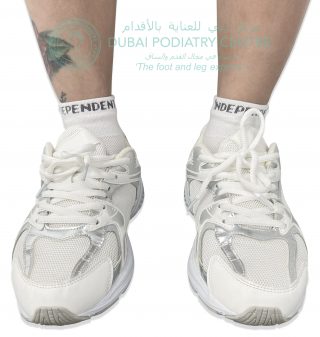
Have you ever wondered why the tongue of your shoe keeps slipping towards the outside of your foot?

Front view of feet in trainers with uneven shoe tongue position linked to hyperpronation and lower limb alignment issues

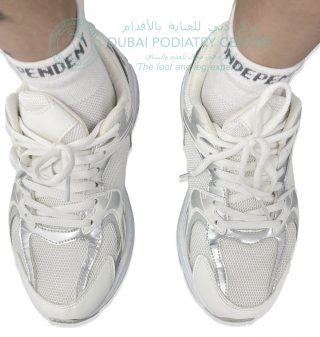
In many cases, the reason is not the shoe itself, but the way your foot and ankle are functioning. When the ankle rolls inwards, known as hyperpronation, it can create a twisting force inside the shoe.This repeated inward lean pushes the shoe tongue towards the outside, which is why you may find yourself constantly pulling it back into place.


Shoe manufacturers recognised this problem some time ago, which is why many modern shoes now have gusseted tongues attached to the upper. This helps keep the tongue centred, but it does not correct the underlying foot mechanics causing the shift.


A similar thing can happen with skinny jeans or tight leggings. Have you ever noticed the inner seam twisting around on one leg? This can happen because clothing is made symmetrically, but the body is often not. A leg length difference, pelvic tilt, or one foot rolling in more than the other can create rotational forces through the leg, causing seams to twist out of place.

So, whether it is the tongue of your shoe drifting sideways or the seam of your leggings twisting around your leg, these can both be signs of asymmetry in the lower body, often linked to foot and ankle alignment.


Top view of white trainers showing shoe tongue slipping outward due to foot alignment and possible hyperpronation

If you have noticed that the tongue of your shoe is always slipping to the outside, or that one trouser seam seems to keep twisting, it may be worth having your foot posture, ankle alignment, and leg lengths assessed by a podiatrist. Correcting the alignment with appropriate treatment, such as orthotic support where needed, can help improve the way forces travel through the feet and legs.


#ShoeTongue #ShoeTongueSlipping #FootAlignment #FootMechanics #Hyperpronation #Pronation #FootPosture #AnkleAlignment #LowerLimbAlignment

For more information or to book an appointment please call our clinic +971 4 3435390 or WhatsApp +971 50 3553024


Copyright Dubai Podiatry 2026. All rights reserved.

WhatsApp us