


Many people believe that ingrown toenails are simply caused by cutting the nail incorrectly. While this can occasionally happen, the vast majority of recurring ingrown toenails have a much more fundamental cause: the nail is simply too wide for the toe that it is growing on.
The Nail Is Often Too Wide for the Toe
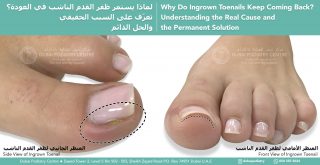
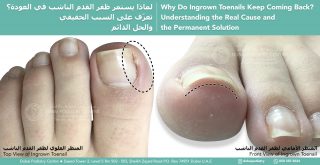
In many patients, the toenail is naturally much wider than the available width of the toe. To fit into this limited space, the nail gradually curves more and more as it grows.
A healthy toenail should have only a gentle curve, rather like an upside-down dinner plate. However, when the nail becomes excessively curved, more like an upside-down soup bowl, the edges begin to press deeply into the surrounding skin. This is when pain, inflammation and recurrent ingrown toenails develop.
Fan-Shaped Toenails
Another common cause is what podiatrists describe as a fan-shaped toenail.
With a fan-shaped nail, the visible nail root, near the cuticle, appears relatively narrow, but the nail becomes progressively wider towards the tip of the toe. As the nail widens, there is simply not enough room for it within the soft tissues, causing the edges to dig into the skin.
These nails frequently become ingrown, regardless of how carefully they are trimmed.
Why Cutting the Sides Is Only a Temporary Fix
Many people seek immediate relief by having the sides of the nail cut away during a pedicure or medical pedicure.
Although this often relieves the pain temporarily, it rarely solves the underlying problem.
When the edge of the nail is removed, the surrounding skin naturally plumps up and heals into the empty space. However, the nail root continues producing the same wide nail as before. As it grows forward, it now has to push through this newly thickened tissue, which often becomes even more painful than before.
This creates a frustrating cycle:
- Pain develops
- The sides are trimmed
- The skin heals and thickens
- The wide nail grows back
- The pain returns
Many patients find themselves needing treatment every one to three months simply to remain comfortable.
The Protective Skin Along the Nail Edge
The firm skin that develops alongside the nail is often viewed as something that should be removed. In reality, it serves an important purpose.
Repeated pressure from the nail causes the body to build a stronger, tougher strip of skin, almost like a protective railway track guiding the nail as it grows.
During aggressive pedicures, this protective tissue is often removed together with the nail edge. Without this natural barrier, the sharp edge of the nail can penetrate the softer skin even more easily, increasing the likelihood of another painful ingrown toenail.
Why We Do Not Recommend Lifelong Trimming
At Dubai Podiatry Centre, we do not recommend relying on repeated trimming of the nail edges as a long-term treatment.
While regular trimming may temporarily relieve symptoms, it does not change the width of the nail growing from the root. The underlying problem remains, meaning patients often become dependent on frequent medical pedicures or painful salon treatments for years.
The Gold Standard: Partial Nail Avulsion with Phenolisation
For patients who repeatedly suffer from ingrown toenails, the most predictable long-term solution is a partial nail avulsion with phenolisation.
During this procedure:
- Only the problematic edge of the nail is removed
- Phenol is carefully applied to permanently stop that narrow strip of nail from regrowing
- The remaining nail continues to grow normally
Because the nail is permanently made slightly narrower, it can fit comfortably within the toe without curling into the surrounding skin.
When performed by an experienced podiatrist, only the minimum amount of nail necessary is removed. This provides a permanent solution while maintaining a natural, aesthetically pleasing appearance.
What About Nail Braces?
Nail braces can temporarily flatten a curved toenail and may provide symptom relief in selected cases.
However, they do not change the actual width of the nail.
In patients whose nails are naturally too wide or fan-shaped, flattening the nail often reveals just how wide it really is. After wearing a brace for one to two years, with replacements every one to three months, the nail frequently returns to its original curved shape once the brace is no longer used.
For this reason, nail braces are generally not considered a permanent solution when the underlying problem is excessive nail width.
Not Every Ingrown Toenail Needs Surgery
Fortunately, not every painful toenail requires a permanent procedure.
Sometimes the discomfort is caused by a tiny nail spike that has broken off during nail cutting. This small fragment may be almost invisible and can work its way into the skin, causing significant pain.
Once this nail spike is removed, the problem is usually resolved and may never happen again.
When Should You Consider Permanent Treatment?
If your ingrown toenail keeps returning every one to three months, despite repeated trimming or pedicures, it is likely that the underlying nail shape, not your nail cutting technique, is responsible.
In these cases, a partial nail avulsion with phenolisation offers the most reliable long-term solution, allowing patients to return to comfortable walking without the need for repeated painful treatments.
At Dubai Podiatry Centre, we carefully assess the shape and width of every toenail before recommending treatment. Our aim is always to provide the smallest correction necessary to permanently eliminate pain while preserving the natural appearance of the toenail.
For more information or to book an appointment please call our clinic +971 4 3435390 or WhatsApp +971 50 3553024