


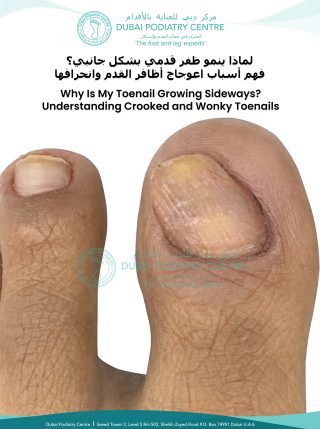
Have you noticed that one of your toenails is growing sideways instead of straight?
Perhaps your big toenail appears to be leaning towards the second toe, or the nail plate seems to be growing at an angle rather than following the natural direction of your toe.
This is a common concern among patients attending Dubai Podiatry Centre.
Some patients have had a crooked toenail for many years, while others notice that their nail gradually begins to change direction.
The interesting thing is that not all crooked toenails have the same cause.
One of the first things we examine is the position of the cuticle line at the base of the nail.
This can provide useful clues about whether the nail has an underlying structural abnormality or whether the visible nail plate is growing unevenly.
1. Start by Looking at the Cuticle Line
The cuticle is the thin protective tissue at the base of your toenail.
Just behind this area lies the nail matrix, which is responsible for producing the nail plate.
When examining a toenail that appears to grow sideways, we look carefully at the proximal nail fold and the line where the nail emerges from beneath the skin.
There are two important patterns to observe.
Pattern One: The cuticle line appears level, but the nail grows sideways.
In this situation, the nail emerges from a relatively normal looking base, but the visible nail plate curves or deviates towards one side.
This may be associated with uneven nail curvature, pressure from the surrounding skin, previous injury or an ingrown nail along one edge.
Pattern Two: The cuticle line itself appears angled.
In this situation, the base of the nail also appears rotated or slanted.
This may suggest a structural difference in the orientation of the nail unit, previous trauma or a change involving the surrounding soft tissues.
The cuticle line is a useful clinical observation, but it cannot confirm the underlying cause on its own.
2. Why Does a Toenail Sometimes Grow Off to One Side?
Toenails grow from specialised cells within the nail matrix.
As new nail cells are produced, the nail plate gradually moves forwards over the nail bed.
Ideally, the nail follows the longitudinal direction of the toe.
However, the direction and appearance of the nail can be influenced by several factors, including:
1. The orientation of the nail matrix
2. Previous trauma to the toe or nail root
3. Pressure from footwear
4. The curvature of the nail plate
5. Changes to the surrounding nail folds
6. Congenital differences in nail alignment
7. Chronic ingrown toenails
Sometimes, the nail appears to be growing sideways because one edge is deeply curved into the surrounding skin.
The opposite edge may remain relatively flat and visible, creating an uneven appearance.
This can make the nail look as though it is being pulled or pushed towards one side.
However, an ingrown toenail does not necessarily change the direction in which the nail matrix produces the nail.
3. When One Side of the Nail Becomes Ingrown
An ingrown toenail occurs when the edge of the nail presses into or penetrates the surrounding skin.
This is particularly common along the medial or lateral borders of the big toenail.
The affected side may become painful, swollen or inflamed.
In some patients, the nail plate also develops an exaggerated curve along that border.
The other side of the nail may remain relatively straight.
As a result, the nail can appear asymmetrical or crooked.
At Dubai Podiatry Centre, we assess whether the problem is primarily an ingrown nail edge, abnormal nail curvature or a structural change affecting the nail unit.
This distinction is important because the treatment will be different.
4. The Handbrake Analogy: Why One Side May Appear Restricted
A useful way to explain an uneven toenail is to imagine a vehicle with a brake applied on one side.
One side appears restricted while the other side seems to move forwards more freely.
This can help patients visualise why a nail with an ingrown or excessively curved border may look uneven.
However, the nail is not literally growing faster on one side because the other side has a handbrake applied.
Nail growth originates within the matrix, and the visible deviation may result from the shape, orientation or curvature of the nail plate.
The important clinical question is whether the nail’s appearance can be improved by treating the problematic edge or whether the nail has a more permanent structural deformity.
5. Correcting a Problematic Nail Edge With Partial Nail Avulsion
When one side of the toenail is persistently ingrown, a partial nail avulsion may be recommended.
This is a procedure in which the problematic strip of nail is removed while preserving the remainder of the nail plate.
The aim is to relieve pressure against the surrounding skin and prevent the painful nail edge from continuing to penetrate the nail fold.
What Is Phenolisation?
Phenolisation is a technique sometimes performed during partial nail avulsion.
A carefully controlled application of phenol is used to destroy the selected portion of the nail matrix responsible for producing the ingrown edge.
This can prevent that narrow section of nail from growing back.
The remaining nail is usually slightly narrower, reducing the likelihood of the same edge becoming ingrown again.
Phenolisation is intended to permanently stop growth from the treated portion of the matrix. It does not simply release the nail edge temporarily.
For patients with recurrent ingrown toenails, this can be an effective treatment.
6. What About Removing the Entire Toenail?
In selected cases, a clinician may consider total nail avulsion.
This involves removing the entire visible nail plate.
The underlying nail bed is then exposed, and if the nail matrix is preserved, a new nail can gradually grow.
A big toenail commonly takes approximately 12 to 18 months to regrow fully, although this varies between patients.
Total nail avulsion may be appropriate for certain severe nail deformities, injuries or other nail conditions.
However, removing the nail does not automatically reset the nail bed or correct the direction of the nail matrix.
If the underlying matrix remains angled or damaged, the new nail may grow in the same abnormal direction.
For this reason, total nail avulsion is not routinely necessary simply because a nail appears crooked.
7. Can Partial Nail Avulsion and Total Nail Avulsion Be Combined?
In selected complex cases, a podiatrist may consider treating a persistently ingrown nail border while also removing the remaining nail plate.
If phenol is applied to one section of the matrix, that treated section is not expected to regrow.
The untreated portion of the matrix may continue producing a new nail.
However, this combined approach is not an established method of reliably straightening a sideways growing toenail.
Its suitability depends on the underlying diagnosis, the condition of the nail matrix and the patient’s treatment goals.
A careful clinical examination is essential before recommending permanent alteration of the nail.
8. What If the Cuticle Line Is Also Slanted?
When the base of the nail appears angled, we consider whether the entire nail unit has an abnormal orientation.
One possible cause is congenital malalignment of the great toenail.
In this condition, the nail plate may grow at an angle relative to the long axis of the toe.
Some patients are born with this pattern, while others develop nail deformities following trauma or changes to the nail matrix.
The supporting tissues around the nail unit may also be affected by previous injury.
However, there is no simple visual test that establishes whether a specific medial or lateral ligament has been damaged.
An angled cuticle line alone does not confirm ligament damage or mean that the nail will always remain crooked.
The likely cause and prognosis depend on the full examination.
9. Can a Crooked Toenail Grow Straight Again?
This depends on why the nail is crooked.
If the appearance is mainly caused by pressure, inflammation or an ingrown nail edge, treating those problems may improve the nail’s appearance and comfort.
If the nail matrix has been permanently damaged or is structurally malaligned, the nail may continue to grow at an angle.
Some patients have a naturally angled toenail that causes no discomfort and requires no treatment.
Others develop recurring ingrown nails, thickening, tenderness or difficulty wearing shoes.
In these cases, treatment is directed towards relieving symptoms and preventing repeated injury.
10. When Should You See a Podiatrist?
Arrange a podiatric assessment if your toenail:
1. Is gradually becoming more crooked
2. Repeatedly grows into the surrounding skin
3. Causes pain when wearing enclosed shoes
4. Becomes thickened or distorted
5. Develops recurrent redness or swelling
6. Changes direction following an injury
A new or unexplained nail deformity should also be assessed to exclude other nail disorders.
If you notice a new dark streak, pigmentation extending onto the surrounding skin, bleeding without a clear injury or a persistent lesion beneath the nail, seek prompt professional assessment.
Our Advice at Dubai Podiatry Centre
A toenail that grows sideways does not always require surgery.
The first step is to understand why the nail is growing or appearing to grow at an angle.
We examine the cuticle line, the orientation of the nail plate, the curvature of both nail borders and the condition of the surrounding skin.
If one edge is persistently ingrown, a partial nail avulsion with phenolisation may provide lasting relief.
If the nail has a structural deformity, the treatment approach may be different.
The most important point is to identify the underlying cause before removing or permanently altering any part of the nail.
A crooked toenail is not always a damaged toenail. Understanding how the nail grows is the key to choosing the correct treatment.
Dubai Podiatry Centre
Specialist Toenail Assessment, Ingrown Toenail Treatment and Nail Surgery
This article provides general educational information and does not replace an individual podiatric assessment.
For more information or to book an appointment please call our clinic +971 4 3435390 or WhatsApp +971 50 3553024