
fbpx

Please wait...


BLOG

No more posts

Flat feet are often blamed for foot problems, but very high-arched feet can be just as challenging, and in many cases, more problematic.

Both flat feet and high-arched feet have their advantages. A flatter foot distributes pressure more evenly across the ground, while a high-arched foot can be more rigid and efficient in propulsion. However, it is the structural differences between these two foot types that determine the kinds of problems that develop.

What Happens in a High-Arched Foot

A high-arched foot is naturally more rigid and elevated. While this may seem strong, it also means the foot has less ability to absorb shock.

Even a slight collapse of a high arch can create significant strain. This is because the ligaments that hold the bones in their precise anatomical position are suddenly placed under high tensile stress. These structures are not designed to stretch excessively, so even small changes can lead to discomfort and instability.

One of the most common areas affected is the forefoot arch, located just behind the toes. This arch runs across the foot from the big toe to the fifth toe.
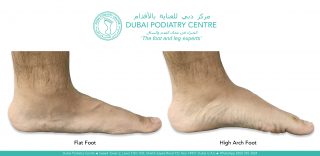
 

Side-by-side comparison of two feet showing different arch types; the right image labeled “High Arch Foot” displays a pronounced upward curve in the midfoot, with the heel and ball of the foot bearing most of the weight, leaving a visible gap under the arch.


When this area begins to collapse:

  • The forefoot structure loses stability
  • The fat pad that normally cushions the bones can migrate forward toward the toes
  • The toes may begin to retract, often described as resembling a bird gripping a branch
  • The patient can feel as though they are walking directly on bone

Why Corns Are More Common in High-Arched Feet

Unlike flat feet, which tend to spread pressure more evenly, high-arched feet concentrate pressure into specific points.

With limited ground contact, the load is primarily taken by the heel and the forefoot. If even one metatarsal head drops slightly, it becomes a focal point of excessive pressure.

This is why high-arched feet are at a much greater risk of developing:

  • Corns
  • Callus
  • Localised pain under the forefoot
  • Stress-related injuries to the bones

Flat feet, by comparison, often do not develop corns as frequently because there are fewer isolated pressure points.

The Role of Orthotic Therapy

A common misconception is that a high-arched foot should be flattened. This is not the goal.

Instead, the correct approach is to bring the ground up to the foot.

This is achieved through custom orthotic therapy. A gypsum cast is taken of the foot in a non-weight-bearing position, capturing the foot at its natural, fully elevated arch height.

From this, an orthotic is created that:

  • Matches the exact structure of the individual foot
  • Supports the arch without forcing it down
  • Distributes weight evenly from the heel to the forefoot
  • Reduces high-pressure points
  • Relieves tensile stress on ligaments
  • Helps prevent corns and stress fractures

Why This Matters

Without proper support, a high-arched foot continues to absorb pressure unevenly. Over time, this can lead to chronic pain, recurrent corns, and structural strain.

By supporting the foot in its natural shape, orthotic therapy allows for controlled, even weight transfer and significantly reduces the risk of long-term damage.


For more information or to book an appointment please call our clinic +971 4 3435390 or WhatsApp +971 50 3553024


Thank goodness for corns on your feet – and here’s why.

It may sound strange, but a corn is actually a sign that your body is trying to protect you.

The body’s first job is always to protect the skin, the tissues underneath, and even the bone. When there is too much pressure or friction on one area of the foot, the body responds by building up a layer of hard skin. If that pressure continues, the hard skin thickens further and becomes a callus. If the pressure becomes even more concentrated over a small area, the body can then form a dense plug of keratin, which we call a corn.

A corn is made of almost pure keratin, similar to the material in a fingernail or toenail, but formed as a small plug. It often has the shape of an upside-down diamond, pointing inward, which is why it can become so painful to walk on.

Although corns are uncomfortable, they are actually part of the body’s natural defence system. They act like a protective plug, helping to prevent deeper tissue damage and protecting the area from excessive pressure that could otherwise lead to skin breakdown.


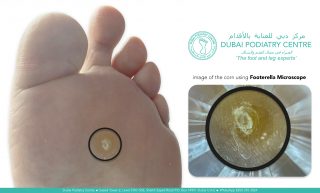
Image showing the bottom of a foot with a small corn circled, alongside a magnified view of the corn under a microscope

This is especially important because when the body cannot produce this protective hard skin response, it may be a sign of an underlying problem. Some people do not develop enough protective hyperkeratinisation, which is the medical term for thickened hard skin. Others may have neuropathy, where sensation is reduced, so the body does not properly detect the ongoing pressure or friction. In these cases, the skin may break down instead of defending itself, which is one reason why neuropathic ulcers and diabetic wounds can develop on the feet.

So in many ways, hard skin, callus, and corns are not the enemy. They are the body’s attempt to shield itself.

Calluses work in the same way elsewhere in the body. For example, weightlifters and athletes often develop calluses on their hands. These are not a bad thing. They are protective. If you peel them away aggressively, the skin underneath may become sore, raw, or even bleed. The same principle applies to the feet.

The problem is that simply removing a corn or callus does not solve the cause. As fast as it is removed, it often returns within days or weeks unless the underlying pressure is properly addressed.

That is why corns keep coming back.

To prevent a corn long term, the pressure has to be redistributed. This may involve:

  • relieving pressure from a dropped metatarsal bone beneath the foot
  • correcting foot function with orthotics
  • lifting and redistributing load away from overloaded areas
  • wearing wider footwear so the toes are not being squeezed
  • avoiding shoes that are too narrow across the forefoot or small toes

For example, a corn under the foot may be caused by excess pressure from a prominent bone. A corn on the side or top of a toe is often caused by tight footwear rubbing repeatedly against the skin.

So yes, a corn may be painful, but it is also your body’s way of defending itself. The alternative can be much worse.

If you have a corn, the answer is not just to keep having it removed every month. The real solution is to find out why it is there in the first place and correct the underlying cause.

Corns are not the cureless problem. Repeated pressure is.

If you have a painful corn, visit a podiatrist to identify the cause and treat it properly. Addressing the underlying issue is the long-term cure.


For more information or to book an appointment please call our clinic +971 4 3435390 or WhatsApp +971 50 3553024


#Corns #FootCorns #Callus #Calluses #HardSkin #Hyperkeratosis #FootConditions


Copyright Dubai Podiatry 2026. All rights reserved.

WhatsApp us