
fbpx

Please wait...


BLOG

No more posts

A big toenail that becomes white, lifted or separated along one side is often assumed to have a fungal infection. However, not every separated toenail is fungal.

In some patients, the underlying problem is mechanical and begins much further up the foot, at the alignment of the subtalar joint and ankle.

What causes the nail to separate?

When the foot pronates excessively, the subtalar joint and ankle lean inwards and the hallux, or big toe, can begin to internally rotate.

At the same time, the soft tissues and fibrofatty padding beneath the hallux are displaced laterally, towards the second toe.

Instead of remaining directly underneath the big toe, these tissues repeatedly move and press against the structures beneath and around the nail plate during standing and walking.

With thousands of steps each day, this repetitive movement can create an up-and-down and side-to-side mechanical force beneath the nail.

Over time, the nail plate can gradually be pulled away from the nail bed underneath. This produces a characteristic curved or U-shaped area of separation, particularly along the lateral border of the hallux nail.

This type of nail separation is known as onycholysis, but importantly, onycholysis describes the separation itself. It does not tell us what caused it.


An interesting left-versus-right comparison

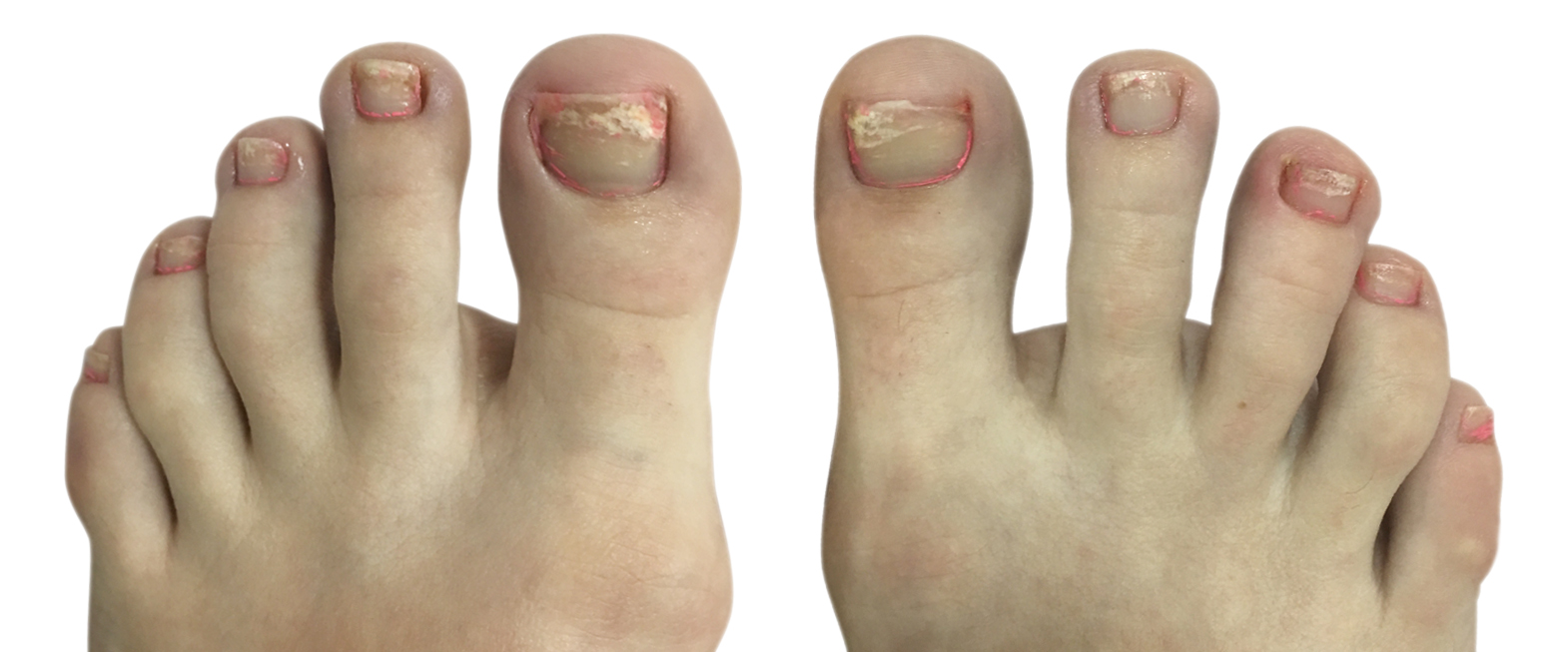
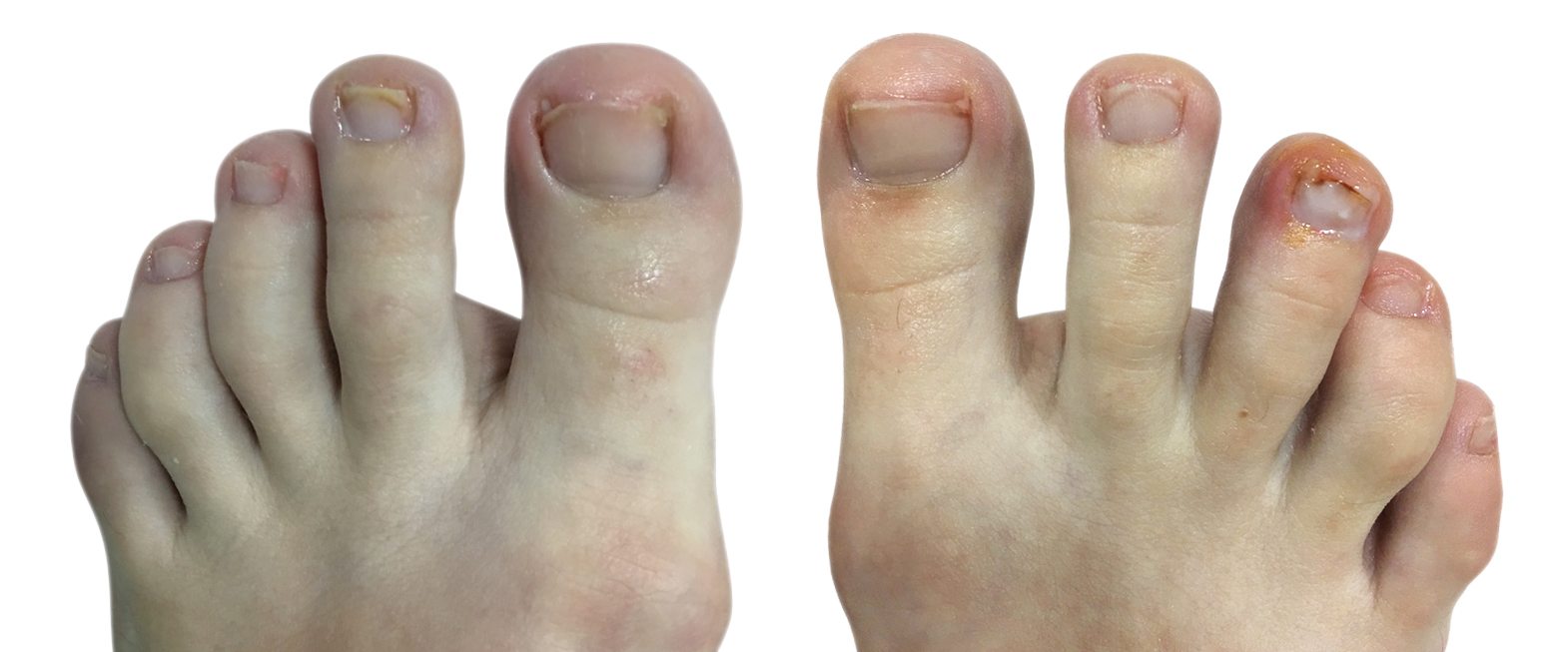
This photographic example of the toes and feet provides an excellent example because the severity of the nail changes is different between the two feet.

On the left foot, the ankle/subtalar joint pronates approximately 30 degrees, and the lateral separation of the hallux nail plate is considerably greater.

On the right foot, the subtalar joint pronates approximately 12 degrees, and the lateral nail separation is noticeably less extensive.

The asymmetry is clinically interesting because the foot demonstrating the greater degree of pronation also demonstrates the greater degree of nail separation.

Rather than examining the toenail in isolation, we therefore need to examine what is happening to the whole foot, ankle and hallux during weight-bearing and walking.


Why can this be mistaken for fungal nail disease?

When air gets underneath a separated nail plate, the nail can appear white, yellowish or opaque. Debris may also accumulate beneath the separated portion.

Visually, this can resemble a fungal toenail.

However, treating a mechanically separated nail with antifungal treatment alone does not correct the forces repeatedly acting upon the nail.

Where fungal infection is suspected, appropriate clinical assessment and, when indicated, laboratory testing can help distinguish fungal nail disease from other causes of nail dystrophy and onycholysis.


The relationship with ankle alignment

In our clinical observations at Dubai Podiatry Centre, we frequently begin to see secondary foot and nail changes as subtalar joint pronation increases.

When inward deviation becomes more pronounced, mechanical stress upon the hallux can increase. With greater degrees of pronation, we may see progressively wider and deeper lateral nail separation together with increasing rotation or displacement of the hallux.

At very significant degrees of pronation, other structural changes, including hallux valgus, may also coexist.

These degree measurements should not be interpreted as universal diagnostic thresholds. Every patient is assessed individually because foot structure, joint mobility, footwear, activity, gait and other medical or dermatological factors can also influence the appearance of the toenail.

Treatment must address the cause, not simply the nail

If the separation is predominantly mechanical, our objective is to reduce the abnormal forces acting upon the hallux long enough for a healthier nail to grow forward while remaining attached to the nail bed.


Depending upon the individual assessment, treatment may include:

  • Corrective orthotics designed to improve subtalar joint alignment and reduce excessive pronation
  • Toe socks to encourage the toes to remain separated and in a more neutral position
  • Silicone toe liners or separators between the toes where appropriate to assist alignment
  • Footwear with an accommodating toe box, including suitable barefoot-style footwear where clinically appropriate, so that the toes are not compressed or displaced by the shoe

The important principle is consistency.

If a corrective device is worn for only one hour each day but the foot spends the remaining weight-bearing hours returning to its previous position, the mechanical forces responsible for the problem continue.

The objective is to maintain improved foot and toe alignment for as much of the patient’s weight-bearing day as reasonably possible.


How long does the nail take to recover?

Toenails grow slowly.

The recovery period therefore depends partly upon how far backwards the existing separation extends. The damaged portion cannot simply be pushed back onto the nail bed. Instead, we need to reduce the causative mechanical stress and allow healthier nail to gradually grow forward.

For some patients, visible improvement may occur over several months. A mechanically separated area may require approximately four to six months or longer to grow forward sufficiently, depending upon the depth of separation, individual nail-growth rate and how effectively the underlying mechanical problem is controlled.

Look beyond the toenail

A separated toenail does not always mean a fungal toenail.

Sometimes the toenail is simply showing us the end result of a biomechanical problem occurring elsewhere in the foot.

By examining the nail together with the hallux position, plantar soft tissues, subtalar joint, ankle alignment, gait and footwear, we can investigate why the nail is separating rather than treating its appearance alone.

Michelle Duffy Champlin
B.Sc. (Podiatry), M.Ch.S., S.R.Ch. (UK)
Chief Podiatrist
Dubai Podiatry Centre


For more information or to book an appointment please call our clinic +971 4 3435390 or WhatsApp +971 50 3553024


Most people think of toenails as purely cosmetic, but in reality, toenails serve an important protective function.

A good way to understand this is to think of a bicycle helmet or a hard hat. Just as a helmet protects your skull from impact, your toenail protects the small bone at the end of your toe, known as the distal phalanx.

This bone is surprisingly fragile and is located in a high-risk area of the body. The toes are frequently exposed to trauma, including objects falling, stubbing, sports injuries, or repeated pressure from footwear. The toenail acts as a rigid protective shield, absorbing and dispersing force away from the bone underneath.

The shape of the toenail is crucial. Rather than transmitting force directly downward, its curved structure helps spread impact sideways into the surrounding fibro fatty padding at the sides and underneath the toe. This load distribution significantly reduces the risk of fractures and crush injuries to the distal phalanx.


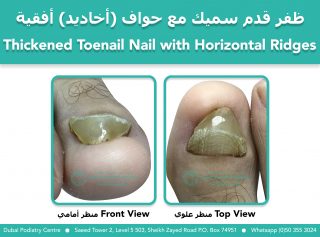
Close-up views of a thickened toenail with horizontal ridges, shown from the front and above


Why Do Toenails Become Thickened or Ridged?

Toenails are highly responsive to trauma. When the nail root, also known as the matrix, senses repeated stress or impact, it adapts by producing thicker nail material as a protective response.

Mild Repetitive Trauma

  • Horizontal ridges or lines across the nail
  • Gradual thickening over time
  • Often caused by tight shoes, sports footwear, or work shoes

Single Significant Trauma

If you stub your toe hard or hit it against a wall, you may notice a horizontal ridge appearing several months later. This ridge represents a short period where the nail temporarily grew thicker to protect itself. Once the trauma stops, nail growth usually returns to normal.


When Thickened Toenails Signal a Footwear Problem

If one toenail, especially the big toenail or fifth toenail, becomes thick while the others remain normal, this often points to daily repetitive trauma rather than infection.

Common causes include:

  • Shoes that are too tight or too narrow in the toe box
  • Almond shaped or pointed shoes worn by people with square or broad forefeet
  • Ill fitting work or safety shoes

With correct footwear, toenail thickness often begins to normalise. However, because toenails grow slowly, it can take around six months before you visibly see healthier nail growth from the root.


Sports, Slippage, and Toenail Damage

Even well fitting shoes can cause nail trauma if the foot slides forward inside the shoe.

This is common in:

  • Tennis
  • Padel
  • Squash
  • Badminton
  • Downhill walking or hiking

Repeated forward movement increases pressure on the nail, sometimes leading to bruising beneath it. In more severe cases, blood may collect under the nail, known as a subungual haematoma.

If the trauma is strong enough, the nail may shed naturally after two to three months as a new nail grows underneath. Treatment is usually unnecessary unless the nail becomes painful, there are signs of infection, or the old nail fails to detach properly.

In these cases, a podiatrist can safely assist with nail removal and aftercare.

Tip. Cushioned sports or hiking socks with extra padding in the toe box can significantly reduce impact and prevent nail damage.


Curved and Involuted Toenails

Some toenails thicken not because of footwear, but because of their shape.

A healthy toenail resembles an upside down dinner plate.
Problem nails may resemble an upside down dinner bowl, curving excessively at the sides.

When a nail is too wide for the toe, it embeds into the surrounding skin, growth in length becomes restricted, and the nail thickens instead. Increased thickness causes more curvature, and more curvature causes more pressure. This vicious cycle often results in a very thick, involuted toenail.

In these cases, nail bracing alone is often ineffective unless the nail is aggressively thinned. The most reliable solution is a medial and lateral partial nail avulsion with phenolisation, often followed by a total nail avulsion. This allows a new, flatter nail of the correct width to grow back.


Toenail Trauma from Toe Hyperextension

Another overlooked cause of toenail thickening or separation is hyperextension of the toe.

When walking or running, the heel strikes the ground and the big toe lifts excessively upward. The nail repeatedly hits the roof of the shoe. This can happen even when shoe size is correct.

While taping or splinting may limit movement, it often leads to tendon strain or tendonitis because the muscle force remains strong.

In most cases, the safest approach is to allow natural toe movement and protect the nail with thick cushioned socks, particularly in the toe box.

Diabetic socks, hiking socks, and specialist padded sports socks are often very effective.


When to See a Podiatrist

You should seek professional assessment if a toenail continues to thicken despite correct footwear, one nail looks significantly different from the others, the nail is painful, curved, or repeatedly bruising, or a nail has detached or is not shedding normally.

Early assessment can prevent long term nail deformity and unnecessary procedures.


For more information or to book an appointment please call our clinic +971 4 3435390 or WhatsApp +971 50 3553024
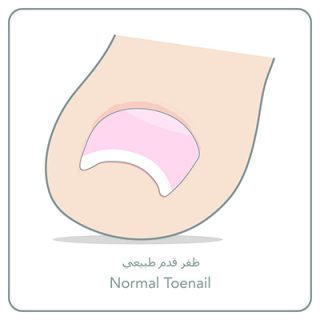


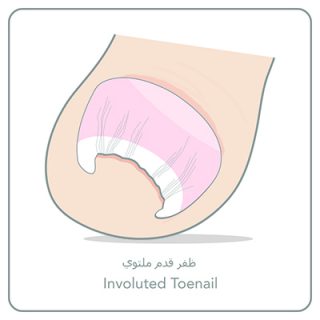
In another diagram, these are common examples of the different types of toenails we see in our clinic. 

في هذا الرسم التوضيحي، هذه هي الأمثلة الشائعة عن الأنواع المختلفة من أظافر القدم التي نراها في عيادتنا


Illustration of a normally shaped toenail with an even curve and suitable width for the toe


Firstly, this is the regular nail where the width is just right and it sits at the correct curvature on to the toe.

أوّلًا، هذا هو الظفر الطبيعي حيث يكون العرض متناسقًا ويتواجد الظفر عند الإنحناء الصحيح على إصبع القدم 


Illustration of a toenail with sides that curve inward and pinch the surrounding skin


Then, this other example of an involuted toenail is in the beginning stages of ‘pinching’. In the other diagram shows the advanced stage of the involuted toenail where it has pinched so much it has separated through the middle channel.

ثمّ هذا المثال الآخر لظفر القدم الملتوي في المرحلة الأولى من”الضغط”. في الرسم التوضيحي الآخر تظهر المرحلة المتقدّمة من ظفر القدم الملتوي حيث ضغط كثيرًا وانفصل عبر القناة الوسطى


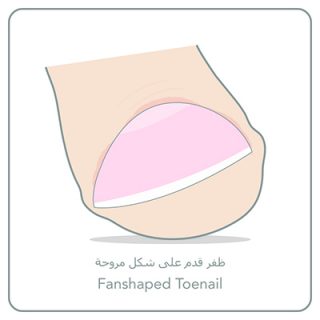
Illustration of a fan-shaped toenail that is wider at the tip than the toe


Next, there is an example of a fan-shaped nail is where the nail is far too wide for the actual toe. When one of these sides collapses it separates and causes a channel of separation which is shown in this other diagram. 

بعد ذلك، هذا المثال عن الظفر على شكل مروحة حيث يكون الظفر عريضًا جدًّا بالنسبة لإصبع القدم الفعلي

عندما يهبط أحد جانبي الظفر، ينفصل الظفر ويسبب ظهور قناة فاصلة تظهر في هذا الرسم التوضيحي


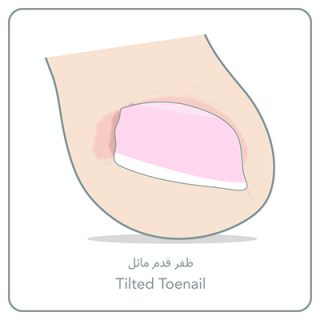
Illustration of a toenail tilted across the toe, with mild redness along one side


Finally, the last example of a tilted toenail starts off slight inflammation on this side due to the toe being tilted inwards. It can also eventually lead to separation of the nail plate here. 

أخيرًا، المثل الأخير عن ظفر القدم الملتوي ، يبدأ بالتهاب طفيف من هذه الجهة بسبب ميل إصبع القدم الى الداخل. ويمكن أن يؤدّي أيضًا في النهاية الى فصل الصفيحة الظفرية هنا


Whenever there is a separation of a nail plate from the skin it can lead to a fungal infection in that warm, moist environment.

انفصال الصفيحة الظفرية عن الجلد، يمكن أن يؤدي الى حدوث عدوى فطرية في تلك البيئة الدافئة والرطبة


For more information or to book an appointment please call our clinic +971 4 3435390 or WhatsApp +971 50 3553024 
للمزيد من المعلومات أو لحجز موعد يرجى الإتصال بعيادتنا على الرقم  ٠٠٩٧١٤٣٤٣٥٣٩٠ أو التواصل عبر الواتساب على الرقم  ٠٠٩٧١٥٠٣٥٥٣٠٢٤    


If you want to know more about different kinds of nails you can read here


Can Nail Polish Cause Toenail Fungus? What to Know About White Toenail Changes

Nail polish can make your toenails look neat, but wearing it for long periods may hide changes in the nail. If you notice white patches, cracking, thickening or crumbling after removing polish, avoid covering the area again until you know what is causing it.

White or chalky marks can be a sign of a fungal nail infection, also known as toenail fungus or onychomycosis. However, nail damage, staining and other conditions can look similar, so it’s best not to self-diagnose.

What should you do if you notice changes?

Remove the polish and arrange an assessment with a podiatrist. They can examine the nail and, if needed, take a sample to help confirm whether fungus is present. Depending on the findings, they may carefully reduce loose or damaged nail and recommend a suitable treatment, such as an antifungal nail lacquer.

Toenails grow slowly, so treating a fungal nail infection takes patience and consistent care. Professional nail care may improve the nail’s appearance, but clearing an infection and seeing healthy nail grow back usually takes time.

If you notice a change in your toenail, don’t simply cover it with more polish. A podiatrist can help identify the cause and guide you towards the right care.


Copyright Dubai Podiatry 2026. All rights reserved.

WhatsApp us