

fbpx

Please wait...


BLOG

No more posts

Not all flat feet are a problem. In fact, many people who believe they have flat feet have perfectly normal, healthy feet that require no treatment whatsoever.

At Dubai Podiatry Centre, one of the most important parts of assessing flat feet is understanding why the arch appears low.

There are several different types of flat feet, and the treatment, if any is required, depends on the structure, flexibility and alignment of the foot and ankle.

1. Some Feet Are Naturally Flat and Perfectly Healthy

Feet come in many different shapes and structures.

Some people naturally have high arches, while others have lower arches. Both can be completely normal.

One particularly interesting difference is the amount of natural fibrofatty padding underneath the foot.

The Importance of Natural Foot Padding

The sole of the foot contains specialised fibrofatty tissue that cushions the bones and helps absorb pressure when we stand and walk.

The amount and distribution of this padding varies between individuals, influenced by genetics, age and other factors.

Some people have generous natural padding underneath their feet, making the arch appear lower than it actually is.

Others have less visible soft tissue padding, making their feet look more bony and highly arched.

A well padded foot may therefore look flat even when the underlying arch structure is perfectly normal.

This is not necessarily related to obesity, and it does not mean the foot requires correction.

In fact, natural plantar cushioning can be particularly beneficial as we get older, when loss or displacement of the protective fat pads may cause discomfort beneath the bones of the feet.

The important message is simple: a foot that looks flat is not necessarily a structurally flat foot.

2. How Do We Know Whether a Foot Is Really Flat?

At Dubai Podiatry Centre, we examine the foot in several positions.

We look at the foot when the patient is sitting, standing and rising onto their tiptoes.

We assess three important factors:

Arch formation: Is there a well formed medial arch when the foot is not bearing weight?

Flexibility: Does the arch reappear when the patient stands on tiptoes, and can the foot be repositioned comfortably?

Ankle alignment: Does the ankle or heel lean inwards when the patient stands?

These observations help distinguish a naturally low arch, a flexible flat foot and a rigid flat foot.
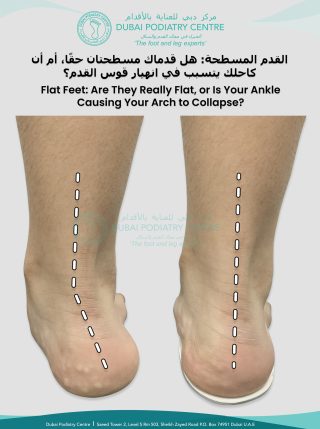
Rear view comparing ankle and heel alignment, illustrating how inward ankle lean can contribute to a lowered foot arch3. The Hyperpronated Foot: When the Ankle Collapses Inwards

One of the common patterns we assess is excessive pronation, also known as hyperpronation.

This is particularly interesting because the patient may have a beautifully formed arch when sitting.

However, when they stand, the arch lowers significantly.

Why Does This Happen?

When the foot bears weight, the heel may tilt outwards and the ankle region may appear to lean inwards.

This movement is often accompanied by lowering of the medial longitudinal arch.

In other words, the arch is present when the foot is unloaded, but it becomes much flatter when the patient stands.

This is a flexible flatfoot pattern associated with excessive pronation.

Pronation is a normal and necessary movement during walking. It becomes clinically relevant when the amount or timing of movement contributes to symptoms, instability or excessive mechanical loading.

Not every hyperpronated foot requires treatment. We consider the patient’s symptoms, age, mobility, function and overall alignment before recommending intervention.

4. What About Ligamentous Laxity?

Some people have naturally more flexible ligaments and joints.

This is known as ligamentous laxity or joint hypermobility.

In these individuals, the arches may lower more easily during standing.

We may also observe increased movement elsewhere in the body, such as hyperextension of the knees, increased flexibility of the ankles, greater movement through the hips and pelvis, and generalised joint hypermobility.

Ligamentous laxity can contribute to flexible flat feet, although it is not present in every patient with low arches.

A full assessment helps us understand whether the flexibility is normal for that individual or is contributing to pain and instability.

5. Flexible Flat Feet Versus Rigid Flat Feet

This is one of the most important distinctions when assessing foot structure.

Flexible Flat Feet

A flexible flat foot typically has an arch when sitting or when the foot is not bearing weight.

When standing, the arch lowers.

When the patient rises onto their tiptoes, the arch may reappear.

The foot can usually be repositioned without significant restriction.

Where excessive pronation is contributing to symptoms or functional problems, corrective orthotic therapy may be considered.

Rigid Flat Feet

A rigid flat foot remains flat even when the foot is not bearing weight.

The arch does not reappear normally when the patient rises onto their tiptoes, and the foot may have restricted movement.

Possible causes include arthritis affecting the joints of the foot, structural changes to the bones or joints, tarsal coalition, long standing deformity and advanced adult acquired flatfoot deformity.

Rigid flat feet require careful assessment. Imaging or specialist referral may be necessary, particularly when pain, progressive deformity or restricted movement is present.

6. Corrective Orthotics: Supporting a Flexible Foot in Better Alignment

At Dubai Podiatry Centre, we distinguish between two important categories of custom made orthotics: corrective and accommodative.

They are not the same, and they serve different purposes.

Corrective orthotics are designed to influence the position and mechanics of a flexible foot and ankle.

For example, a patient may have a well formed arch when sitting, but the arch lowers excessively when standing because of hyperpronation.

When clinically appropriate, a corrective orthotic can be designed using the foot’s non weightbearing shape and its assessed alignment.

The orthotic is then manufactured with specific contours and posting angles intended to improve support and influence how the foot and ankle function during weightbearing.

How Corrective Orthotic Therapy Works

At Dubai Podiatry Centre, our approach includes:

1. Examining the patient’s foot and ankle alignment
2. Assessing the shape of the foot without weightbearing
3. Determining how much of the pronation is flexible and correctable
4. Designing a custom orthotic with the appropriate arch support and alignment features
5. Introducing the orthotic gradually, according to the patient’s tolerance and treatment plan
6. Monitoring comfort, symptoms and foot function over time

The aim is to reduce excessive mechanical loading and improve functional alignment.

Corrective orthotics are individualised and may require adjustments as the patient’s symptoms, footwear, activity or foot mechanics change.

However, wearing corrective orthotics does not necessarily permanently reshape the foot or ankle. Their principal mechanical effect occurs while they are being worn.

7. Accommodative Orthotics: Supporting the Foot Without Forcing Correction

Accommodative orthotics are also custom made, but they have a different purpose.

Rather than attempting to reposition a foot into a new alignment, they are designed to fit and support its existing structure.

These orthotics are particularly useful when the foot cannot comfortably be moved into a neutral position.

Examples include rigid flat feet, arthritic feet with restricted joint movement, structural bone or joint deformities, feet with painful pressure points and certain complex or sensitive foot conditions.

An accommodative orthotic can distribute pressure more evenly, provide cushioning and support the foot in a comfortable position.

It does not attempt to force a rigid or arthritic foot into an alignment that the joints cannot achieve.

These orthotics may be used for many years, although they require periodic assessment and replacement as materials wear or the patient’s needs change.
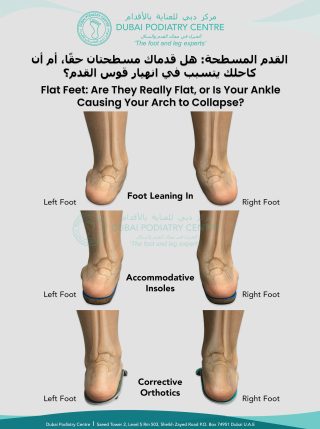
Foot alignment comparison showing inward leaning feet and examples of accommodative and corrective orthotics8. Corrective Versus Accommodative Orthotics: What Is the Difference?

Corrective Orthotics

Corrective orthotics are designed to influence foot and ankle mechanics.

They are commonly used for selected flexible deformities and may include specific alignment angles and posting.

They often require progressive adjustment and monitoring.

Their aim is to improve functional alignment during wear.

Accommodative Orthotics

Accommodative orthotics are designed to support the existing foot shape.

They are commonly used for rigid or painful deformities and focus on cushioning, pressure distribution and comfort.

They are often used as longer term supportive devices.

Their aim is to reduce pressure without forcing realignment.

Both types can be custom made. Both are valuable. But they are designed for different clinical purposes.

The term custom made orthotics alone does not tell you whether a device is corrective or accommodative.

It is important to understand what the orthotic has been designed to achieve.

9. Do All Flat Feet Need Orthotics?

Absolutely not.

A naturally low arch that is comfortable, stable and functioning normally may need no treatment at all.

Likewise, many children have flexible flat feet as part of normal development, and most painless flexible flat feet in children do not require orthotic correction.

Orthotic therapy is considered when there is a clinical reason to intervene, such as pain, fatigue, instability, excessive mechanical loading or functional limitations.

The decision should be based on a proper examination rather than the appearance of the arch alone.

10. How Can You Check Your Feet at Home?

There are a few simple observations you can make.

Step 1: Sit down and look at your arches

Can you see an arch along the inside of your foot?

Step 2: Stand up and look again

Does the arch become significantly lower when you place weight on your feet?

Step 3: Rise gently onto your tiptoes while holding a stable support

Does the arch reappear?

Step 4: Look at your heel alignment

Does the heel appear to tilt outwards, with the ankle region leaning inwards?

These observations may help identify a flexible flatfoot pattern, but they cannot provide a diagnosis on their own.

If your flat feet are painful, becoming progressively flatter, noticeably different between the two sides or associated with stiffness, arrange a professional assessment.

Our Advice at Dubai Podiatry Centre

The most important thing to understand is that flat feet are not automatically abnormal.

Some feet simply have generous natural padding. Some have naturally low arches. Others have flexible arches that lower during standing because of excessive pronation.

A smaller number have rigid structural deformities that require a different approach.

At Dubai Podiatry Centre, we assess the structure and function of the foot and ankle before deciding whether treatment is necessary.

Our aim is not to give every patient a higher arch. It is to understand the individual foot, identify any mechanical problems and recommend the most appropriate treatment.

A healthy foot does not have to look highly arched. It needs to function comfortably and effectively.

Dubai Podiatry Centre

Specialist Foot and Ankle Biomechanical Assessment

www.dubaipodiatry.com

This article is for general educational purposes and does not replace an individual podiatric assessment.


For more information or to book an appointment please call our clinic +971 4 3435390 or WhatsApp +971 50 3553024


Children’s foot and ankle development is extremely important. One of the main causes of suspected flat feet in children is not always a truly flat foot, but extreme hyperpronation of the subtalar joint. This causes the ankles to lean inwards and the arch to collapse when the child is standing.

تُعدّ مرحلة تطوّر القدم والكاحل لدى الأطفال أمرًا بالغ الأهمية. ومن أبرز أسباب الاشتباه بوجود القدم المسطّحة لدى الأطفال ليس دائمًا تسطّحًا حقيقيًا في القدم، بل قد يكون نتيجة فرط الانقلاب الداخلي (Hyperpronation) في المفصل تحت الكاحل (Subtalar Joint). وهذا يؤدي إلى ميلان الكاحلين إلى الداخل وانهيار قوس القدم عند وقوف الطفل.


During periods of rapid growth, children can have a high level of growth hormone over a short period of time. This can make the ligaments very soft and stretchy, almost like chewing gum. The ligaments on the inside of the ankle help hold the subtalar joint in a neutral position. When these ligaments become too soft, the talus bone can lean inwards, causing the ankle to roll in and the arch to flatten.

خلال فترات النمو السريع، قد ترتفع مستويات هرمون النمو لدى الأطفال خلال فترة زمنية قصيرة، مما يجعل الأربطة لينة ومطاطية جدًا، أشبه بالعلكة. تساعد الأربطة الموجودة في الجهة الداخلية من الكاحل على تثبيت المفصل تحت الكاحل في وضعٍ محايد. وعندما تصبح هذه الأربطة رخوة أكثر من اللازم، قد يميل عظم الكاحل (Talus) إلى الداخل، مما يؤدي إلى انحراف الكاحل للداخل وتسطيح قوس القدم.


An accommodative insole that simply supports the arch may help the foot feel more supported, but it is not always enough to correct the ankle alignment. To improve the position of the foot and ankle, the subtalar joint needs to be brought back towards neutral using very specific corrective angles.

إن النعال التكيُّفية التي تدعم القوس فقط قد تعطي شعورًا أفضل بالدعم، لكنها غالبًا لا تكون كافية لتصحيح محاذاة الكاحل. ولتحسين وضعية القدم والكاحل، يجب إعادة المفصل تحت الكاحل إلى وضعه المحايد باستخدام زوايا تصحيحية دقيقة جدًا.


For example, if the subtalar joint pronates by 30 degrees, the orthotic correction must be designed to address that degree of movement. If the ankle is not corrected and only the arch is supported, the foot may continue to appear flat when standing.

فعلى سبيل المثال، إذا كان المفصل تحت الكاحل ينحرف بمقدار 30 درجة، فيجب تصميم الدعامة التقويمية بحيث تعالج هذه الدرجة من الانحراف. وإذا لم يتم تصحيح الكاحل وتم الاكتفاء بدعم القوس فقط، فقد تبدو القدم مسطّحة عند الوقوف.


This is why it is essential to assess the child’s foot and ankle alignment while they are standing. When a child is sitting, the foot may look well arched and the ankle may return to a neutral position. However, once the child stands and body weight passes through the feet, the subtalar joint may hyperpronate, the ankle may lean inwards, and the arch may collapse.

لهذا السبب، من الضروري تقييم محاذاة القدم والكاحل لدى الطفل أثناء الوقوف. فعند جلوس الطفل، قد تبدو القدم ذات قوس طبيعي ويعود الكاحل إلى وضعه المحايد. ولكن عند الوقوف ومرور وزن الجسم عبر القدمين، قد يحدث فرط الانقلاب في المفصل تحت الكاحل، ويميل الكاحل إلى الداخل، وينهار القوس.


Corrective orthotics are therefore measured and designed specifically for each child, often with different angles for the left and right foot. This helps improve foot and ankle alignment and can also assist in balancing leg length differences caused by uneven pronation.

لذلك، يتم قياس وتصميم الدعامات التقويمية التصحيحية بشكل خاص لكل طفل، وغالبًا بزوايا مختلفة لكل قدم. وهذا يساعد على تحسين محاذاة القدم والكاحل، كما يمكن أن يساهم في موازنة اختلاف طول الساق الناتج عن عدم تساوي الانقلاب.


Accommodative orthotics are often used in very young children to support the foot and help train the arch. However, in children diagnosed with flat feet due to subtalar joint hyperpronation, corrective orthotics with specific wedging are usually required to bring the ankle into a better aligned position.

تُستخدم الدعامات التكيُّفية غالبًا مع الأطفال الصغار جدًا لدعم القدم والمساعدة في تدريب القوس. أما في الحالات التي يتم فيها تشخيص القدم المسطّحة نتيجة فرط الانقلاب في المفصل تحت الكاحل، فعادةً ما تكون الدعامات التقويمية التصحيحية المزودة بزوايا وتعديلات محددة ضرورية لإعادة الكاحل إلى وضعية أكثر توازنًا.


For more information or to book an appointment please call our clinic +971 4 3435390 or WhatsApp +971 50 3553024


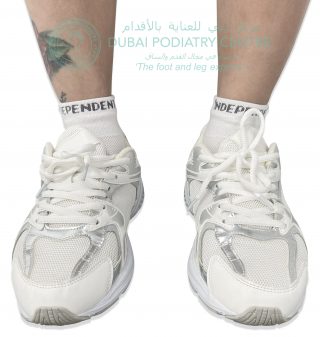
Have you ever wondered why the tongue of your shoe keeps slipping towards the outside of your foot?

Front view of feet in trainers with uneven shoe tongue position linked to hyperpronation and lower limb alignment issues

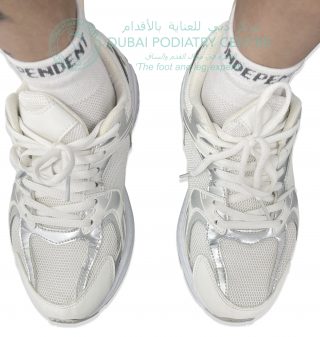
In many cases, the reason is not the shoe itself, but the way your foot and ankle are functioning. When the ankle rolls inwards, known as hyperpronation, it can create a twisting force inside the shoe.This repeated inward lean pushes the shoe tongue towards the outside, which is why you may find yourself constantly pulling it back into place.


Shoe manufacturers recognised this problem some time ago, which is why many modern shoes now have gusseted tongues attached to the upper. This helps keep the tongue centred, but it does not correct the underlying foot mechanics causing the shift.


A similar thing can happen with skinny jeans or tight leggings. Have you ever noticed the inner seam twisting around on one leg? This can happen because clothing is made symmetrically, but the body is often not. A leg length difference, pelvic tilt, or one foot rolling in more than the other can create rotational forces through the leg, causing seams to twist out of place.

So, whether it is the tongue of your shoe drifting sideways or the seam of your leggings twisting around your leg, these can both be signs of asymmetry in the lower body, often linked to foot and ankle alignment.


Top view of white trainers showing shoe tongue slipping outward due to foot alignment and possible hyperpronation

If you have noticed that the tongue of your shoe is always slipping to the outside, or that one trouser seam seems to keep twisting, it may be worth having your foot posture, ankle alignment, and leg lengths assessed by a podiatrist. Correcting the alignment with appropriate treatment, such as orthotic support where needed, can help improve the way forces travel through the feet and legs.


#ShoeTongue #ShoeTongueSlipping #FootAlignment #FootMechanics #Hyperpronation #Pronation #FootPosture #AnkleAlignment #LowerLimbAlignment

For more information or to book an appointment please call our clinic +971 4 3435390 or WhatsApp +971 50 3553024


Flat feet can cause changes with the legs in some cases.

In this first example, the ankles have leaned in and the arches have collapsed down.

This in turn makes it every difficult for the person to walk with straight feet.

So, they’ have moved their feet outwards and this is called abduction.

This also makes the knees point outwards and can creates issues with the hips.

In this next example, the arches have collapsed, the ankles are leaning in and it brings the knees in together. We call this ‘X’ legs.

In this one, one leg is straight, the other foot has a collapsed arch and an ankle leaning in.

This brings the knee in to touch the other.

So one leg is straight and the other is not, we call this a ‘K’ leg.

In all of these cases it is very import to put something under the feet, lift the arches and tilt the ankles back to straight.

This helps the ankle, knee and hip alignment back in to the perfect position.


قد تسبب القدم المسطحة تغيرات في الساقين في بعض الحالات.

في المثال الأول، يميل الكاحلان إلى الداخل ويهبط قوسا القدم.

وهذا يجعل المشي مع توجيه القدمين إلى الأمام أمرًا صعبًا للغاية.

لذلك، يوجّه الشخص قدميه إلى الخارج، ويُسمّى ذلك «إبعاد القدمين».

وقد يؤدي هذا أيضًا إلى توجيه الركبتين إلى الخارج، مما قد يسبب مشكلات في الوركين.

في المثال التالي، يهبط قوسا القدمين ويميل الكاحلان إلى الداخل، فتتقارب الركبتان. ويُسمّى ذلك «الساقين على شكل X».

في هذا المثال، إحدى الساقين مستقيمة، بينما قوس القدم الأخرى منخفض والكاحل يميل إلى الداخل.

وهذا يجعل إحدى الركبتين تقترب من الأخرى.

أي إن إحدى الساقين مستقيمة والأخرى ليست كذلك، ويُسمّى هذا «الساق على شكل K».

في جميع هذه الحالات، من المهم وضع دعامة تحت القدمين لرفع قوسي القدمين وإعادة الكاحلين إلى وضع مستقيم.

يساعد ذلك على تحسين محاذاة الكاحلين والركبتين والوركين وإعادتها إلى وضعية سليمة.

For more information or to book an appointment please call our clinic +971 4 3435390 or WhatsApp +971 50 3553024


Young children with flat feet.
.الأطفال الصغار بأقدام مسطحة

It is quite normal for babies and little children to have flat feet.
.من الطبيعي جدًا أن يكون لدى الرضع والأطفال الصغار أقدام مسطحة

They have extra fatty padding in the sole of their foot and as they grow a little bit older the fatty padding disperses.
.لديهم بطانة دهنية إضافية في باطن أقدامهم، وعندما يكبرون قليلاً تختفي البطانة الدهنية

However, if you think there is a problematic flat foot you might notice the child is walking with their feet turned outwards.
.ومع ذلك، إذا كنت تعتقد أن هناك مشكلة في القدم المسطحة، فقد تلاحظ أن الطفل يمشي وأقدامه متجهة إلى الخارج

When they are running you might notice their feet turned outwards and the legs are quite wide.
.عندما يركضون، قد تلاحظ أن أقدامهم متجهة إلى الخارج وأرجلهم واسعة جدًا

When they are standing they might have to stand with their feet quite wide apart with their feet turned outwards as well.
.عندما يقفون، قد يضطرون إلى الوقوف وأقدامهم متباعدة تمامًا مع توجيه أقدامهم إلى الخارج أيضًا

That type of flat foot requires treatment.
.هذا النوع من القدم المسطحة يتطلب العلاج

The treatment we would propose to do is put an insole inside the shoes that lifts the arches up and gets the ankles and the legs aligned.
.العلاج الذي نقترح القيام به هو وضع نعل داخل الحذاء يعمل على رفع الأقواس للأعلى ومحاذاة الكاحلين والساقين


For more information or to book an appointment please call our clinic +971 4 3435390 or WhatsApp +971 50 3553024

‎لمزيد من المعلومات أو لحجز موعد يرجى الإتصال بعيادتنا على الرقم : ٠٠٩٧١٤٣٤٣٥٣٩٠ أو التواصل على الواتساب على الرقم  ٠٠٩٧١٥٠٣٥٥٣٠٢٤


These are some of the effects that flat feet can have on a growing child.

When a child is very young, 2 years old, it is quite normal for them to have flat feet.

As the child grows to 4 years old, the arches of the feet normally develop quite nicely and they grow out of flat feet.

If you notice your young child is having difficulty walking, falling down too easily and they become tired, it could be because the ankles are leaning-in. This makes the feet look flat and that is very tiresome for the child.

Without treatment when the child gets to 10 years old you might notice the feet are even more flat, the feet turn outwards and they are beginning to get a slouched posture.


Illustration of a 2-year-old child with feet turned outward and a wide stance, highlighting delayed walking, frequent falls, and balance concerns Rear-view illustration of a 10-year-old child with feet turned outward, with captions noting possible difficulty running, jumping, and sprinting Rear-view illustration of a 16-year-old with outward-facing feet and a slouched posture, highlighting possible difficulty running


Without treatment the child grows to 16 years old and may have feet turned out even more with very flat feet and obvious slouched position when they standing and walking.

Treatment as young as possible involves putting an insole inside the child’s school shoes and sports shoes that help to lift the arches and align the ankles. The child will have better stability and ease when it’s come to running and doing sports.


For more information or to book an appointment please call our clinic +971 4 3435390 or WhatsApp +971 50 3553024


Copyright Dubai Podiatry 2026. All rights reserved.

WhatsApp us