
fbpx

Please wait...


BLOG

No more posts

Thank goodness for corns on your feet – and here’s why.

It may sound strange, but a corn is actually a sign that your body is trying to protect you.

The body’s first job is always to protect the skin, the tissues underneath, and even the bone. When there is too much pressure or friction on one area of the foot, the body responds by building up a layer of hard skin. If that pressure continues, the hard skin thickens further and becomes a callus. If the pressure becomes even more concentrated over a small area, the body can then form a dense plug of keratin, which we call a corn.

A corn is made of almost pure keratin, similar to the material in a fingernail or toenail, but formed as a small plug. It often has the shape of an upside-down diamond, pointing inward, which is why it can become so painful to walk on.

Although corns are uncomfortable, they are actually part of the body’s natural defence system. They act like a protective plug, helping to prevent deeper tissue damage and protecting the area from excessive pressure that could otherwise lead to skin breakdown.
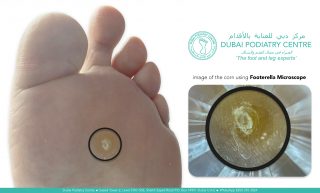
 

Image showing the bottom of a foot with a small corn circled, alongside a magnified view of the corn under a microscope

This is especially important because when the body cannot produce this protective hard skin response, it may be a sign of an underlying problem. Some people do not develop enough protective hyperkeratinisation, which is the medical term for thickened hard skin. Others may have neuropathy, where sensation is reduced, so the body does not properly detect the ongoing pressure or friction. In these cases, the skin may break down instead of defending itself, which is one reason why neuropathic ulcers and diabetic wounds can develop on the feet.

So in many ways, hard skin, callus, and corns are not the enemy. They are the body’s attempt to shield itself.

Calluses work in the same way elsewhere in the body. For example, weightlifters and athletes often develop calluses on their hands. These are not a bad thing. They are protective. If you peel them away aggressively, the skin underneath may become sore, raw, or even bleed. The same principle applies to the feet.

The problem is that simply removing a corn or callus does not solve the cause. As fast as it is removed, it often returns within days or weeks unless the underlying pressure is properly addressed.

That is why corns keep coming back.

To prevent a corn long term, the pressure has to be redistributed. This may involve:

  • relieving pressure from a dropped metatarsal bone beneath the foot
  • correcting foot function with orthotics
  • lifting and redistributing load away from overloaded areas
  • wearing wider footwear so the toes are not being squeezed
  • avoiding shoes that are too narrow across the forefoot or small toes

For example, a corn under the foot may be caused by excess pressure from a prominent bone. A corn on the side or top of a toe is often caused by tight footwear rubbing repeatedly against the skin.

So yes, a corn may be painful, but it is also your body’s way of defending itself. The alternative can be much worse.

If you have a corn, the answer is not just to keep having it removed every month. The real solution is to find out why it is there in the first place and correct the underlying cause.

Corns are not the cureless problem. Repeated pressure is.

If you have a painful corn, visit a podiatrist to identify the cause and treat it properly. Addressing the underlying issue is the long-term cure.


For more information or to book an appointment please call our clinic +971 4 3435390 or WhatsApp +971 50 3553024


#Corns #FootCorns #Callus #Calluses #HardSkin #Hyperkeratosis #FootConditions
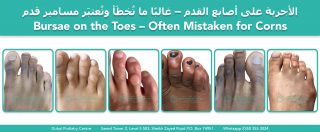


Bursae on the Toes – Often Mistaken for Corns

By Michelle Champlin, Chief Podiatrist – Dubai Podiatry Centre


Bursae on the toes are very commonly mistaken for corns, yet they are entirely different conditions. A corn is a thickened plug of hard skin that forms due to pressure or friction. A bursa, however, is a fluid-filled sac that the body creates as a protective cushion over irritated tissues, particularly around tendons and bones.


Infographic titled “Bursae on the Toes – Often Mistaken for Corns,” with six close-up photos showing raised or thickened areas on the toes that can resemble corns


Why Bursae Develop on the Toes

When the toes begin to retract or claw, the tendons that run from the front of the leg over the top of the foot must bend sharply across the toe joints. These tendons are responsible for gripping movements of the toes. As they move back and forth over bony areas, friction develops.


To protect the tendons from fraying or tearing, the body creates a small jelly-like sac—the bursa. This is the body’s built-in defense mechanism, acting as a cushion to prevent tendon injury.


Bursae most commonly develop on the tops of the smaller toes, especially over the knuckles where shoes rub, or on the side of the fifth toe if footwear is tight.


Common Causes of Toe Bursae

Toe bursae can develop from several biomechanical or lifestyle factors, including:

  • Collapsed transverse arch under the forefoot, causing the toes to retract upward.
  • High-arched feet (pes cavus), which naturally draw the toes back.
  • Tight socks, stockings, or tights that pull on the toes.
  • Ill-fitting footwear, especially narrow shoes that compress the little toe.
  • Occupations such as cabin crew, where long hours in fitted shoes are common with stocking abandons that pull and retract the toes into a bent and clawed position.


Over time, bursae may become inflamed or form a callus or corn over the area, making them easy to misdiagnose.


Treatment and Long-Term Correction

Successful treatment focuses on correcting the underlying biomechanics, not just reducing the bursa itself.

  • Orthotic therapy – Custom orthotics lift the transverse arch, rebalance the foot, and straighten the toes.
  • Toe socks and toe stockings – Designed to keep toes straight and prevent retraction.
  • Silicone toe separators or toe aligners – Used to realign the toes and relieve pressure.
  • Accommodative footwear – Properly fitted shoes with space for toe movement.
  • Foot strapping or taping – Sometimes applied to support alignment during the corrective phase.


With this combination, bursae typically settle within four to six months, once the mechanical irritation is removed.


Why Steroid Injections Are Rarely Recommended

While a steroid injection can theoretically reduce a bursa quickly, it carries a serious risk: the tendon can become brittle and lose its natural elasticity. This can lead to long-term damage and even tendon rupture.

Therefore, conservative correction, similar to wearing braces for teeth, is preferred for the best long-term results.


Key Takeaway

A bursa is not a bad thing, it’s the body’s way of protecting tendons from damage. However, when it develops on the toes, it signals an underlying mechanical imbalance that should be corrected.

Through orthotic therapy, toe alignment, and proper footwear, bursae can be resolved safely and naturally, preventing future tendon injury and keeping your feet comfortable for the long term.


For more information or to book an appointment please call our clinic +971 4 3435390 or WhatsApp +971 50 3553024


It is quite common for children to intoe.

There are three main reasons why they can do it.

In this case the intoeing is coming from the hips.

So the hips are internally rotated and the entire leg is turning in.

This second case is coming only from the feet, so the feet only are turning in.

In the last case is where the ankles are leaning outwards and that is turning the feet.

This is from the ankles, this is from the foot and this is from the hips.

There are a few other reasons why the child can intoe as well but these are the three main types that we see here in the clinic.

Each one of these requires a different type of insole inside the shoe.

The insole inside the shoe in all three cases are very different to each other even if the intoeing all looks similar to an outsider.

So this is why it is very important to come in and have the podiatrist check which type of intoeing the child has.


For more information or to book an appointment please call our clinic +971 4 3435390 or WhatsApp +971 50 3553024


Flat feet can cause changes with the legs in some cases.

In this first example, the ankles have leaned in and the arches have collapsed down.

This in turn makes it every difficult for the person to walk with straight feet.

So, they’ have moved their feet outwards and this is called abduction.

This also makes the knees point outwards and can creates issues with the hips.

In this next example, the arches have collapsed, the ankles are leaning in and it brings the knees in together. We call this ‘X’ legs.

In this one, one leg is straight, the other foot has a collapsed arch and an ankle leaning in.

This brings the knee in to touch the other.

So one leg is straight and the other is not, we call this a ‘K’ leg.

In all of these cases it is very import to put something under the feet, lift the arches and tilt the ankles back to straight.

This helps the ankle, knee and hip alignment back in to the perfect position.


قد تسبب القدم المسطحة تغيرات في الساقين في بعض الحالات.

في المثال الأول، يميل الكاحلان إلى الداخل ويهبط قوسا القدم.

وهذا يجعل المشي مع توجيه القدمين إلى الأمام أمرًا صعبًا للغاية.

لذلك، يوجّه الشخص قدميه إلى الخارج، ويُسمّى ذلك «إبعاد القدمين».

وقد يؤدي هذا أيضًا إلى توجيه الركبتين إلى الخارج، مما قد يسبب مشكلات في الوركين.

في المثال التالي، يهبط قوسا القدمين ويميل الكاحلان إلى الداخل، فتتقارب الركبتان. ويُسمّى ذلك «الساقين على شكل X».

في هذا المثال، إحدى الساقين مستقيمة، بينما قوس القدم الأخرى منخفض والكاحل يميل إلى الداخل.

وهذا يجعل إحدى الركبتين تقترب من الأخرى.

أي إن إحدى الساقين مستقيمة والأخرى ليست كذلك، ويُسمّى هذا «الساق على شكل K».

في جميع هذه الحالات، من المهم وضع دعامة تحت القدمين لرفع قوسي القدمين وإعادة الكاحلين إلى وضع مستقيم.

يساعد ذلك على تحسين محاذاة الكاحلين والركبتين والوركين وإعادتها إلى وضعية سليمة.

For more information or to book an appointment please call our clinic +971 4 3435390 or WhatsApp +971 50 3553024


‏For children with flat feet we were discussing putting something inside their sports shoes and school shoes that helps to align their feet and ankles.

بالنسبة للأطفال ذوي الأقدام المسطحة، نوصي بوضع شيء داخل أحذيتهم الرياضية والمدرسية ليساعد على  محاذاة القدمين والكاحلين

‏This is what we would put inside this girls shoes. It lifts the arch and tilts the ankle back to straight again.

هذا هو ما سنقوم بوضعه داخل حذاء الفتاة. يرفع القوس ويعيد الكاحل إلى الوضع المستقيم

‏And inside the school shoes we have coloured matched it so you don’t see anything inside the school shoes.

أمّا بالنسبة إلى أحذية المدرسة، فقد قمنا بتنسيق اللون لضمان عدم ظهورها من داخل الحذاء

‏And when we remove it you can see again that we are lifting the arch and tilting the foot so we can get the ankle and foot back to a straight position.

عندما نقوم بإزالته، ترى كيف قمنا برفع القوس وإمالة القدم، مما ساعد في إعادة الكاحل والقدم إلى وضع مستقيم.

‏This helps to grow greater confidence and faster running without the chance of falling down.

يساعد ذلك على إعادة الثقة وإمكانية الركض بسرعة أكبر دون خطر السقوط


For more information or to book an appointment please call our clinic +971 4 3435390 or WhatsApp +971 50 3553024


Copyright Dubai Podiatry 2026. All rights reserved.

WhatsApp us