Hard skin under one big toe is more than the other and it’s splitting like paper cuts.
When hard skin keeps coming back, look at why the skin is protecting itself
A common complaint we hear from patients is:
“I constantly get hard skin underneath my big toe. It splits and feels like little paper cuts. I use foot cream, file it and have the callus removed during pedicures, but it always comes back.”
When callus repeatedly develops in exactly the same place, simply removing the hard skin may not address the reason it is forming.
Callus is often the skin’s response to repeated pressure, shear and friction. The location and pattern of the callus can therefore provide useful clues about how forces are travelling through the foot.
A patient with painful, splitting callus
In this particular case, the patient had recurring hard skin underneath her big toe which frequently split, producing a painful sensation similar to paper cuts.
She had tried creams, regular filing and intensive callus removal at pedicure salons, but the problem continued to return.
She also had areas of callus beneath the ball of the foot, particularly underneath the second metatarsal head, as well as callus and a corn around the fifth metatarsal head.
She had also noticed that her feet seemed to be becoming broader.
What was particularly interesting was the difference between her two feet.
The left foot had only a relatively mild amount of hard skin underneath the big toe and forefoot.
The right foot showed considerably more.
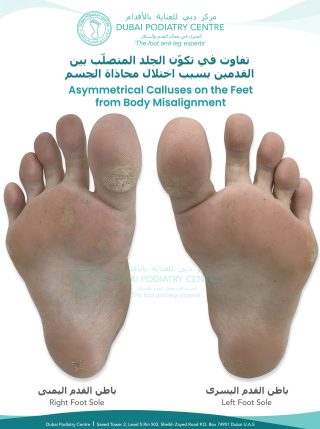
Why was one foot worse than the other?
When we see a significant difference between the right and left feet, we don’t just examine the skin.
We look higher up the body.
In this patient’s assessment, we identified a leg-length discrepancy associated with pelvic asymmetry. Her right side demonstrated a pelvic tilt and altered lower-limb position, with the right foot abducting as she walked.
Instead of progressing straight over the big toe, she was repeatedly rolling across the side of it.
This created increased pressure and shear around the plantar and side of the big toe and first metatarsal region.
The skin was therefore repeatedly being subjected to mechanical stress in the same location.
Removing the callus could make the skin temporarily smoother, but it did not remove the forces that were causing it to develop.
The callus in the middle of the foot told us something different
Not every area of callus on this patient’s foot had the same mechanical explanation.
She also had callus underneath the second metatarsal head and around the fifth metatarsal head.
During her examination, this corresponded with changes in the shape and loading of her forefoot and a reduction in the normal transverse arch across the front of the foot.
As the forefoot spreads and its loading pattern changes, individual metatarsal heads can become more prominent beneath the foot.
The second metatarsal head is a particularly common area of increased plantar pressure.
Between the metatarsal bones and the ground lies an important layer of specialised fibrofatty tissue that helps cushion the foot.
When excessive pressure and shear repeatedly occur over a prominent metatarsal head, the skin may respond by producing additional keratin.
This is what we recognise as callus.
A more concentrated area of pressure can produce a corn.
Callus isn’t necessarily the problem. It can be a clue.
This is an important distinction.
Callus is not simply “dead skin that needs to be removed”
Its distribution can act almost like a map of pressure across the foot.
A podiatrist will therefore look at questions such as:
- Is the callus symmetrical between the two feet?
- Is it underneath a particular metatarsal head?
- Is it underneath or along one side of the big toe?
- Is there a corn in the centre of the callus?
- Has the forefoot become broader?
- Is one arch lower than the other?
- Does one foot pronate more than the other?
- Is one leg functionally or structurally longer?
- Is there pelvic asymmetry?
- Is the patient’s walking pattern creating excessive pressure or shear?
The position of the callus can help us understand what may be happening mechanically above it.
Why do some calluses crack and feel like paper cuts?
When callus becomes thick, it is less flexible than normal skin.
Every time the toe bends, twists or pushes against the ground, that thickened skin is subjected to movement and shear.
Eventually tiny fissures can develop.
These cracks can feel surprisingly painful, sometimes exactly like a paper cut.
Applying moisturiser may improve the flexibility and condition of the skin, and careful reduction of excessive callus can provide considerable relief.
However, if abnormal pressure and shear remain, the skin may continue to rebuild the callus.
That is why some patients find themselves in a cycle:
Callus forms → callus is filed or removed → skin feels better → the same mechanical forces continue → callus returns
What about people with diabetes or neuropathy?
This is particularly important in patients who have reduced sensation in their feet.
A person with neuropathy may not feel excessive pressure, rubbing, a blister or a developing wound normally.
Callus can itself be an important warning sign of repetitive high pressure, and in a neuropathic foot, areas beneath callus may be at increased risk of tissue breakdown and ulceration.
For this reason, recurrent callus in a person with diabetes, neuropathy or reduced circulation should not simply be aggressively filed or treated with corn-removing acids without appropriate professional assessment.
Why we examine the whole body
At Dubai Podiatry Centre, when we see a recurrent pattern of callus, particularly when one foot is significantly worse than the other, we don’t only look at the piece of hard skin.
We assess the biomechanics producing the pressure.
This can include examining:
Pelvis → hips → knees → ankles → subtalar joints → arches → forefoot → toes
Human bodies are naturally asymmetrical. Small differences are extremely common and do not necessarily cause problems.
It is when that asymmetry produces excessive or repetitive loading that symptoms can begin to appear.
In this patient’s case, the difference between the right and left callus patterns was an important clue.
Why the right and left orthotics may be different
If biomechanical assessment indicates that orthotic therapy is appropriate, the objective is not simply to put identical arch supports underneath both feet.
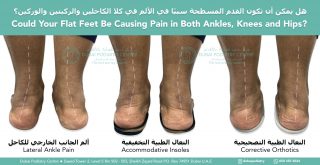
The two sides of the body may require different corrections.
For example, one orthotic may require a different thickness, inclination or degree of support from the other. The medial arch support may differ, and the forefoot or transverse arch may require different accommodation or correction.
The prescription is based on the individual patient’s examination.
The aim is to redistribute plantar pressure and improve lower-limb and foot mechanics so that the skin is no longer repeatedly exposed to the same excessive forces.
How long does it take for the callus to stop returning?
Skin does not necessarily change immediately when biomechanics are altered.
Even after the source of excessive pressure has been reduced, the skin may continue producing protective keratin for some time.
In clinical practice, we may see the callus pattern gradually reduce over the following months as pressure and shear are better controlled. For some patients, noticeable changes may occur over approximately four to six months, although this varies considerably according to the individual, their footwear, activity, skin condition and underlying biomechanics.
The important point is that we are not simply asking:
“How do we remove this hard skin?”
We are asking:
“Why does this particular piece of skin keep needing to protect itself?”
Once we understand that, we can work on the underlying mechanical cause as well as treating the skin itself.
The takeaway
Recurring callus can be more than a cosmetic problem.
Its location, shape and whether it is symmetrical between the two feet can provide valuable information about pressure, friction, foot structure and walking mechanics.
If the same callus keeps returning despite creams, filing and pedicures, it may be time to stop treating only the surface and investigate what is happening underneath it.
Dubai Podiatry Centre
Looking beyond the callus to understand why it formed.
For more information or to book an appointment please call our clinic +971 4 3435390 or WhatsApp +971 50 3553024