

fbpx

Please wait...


BLOG

No more posts

Are you experiencing foot pain, heel pain, arch pain, knee pain, or lower back pain? The underlying cause may be the way your feet are aligned. Flat feet (pes planus), overpronation (feet rolling inward), and supination (feet rolling outward) can affect your entire body, leading to discomfort, poor posture, and inefficient walking.

At Dubai Podiatry Centre, our experienced podiatrists specialize in diagnosing and treating flat feet, overpronation, and other biomechanical foot problems using advanced assessment techniques and custom-made orthotics.

Common Symptoms of Flat Feet and Overpronation

Poor foot alignment can contribute to:

  • Flat feet (fallen arches)
  • Heel pain
  • Plantar fasciitis
  • Arch pain
  • Corns and calluses
  • Bunions
  • Ankle instability
  • Knee pain
  • Hip pain
  • Lower back pain
  • Foot fatigue
  • Difficulty walking or standing for long periods
  • Sports and running injuries

Comprehensive Biomechanical Assessment

At Dubai Podiatry Centre, we perform a detailed biomechanical assessment to identify the cause of your symptoms. Your assessment may include:

  • Foot posture evaluation
  • Gait analysis (walking assessment)
  • Digital foot impressions
  • Foot alignment assessment
  • Lower limb biomechanics evaluation
  • Custom orthotic assessment

This allows us to accurately diagnose the source of your pain and recommend the most effective treatment.

How Custom Orthotics Help Flat Feet

Our custom orthotics (medical shoe insoles) are individually designed to support your feet and restore proper alignment. They can help:

  • Correct overpronation and excessive foot rolling
  • Support flat feet and fallen arches
  • Improve foot posture and body alignment
  • Redistribute pressure across the feet
  • Reduce heel, arch, knee, hip, and back pain
  • Improve walking, standing, and athletic performance
  • Prevent further foot and lower limb injuries

Unlike over-the-counter insoles, custom orthotics are made specifically for your feet, providing targeted support and long-term comfort.

Watch the Video

Watch our video to see how custom orthotics can immediately improve foot alignment by correcting excessive inward or outward foot movement. Proper foot support can reduce pain, improve balance, and help you move more comfortably every day.

If you have flat feet, overpronation, heel pain, or recurring foot discomfort, book a biomechanical assessment with the specialists at Dubai Podiatry Centre. Our expert podiatrists will determine whether custom orthotics are the right solution to improve your foot health and overall mobility.

For more information or to book an appointment please call our clinic +971 4 3435390 or WhatsApp +971 50 3553024
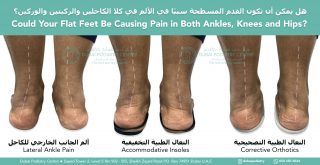


Illustration showing flat feet causing lateral ankle pain, knee pain and hip pain, comparing accommodative insoles with corrective orthotics to improve lower limb alignment


Many people think flat feet only cause tired or aching feet. However, the effects of flat feet often extend much further up the body. When the feet do not provide a stable foundation, the ankles, knees and hips must compensate, which can eventually lead to pain in multiple joints.

At Dubai Podiatry Centre, we frequently see patients whose symptoms begin in the feet but gradually progress higher up the legs.

Flat Feet Affect More Than Just Your Feet

Your feet are the foundation of your body. Every step you take begins with the way your feet contact the ground.

In people with flat feet, the arches collapse more than they should during walking, causing the feet to roll inwards a movement known as overpronation.

As the feet roll inward, the rest of the leg follows.

This can lead to:

  • Increased inward rotation of the lower leg
  • Changes in knee alignment
  • Altered hip mechanics
  • Increased stress on muscles, tendons and joints

Rather than one isolated problem, it becomes a chain reaction affecting the entire lower limb.

Why Does the Outside of the Ankle Hurt?

Many people expect flat feet to cause pain on the inside of the ankle, but pain on the outside is actually very common.

As the foot collapses inward, the heel tilts and the structures on the outside of the ankle are forced to work harder to stabilise the foot.

This may place excessive strain on:

  • The peroneal tendons
  • The lateral ankle ligaments
  • The muscles that support balance during walking

Over time, these structures become overloaded, resulting in persistent pain on the outside of the ankles.

How Flat Feet Can Lead to Knee Pain

The feet and knees work together with every step.

When the feet overpronate excessively, the shin bone rotates inward. This alters the normal movement of the knee and increases stress across the joint.

Patients commonly experience:

  • Pain during walking
  • Discomfort when climbing stairs
  • Knee fatigue after standing for long periods
  • Gradually worsening symptoms with activity

If the underlying foot mechanics are not addressed, the knee continues to compensate with every step.

Why Hip Pain Often Develops

The inward rotation that begins at the foot doesn’t stop at the knee.

It continues into the hips, affecting the muscles that stabilise the pelvis and changing the way the hip joint functions.

This can lead to:

  • Hip muscle fatigue
  • Pain around the outside of the hips
  • Reduced walking endurance
  • Difficulty standing for prolonged periods

Many patients are surprised to discover that their hip pain may actually begin with poor foot alignment.

Not All Insoles Work the Same Way

Many patients tell us they have already tried insoles but still have pain.

This is because there are two very different types of insoles.

Accommodative insoles are designed to cushion the feet and improve comfort by redistributing pressure. They can be very helpful for reducing discomfort but do not significantly change foot alignment.

Corrective orthotics, on the other hand, are designed to control excessive foot movement, improve heel position and restore better lower limb alignment. By addressing the underlying biomechanics, they may reduce abnormal loading through the ankles, knees and hips.

The most appropriate option depends on a thorough biomechanical assessment and the specific cause of the patient’s symptoms.

Why a Biomechanical Assessment Is Important

Pain in multiple joints is often treated one area at a time. However, unless the underlying cause is identified, symptoms may continue to return.

A comprehensive biomechanical assessment allows the podiatrist to evaluate:

  • Foot posture
  • Walking pattern (gait)
  • Heel alignment
  • Lower limb biomechanics
  • Muscle function and joint movement

This helps determine whether abnormal foot mechanics are contributing to pain higher up the body.

Early Treatment Can Prevent Further Problems

Flat feet do not always require treatment. However, when they are causing pain in the ankles, knees or hips, early intervention can improve function and help prevent further joint overload.

Treatment may include:

  • A comprehensive biomechanical assessment
  • Custom corrective orthotics where clinically indicated
  • Footwear advice
  • Stretching and strengthening exercises
  • Ongoing monitoring to optimise lower limb alignment


If you have flat feet and are experiencing pain on the outside of both ankles, followed by aching knees and hips, the problem may not be isolated to each joint. Instead, your symptoms could be the result of altered foot mechanics affecting the entire lower limb.

Rather than simply treating the painful area, identifying and correcting the underlying cause can help improve movement, reduce abnormal stress and provide longer-term relief.

At Dubai Podiatry Centre, we assess the body as a connected system because healthy movement starts with a stable foundation.

For more information or to book an appointment please call our clinic +971 4 3435390 or WhatsApp +971 50 3553024
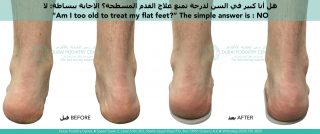


One of the most common questions patients ask at Dubai Podiatry Centre is:

“Am I too old to treat my flat feet?”

The simple answer is no.

Many people believe that flat feet can only be treated during childhood and that once you become an adult, nothing more can be done. Fortunately, this is one of the biggest misconceptions we hear in clinic.


Not Everyone Diagnosed with Flat Feet Actually Has Flat Feet

There are several different types of flat feet, but the most common condition we see is not a true flat foot at all.

In many cases, the ankle leans inwards, causing the arch to collapse under body weight. The arch then appears flat, even though the foot itself still has the ability to regain its natural shape once the ankle is correctly aligned.

Rather than thinking of the foot as permanently flat, it is often more accurate to think of it as an arch that has collapsed because the ankle is no longer supporting it correctly.


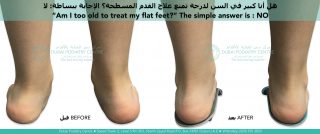
Adult flat feet before and after custom orthotics showing improved heel alignment and foot posture

Child with flat feet before and after podiatry treatment using custom orthotics showing corrected heel alignment


Adult Treatment Can Actually Be Faster

Many people are surprised when we explain that correcting this type of flat foot can actually progress faster in adults than in children.

Children have high levels of human growth hormone, which keeps their ligaments soft, flexible and easy to manipulate. This makes repositioning the bones relatively straightforward and usually very comfortable.

However, because the ligaments are constantly growing and remodelling, they often take longer to adapt and stabilise in their new position. For this reason, children commonly progress through each stage of treatment over approximately three to six months.

Adults are different.

Adult ligaments are firmer and less elastic, so there can be slightly more resistance when repositioning the foot. For this reason, we usually make smaller adjustments at each stage.

Once the bones have been repositioned, however, the adult foot often adapts surprisingly quickly. Instead of waiting three to six months between stages, many adults can progress every one to three months, allowing treatment to advance more rapidly.

Similar to Orthodontic Braces

A useful comparison is orthodontic braces for the teeth.

Most people understand that braces are not just for children. Adults successfully wear braces every day to gradually reposition their teeth into better alignment.

Corrective orthotics work on a similar principle.

Instead of moving teeth, they gently reposition the bones of the feet and ankles in carefully planned stages. As the alignment improves, the arch is supported more effectively and, in suitable cases, the foot can gradually regain a healthier arch shape.

Each new stage builds upon the previous one, allowing gradual correction rather than trying to make one large adjustment all at once.


It’s Never Too Late to Have an Assessment

If you have been told you have flat feet, it does not necessarily mean your feet are permanently flat.

The first step is determining why your arch has collapsed. For many patients, the underlying issue is ankle alignment rather than the shape of the foot itself.

With the correct diagnosis and a staged treatment plan, adults can often achieve significant improvements in foot alignment, comfort and function.

So if you’ve been wondering whether you’ve left it too late to treat your flat feet, the answer may be much more encouraging than you expected.

At Dubai Podiatry Centre, we regularly assess both children and adults and develop personalised treatment plans based on the specific cause of each patient’s foot alignment, because no two cases of flat feet are exactly the same.


For more information or to book an appointment please call our clinic +971 4 3435390 or WhatsApp +971 50 3553024


Plantar fasciitis is one of the most common causes of heel pain. People typically notice it when they take their first steps out of bed in the morning or when they stand after sitting for a prolonged period. The pain often eases after walking for a few minutes, only to return again after periods of rest.


What is the plantar fascia?

The plantar fascia is a strong band of connective tissue that runs from the heel bone (calcaneus) to the base of the toes. Its primary function is to help support the arch of the foot.

When you walk, run or land from a jump, the plantar fascia becomes tensioned, helping the arch maintain its shape and absorb forces. Without this support, the bones of the midfoot would be subjected to much greater mechanical stress.

A healthy plantar fascia is not designed to remain under constant tension. Instead, it should be relatively relaxed at rest and become taut only when required during movement and weight-bearing activities.


Why does plantar fasciitis develop?

The term plantar fasciitis literally means inflammation associated with the plantar fascia. Although the pain is felt in the heel, the discomfort is usually concentrated where the plantar fascia attaches to the heel bone.

Rather than viewing plantar fasciitis as simply an isolated heel problem, it is often more helpful to consider why the plantar fascia has become overloaded in the first place.

In many people, the ligaments and muscles of the foot provide enough stability to support the arch without excessive strain on the plantar fascia. However, if the alignment of the foot changes, the plantar fascia may remain under tension for much longer than it was designed to.

One of the most common contributing factors is excessive pronation of the foot and ankle. As the foot rolls inward, the plantar fascia may become progressively tensioned throughout standing and walking instead of only during the phases when it is normally required.

An easy way to understand the problem

Imagine holding a single strand of long hair with a heavy weight attached to the end.

The hair itself is not painful.

The pain would occur where the hair is anchored into the scalp because that attachment point is constantly being pulled.

Once the weight is removed, the strain at the attachment point disappears.

The plantar fascia behaves in a similar way. The discomfort usually develops where the fascia attaches into the heel bone rather than within the fascia itself. If excessive tension continues day after day, this attachment site can become irritated and painful.


Why is the pain worse in the morning?

Many people notice that the first few steps in the morning are the most painful.

After sleeping or sitting for a prolonged period, blood flow and tissue fluid movement slow down. When the foot is suddenly loaded, the already irritated attachment of the plantar fascia is placed under tension again, producing the characteristic sharp heel pain.

As you begin walking, the calf muscles act as a pump, improving circulation through the lower leg and foot. This often reduces discomfort temporarily, which explains why many people feel better after several minutes of walking.

Treating the cause—not just the symptoms

While heel cushions, supportive insoles and stretching programmes may provide symptom relief for some individuals, long-term improvement depends on identifying and correcting the mechanical cause of the overload.

If excessive pronation or another alignment abnormality is placing unnecessary tension on the plantar fascia, simply adding cushioning beneath the heel may not adequately address the underlying problem.

A corrective orthotic is designed to improve foot and ankle alignment rather than simply support the arch. Because every person walks differently, the correction required for the left foot is often different from that required for the right foot. The amount of correction should therefore be individually prescribed.

As the abnormal strain on the plantar fascia is reduced over time, the attachment at the heel is given the opportunity to recover, allowing symptoms to gradually settle while also addressing the underlying biomechanical problem that contributed to the condition.

The key message

Plantar fasciitis should not simply be viewed as inflammation of the heel. In many cases, it is the result of an underlying mechanical imbalance that places excessive and prolonged tension on the plantar fascia where it attaches to the heel bone.

Successful long-term treatment focuses on identifying the biomechanical cause, correcting the alignment of the foot and ankle, and reducing the abnormal forces responsible for the condition. By addressing the underlying mechanics rather than simply cushioning the symptoms, many patients can achieve lasting relief and reduce the likelihood of recurrence.


For more information or to book an appointment please call our clinic +971 4 3435390 or WhatsApp +971 50 3553024
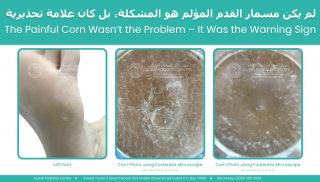


A patient attended our clinic today complaining of severe pain underneath the outside of his left foot. The pain had become so intense that he was limping and described the sensation as walking on a sharp piece of glass.

On examination, we found a hard corn underneath the fifth metatarsal head on the outside border of his left foot. Many people assume that a corn is the problem, but in reality a corn is often the body’s attempt to protect itself from excessive pressure.

We removed the corn painlessly, and the patient experienced immediate relief. However, we explained that unless we addressed the underlying cause, the corn would simply return.

To investigate further, we performed a 3D body scan and biomechanical assessment.

The results were fascinating.

The patient had a significant imbalance throughout his body. His left leg was functionally longer than his right. His pelvis was tilted, with the right side anteriorly tilted and the left side posteriorly tilted. He was carrying considerably more body weight through the left side of his body, creating excessive pressure beneath the outside of the left foot.

His medical history helped explain the pattern. He had previously undergone two lower back surgeries on the left side, suffered left hip problems, torn ACL injuries involving the left knee, and undergone left Achilles tendon surgery.

Over many years, his body had adapted to these injuries.

The scan showed that his pelvis had shifted towards the left side, causing increased loading through the left leg and foot. At the same time, his right foot was internally rotated and functioning almost like a golfer at the top of a backswing position. This created high tensile stress through the right Achilles tendon, the right knee, and the lower back while simultaneously increasing compression forces through the left side of the body.

The painful corn underneath the left foot was simply the area where the body was absorbing the greatest amount of pressure.

The development of a corn follows a predictable sequence.

First, the body produces a layer of hard skin to protect itself. This creates a broad plaque of callus, similar to a pancake of thicker skin.

If the pressure continues, the body creates a concentrated plug of dense keratin at the centre of the pressure point. Keratin is the same material found in toenails. This hard central core forms what we recognise as a hard corn.

As pressure continues to increase, inflammation develops beneath the area. Patients often describe burning, stinging, or sharp sensations. This was the stage our patient had reached.

If left untreated, the next stage can be the formation of a soft corn. The tissues become saturated with inflammatory fluid and appear white, rubbery, and extremely painful.

The final stage is tissue breakdown and ulceration.

This progression is particularly important in patients with diabetes, neuropathy, or vascular disease. These patients may not feel the early warning signs of pressure and pain. As a result, the protective stages can progress unnoticed until an ulcer develops.

Many patients believe ulcers appear suddenly and without warning. In reality, the body often gives multiple warning signals beforehand, but if sensation is reduced, those signals may not be recognised.

For this patient, the solution was not repeated corn removal.

The solution was correcting the forces causing the corn.

We prescribed custom corrective orthotics designed specifically for his individual biomechanics. The right orthotic was intentionally very different from the left because each side of the body required a different correction.

The aim was to improve pelvic balance, reduce the functional leg length discrepancy, redistribute pressure more evenly between both feet, and decrease excessive loading through the left foot.

We performed further scans with the orthotics in place and saw immediate improvements in alignment and pressure distribution.

The body can be compared to a wobbly table. If one table leg is shorter than the others, the tabletop becomes uneven. Placing a carefully measured support beneath the shorter leg restores balance.

Corrective orthotics work in a similar way. While we cannot make one leg physically grow longer, we can improve balance and alignment so that the body functions more efficiently and with less stress.

The patient will return in three months for reassessment. As the body adapts to improved alignment, muscle tension, posture, and weight distribution can all change. Repeat scanning will allow us to monitor these changes and determine whether further orthotic adjustments are required.

The important lesson from this case is that a corn is rarely just a skin problem.

A corn is often a warning sign that excessive pressure is travelling through a specific part of the foot. Removing the corn may provide temporary relief, but identifying and correcting the underlying mechanical cause is what provides a long-term solution.


For more information or to book an appointment please call our clinic +971 4 3435390 or WhatsApp +971 50 3553024
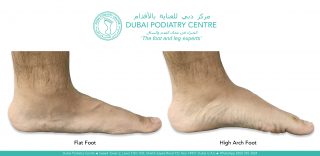


Flat feet are often blamed for foot problems, but very high-arched feet can be just as challenging, and in many cases, more problematic.

Both flat feet and high-arched feet have their advantages. A flatter foot distributes pressure more evenly across the ground, while a high-arched foot can be more rigid and efficient in propulsion. However, it is the structural differences between these two foot types that determine the kinds of problems that develop.

What Happens in a High-Arched Foot

A high-arched foot is naturally more rigid and elevated. While this may seem strong, it also means the foot has less ability to absorb shock.

Even a slight collapse of a high arch can create significant strain. This is because the ligaments that hold the bones in their precise anatomical position are suddenly placed under high tensile stress. These structures are not designed to stretch excessively, so even small changes can lead to discomfort and instability.

One of the most common areas affected is the forefoot arch, located just behind the toes. This arch runs across the foot from the big toe to the fifth toe.


Side-by-side comparison of two feet showing different arch types; the right image labeled “High Arch Foot” displays a pronounced upward curve in the midfoot, with the heel and ball of the foot bearing most of the weight, leaving a visible gap under the arch.


When this area begins to collapse:

  • The forefoot structure loses stability
  • The fat pad that normally cushions the bones can migrate forward toward the toes
  • The toes may begin to retract, often described as resembling a bird gripping a branch
  • The patient can feel as though they are walking directly on bone

Why Corns Are More Common in High-Arched Feet

Unlike flat feet, which tend to spread pressure more evenly, high-arched feet concentrate pressure into specific points.

With limited ground contact, the load is primarily taken by the heel and the forefoot. If even one metatarsal head drops slightly, it becomes a focal point of excessive pressure.

This is why high-arched feet are at a much greater risk of developing:

  • Corns
  • Callus
  • Localised pain under the forefoot
  • Stress-related injuries to the bones

Flat feet, by comparison, often do not develop corns as frequently because there are fewer isolated pressure points.

The Role of Orthotic Therapy

A common misconception is that a high-arched foot should be flattened. This is not the goal.

Instead, the correct approach is to bring the ground up to the foot.

This is achieved through custom orthotic therapy. A gypsum cast is taken of the foot in a non-weight-bearing position, capturing the foot at its natural, fully elevated arch height.

From this, an orthotic is created that:

  • Matches the exact structure of the individual foot
  • Supports the arch without forcing it down
  • Distributes weight evenly from the heel to the forefoot
  • Reduces high-pressure points
  • Relieves tensile stress on ligaments
  • Helps prevent corns and stress fractures

Why This Matters

Without proper support, a high-arched foot continues to absorb pressure unevenly. Over time, this can lead to chronic pain, recurrent corns, and structural strain.

By supporting the foot in its natural shape, orthotic therapy allows for controlled, even weight transfer and significantly reduces the risk of long-term damage.


For more information or to book an appointment please call our clinic +971 4 3435390 or WhatsApp +971 50 3553024



Why Plantar Fasciitis Isn’t Really About a “Tight” Fascia

By Michelle Champlin, Chief Podiatrist – Dubai Podiatry Centre

Plantar fasciitis is one of the most common and painful foot conditions we see in clinic. It causes sharp, stabbing heel pain—especially when getting out of bed in the morning or after sitting for a while. But the name plantar fasciitis can actually be misleading.


Understanding the Plantar Fascia

The plantar fascia is a thick, collagen-like band that runs from the heel bone to the toes. It acts like a suspension bridge to keep the foot’s arches intact and to stabilise every step you take.

Because the plantar fascia is made of densely woven collagen fibres, it’s extremely strong but not very stretchy. Many articles suggest “stretching” the fascia, but in truth, it doesn’t tighten—it becomes pulled taut when the foot’s structure begins to collapse.

Why It Happens

When you have healthy arches, the plantar fascia works quietly in the background to keep your foot stable. But when one or more of your foot’s three main arches—

  • the medial arch (inside edge of the foot),
  • the lateral arch (outer edge), or
  • the transverse arch (across the ball of the foot)—
  • start to flatten or your ankle leans inward or outward, the fascia is forced to work overtime.

That constant tension at its attachment into the heel bone causes tiny micro-tears in the outer casing of the bone, leading to inflammation and pain.

Why the Pain Comes and Goes

When you sit or sleep, inflammation builds up in the casing around the heel bone. The moment you stand up, pressure on that area causes intense pain. After walking a few minutes, your calf muscles begin to pump blood through the foot, draining the inflammation and easing the discomfort—until you sit again.

That’s why many people describe their first steps out of bed as agonising, but feel somewhat better once they “get moving.”


Who Gets Plantar Fasciitis—And Who Doesn’t

Interestingly, people with genuinely flat feet rarely get plantar fasciitis, because their fascia never needs to engage—it’s already at rest. The condition typically affects those whose arches are collapsing under load, not those whose arches are already fully flat.

The Real Solution: Structural Correction

Treating the heel pain directly—ice, massage, or anti-inflammatory creams—only addresses the symptom. The long-term solution is to correct the structure of the foot so that the fascia no longer has to overwork.

This might involve:

  • Custom orthotics to lift the medial and transverse arches
  • Supporting the ankle to stop it leaning in or out
  • Strengthening the calf and intrinsic foot muscles


Once the arches are properly supported, the fascia relaxes and the inflammation at the heel naturally subsides.


Healing Time: 12–14 Weeks

True healing takes time. The recovery process for plantar fasciitis typically spans 12 to 14 weeks.

You can imagine the heel bone where the plantar fascia attaches as a large window that has had a stone thrown at it, causing tiny micro-fractures across the glass.

  • During the first six weeks, the outer edges of the “window” begin to self-heal.
  • Over the next six weeks, the centre, or the “bull’s-eye” where the impact was greatest, gradually repairs.
  • The final two weeks allow for complete healing and realignment.

This is why genuine corrective orthotic therapy, which lifts and supports all three arches of the foot and stabilises the ankle, requires this full 12–14 week period—to give the plantar fascia the rest it needs for complete recovery.

A Helpful Analogy

Imagine the plantar fascia like a strong sticker on a wall. If you start to peel it off, some paint and plaster may come away, but the concrete beneath is still intact. That’s similar to what happens when the fascia pulls on the heel bone—micro-damage occurs, but the structure can heal once tension is reduced.

Another way to picture it: think of the heel bone as a ceiling with a hidden water bubble. When you sleep, fluid builds up in that bubble, and when you stand, it’s suddenly compressed—painful until movement drains it away.

In Summary

Plantar fasciitis isn’t simply inflammation of a “tight” band. It’s a structural response to stress in the foot’s architecture. Correct the mechanics, and the pain goes away naturally.

If you suffer from heel pain, especially first thing in the morning, book a biomechanical assessment with our podiatrists. By identifying which arch is collapsing, we can design a treatment that targets the cause—not just the symptom.


#PlantarFasciitis #HeelPain #HeelPainRelief #DubaiPodiatryCentre #FootPain #FlatFeet #ArchSupport #OrthoticsDubai #Podiatry #FootCare #Biomechanics #HealthyFeet #Footerella #PodiatristDubai #DubaiHealth


For more information or to book an appointment please call our clinic +971 4 3435390 or WhatsApp +971 50 3553024


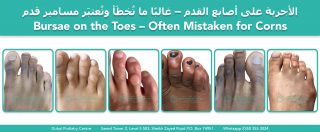
Bursae on the Toes – Often Mistaken for Corns

By Michelle Champlin, Chief Podiatrist – Dubai Podiatry Centre


Bursae on the toes are very commonly mistaken for corns, yet they are entirely different conditions. A corn is a thickened plug of hard skin that forms due to pressure or friction. A bursa, however, is a fluid-filled sac that the body creates as a protective cushion over irritated tissues, particularly around tendons and bones.


Infographic titled “Bursae on the Toes – Often Mistaken for Corns,” with six close-up photos showing raised or thickened areas on the toes that can resemble corns


Why Bursae Develop on the Toes

When the toes begin to retract or claw, the tendons that run from the front of the leg over the top of the foot must bend sharply across the toe joints. These tendons are responsible for gripping movements of the toes. As they move back and forth over bony areas, friction develops.


To protect the tendons from fraying or tearing, the body creates a small jelly-like sac—the bursa. This is the body’s built-in defense mechanism, acting as a cushion to prevent tendon injury.


Bursae most commonly develop on the tops of the smaller toes, especially over the knuckles where shoes rub, or on the side of the fifth toe if footwear is tight.


Common Causes of Toe Bursae

Toe bursae can develop from several biomechanical or lifestyle factors, including:

  • Collapsed transverse arch under the forefoot, causing the toes to retract upward.
  • High-arched feet (pes cavus), which naturally draw the toes back.
  • Tight socks, stockings, or tights that pull on the toes.
  • Ill-fitting footwear, especially narrow shoes that compress the little toe.
  • Occupations such as cabin crew, where long hours in fitted shoes are common with stocking abandons that pull and retract the toes into a bent and clawed position.


Over time, bursae may become inflamed or form a callus or corn over the area, making them easy to misdiagnose.


Treatment and Long-Term Correction

Successful treatment focuses on correcting the underlying biomechanics, not just reducing the bursa itself.

  • Orthotic therapy – Custom orthotics lift the transverse arch, rebalance the foot, and straighten the toes.
  • Toe socks and toe stockings – Designed to keep toes straight and prevent retraction.
  • Silicone toe separators or toe aligners – Used to realign the toes and relieve pressure.
  • Accommodative footwear – Properly fitted shoes with space for toe movement.
  • Foot strapping or taping – Sometimes applied to support alignment during the corrective phase.


With this combination, bursae typically settle within four to six months, once the mechanical irritation is removed.


Why Steroid Injections Are Rarely Recommended

While a steroid injection can theoretically reduce a bursa quickly, it carries a serious risk: the tendon can become brittle and lose its natural elasticity. This can lead to long-term damage and even tendon rupture.

Therefore, conservative correction, similar to wearing braces for teeth, is preferred for the best long-term results.


Key Takeaway

A bursa is not a bad thing, it’s the body’s way of protecting tendons from damage. However, when it develops on the toes, it signals an underlying mechanical imbalance that should be corrected.

Through orthotic therapy, toe alignment, and proper footwear, bursae can be resolved safely and naturally, preventing future tendon injury and keeping your feet comfortable for the long term.


For more information or to book an appointment please call our clinic +971 4 3435390 or WhatsApp +971 50 3553024

Copyright Dubai Podiatry 2026. All rights reserved.

WhatsApp us