

Not all flat feet are a problem. In fact, many people who believe they have flat feet have perfectly normal, healthy feet that require no treatment whatsoever.
At Dubai Podiatry Centre, one of the most important parts of assessing flat feet is understanding why the arch appears low.
There are several different types of flat feet, and the treatment, if any is required, depends on the structure, flexibility and alignment of the foot and ankle.
1. Some Feet Are Naturally Flat and Perfectly Healthy
Feet come in many different shapes and structures.
Some people naturally have high arches, while others have lower arches. Both can be completely normal.
One particularly interesting difference is the amount of natural fibrofatty padding underneath the foot.
The Importance of Natural Foot Padding
The sole of the foot contains specialised fibrofatty tissue that cushions the bones and helps absorb pressure when we stand and walk.
The amount and distribution of this padding varies between individuals, influenced by genetics, age and other factors.
Some people have generous natural padding underneath their feet, making the arch appear lower than it actually is.
Others have less visible soft tissue padding, making their feet look more bony and highly arched.
A well padded foot may therefore look flat even when the underlying arch structure is perfectly normal.
This is not necessarily related to obesity, and it does not mean the foot requires correction.
In fact, natural plantar cushioning can be particularly beneficial as we get older, when loss or displacement of the protective fat pads may cause discomfort beneath the bones of the feet.
The important message is simple: a foot that looks flat is not necessarily a structurally flat foot.
2. How Do We Know Whether a Foot Is Really Flat?
At Dubai Podiatry Centre, we examine the foot in several positions.
We look at the foot when the patient is sitting, standing and rising onto their tiptoes.
We assess three important factors:
Arch formation: Is there a well formed medial arch when the foot is not bearing weight?
Flexibility: Does the arch reappear when the patient stands on tiptoes, and can the foot be repositioned comfortably?
Ankle alignment: Does the ankle or heel lean inwards when the patient stands?
These observations help distinguish a naturally low arch, a flexible flat foot and a rigid flat foot.
 3. The Hyperpronated Foot: When the Ankle Collapses Inwards
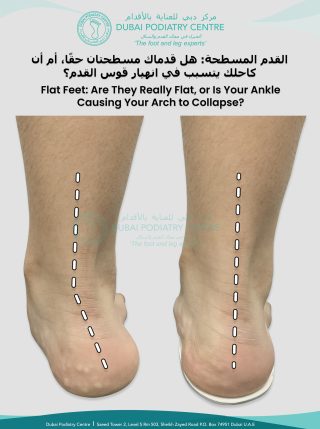
One of the common patterns we assess is excessive pronation, also known as hyperpronation.
This is particularly interesting because the patient may have a beautifully formed arch when sitting.
However, when they stand, the arch lowers significantly.
Why Does This Happen?
When the foot bears weight, the heel may tilt outwards and the ankle region may appear to lean inwards.
This movement is often accompanied by lowering of the medial longitudinal arch.
In other words, the arch is present when the foot is unloaded, but it becomes much flatter when the patient stands.
This is a flexible flatfoot pattern associated with excessive pronation.
Pronation is a normal and necessary movement during walking. It becomes clinically relevant when the amount or timing of movement contributes to symptoms, instability or excessive mechanical loading.
Not every hyperpronated foot requires treatment. We consider the patient’s symptoms, age, mobility, function and overall alignment before recommending intervention.
4. What About Ligamentous Laxity?
Some people have naturally more flexible ligaments and joints.
This is known as ligamentous laxity or joint hypermobility.
In these individuals, the arches may lower more easily during standing.
We may also observe increased movement elsewhere in the body, such as hyperextension of the knees, increased flexibility of the ankles, greater movement through the hips and pelvis, and generalised joint hypermobility.
Ligamentous laxity can contribute to flexible flat feet, although it is not present in every patient with low arches.
A full assessment helps us understand whether the flexibility is normal for that individual or is contributing to pain and instability.
5. Flexible Flat Feet Versus Rigid Flat Feet
This is one of the most important distinctions when assessing foot structure.
Flexible Flat Feet
A flexible flat foot typically has an arch when sitting or when the foot is not bearing weight.
When standing, the arch lowers.
When the patient rises onto their tiptoes, the arch may reappear.
The foot can usually be repositioned without significant restriction.
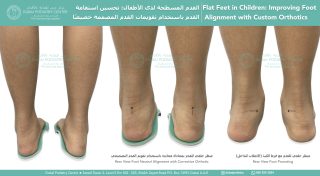
Where excessive pronation is contributing to symptoms or functional problems, corrective orthotic therapy may be considered.
Rigid Flat Feet
A rigid flat foot remains flat even when the foot is not bearing weight.
The arch does not reappear normally when the patient rises onto their tiptoes, and the foot may have restricted movement.
Possible causes include arthritis affecting the joints of the foot, structural changes to the bones or joints, tarsal coalition, long standing deformity and advanced adult acquired flatfoot deformity.
Rigid flat feet require careful assessment. Imaging or specialist referral may be necessary, particularly when pain, progressive deformity or restricted movement is present.
6. Corrective Orthotics: Supporting a Flexible Foot in Better Alignment
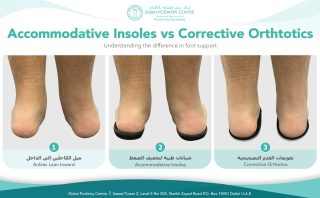
At Dubai Podiatry Centre, we distinguish between two important categories of custom made orthotics: corrective and accommodative.
They are not the same, and they serve different purposes.
Corrective orthotics are designed to influence the position and mechanics of a flexible foot and ankle.
For example, a patient may have a well formed arch when sitting, but the arch lowers excessively when standing because of hyperpronation.
When clinically appropriate, a corrective orthotic can be designed using the foot’s non weightbearing shape and its assessed alignment.
The orthotic is then manufactured with specific contours and posting angles intended to improve support and influence how the foot and ankle function during weightbearing.
How Corrective Orthotic Therapy Works
At Dubai Podiatry Centre, our approach includes:
1. Examining the patient’s foot and ankle alignment
2. Assessing the shape of the foot without weightbearing
3. Determining how much of the pronation is flexible and correctable
4. Designing a custom orthotic with the appropriate arch support and alignment features
5. Introducing the orthotic gradually, according to the patient’s tolerance and treatment plan
6. Monitoring comfort, symptoms and foot function over time
The aim is to reduce excessive mechanical loading and improve functional alignment.
Corrective orthotics are individualised and may require adjustments as the patient’s symptoms, footwear, activity or foot mechanics change.
However, wearing corrective orthotics does not necessarily permanently reshape the foot or ankle. Their principal mechanical effect occurs while they are being worn.
7. Accommodative Orthotics: Supporting the Foot Without Forcing Correction
Accommodative orthotics are also custom made, but they have a different purpose.
Rather than attempting to reposition a foot into a new alignment, they are designed to fit and support its existing structure.
These orthotics are particularly useful when the foot cannot comfortably be moved into a neutral position.
Examples include rigid flat feet, arthritic feet with restricted joint movement, structural bone or joint deformities, feet with painful pressure points and certain complex or sensitive foot conditions.
An accommodative orthotic can distribute pressure more evenly, provide cushioning and support the foot in a comfortable position.
It does not attempt to force a rigid or arthritic foot into an alignment that the joints cannot achieve.
These orthotics may be used for many years, although they require periodic assessment and replacement as materials wear or the patient’s needs change.
 8. Corrective Versus Accommodative Orthotics: What Is the Difference?
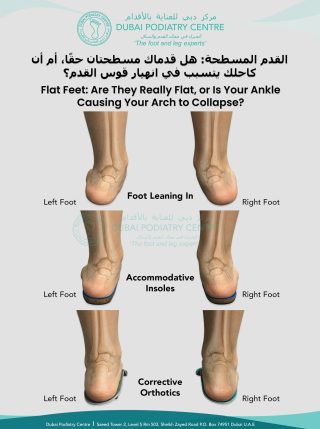
Corrective Orthotics
Corrective orthotics are designed to influence foot and ankle mechanics.
They are commonly used for selected flexible deformities and may include specific alignment angles and posting.
They often require progressive adjustment and monitoring.
Their aim is to improve functional alignment during wear.
Accommodative Orthotics
Accommodative orthotics are designed to support the existing foot shape.
They are commonly used for rigid or painful deformities and focus on cushioning, pressure distribution and comfort.
They are often used as longer term supportive devices.
Their aim is to reduce pressure without forcing realignment.
Both types can be custom made. Both are valuable. But they are designed for different clinical purposes.
The term custom made orthotics alone does not tell you whether a device is corrective or accommodative.
It is important to understand what the orthotic has been designed to achieve.
9. Do All Flat Feet Need Orthotics?
Absolutely not.
A naturally low arch that is comfortable, stable and functioning normally may need no treatment at all.
Likewise, many children have flexible flat feet as part of normal development, and most painless flexible flat feet in children do not require orthotic correction.
Orthotic therapy is considered when there is a clinical reason to intervene, such as pain, fatigue, instability, excessive mechanical loading or functional limitations.
The decision should be based on a proper examination rather than the appearance of the arch alone.
10. How Can You Check Your Feet at Home?
There are a few simple observations you can make.
Step 1: Sit down and look at your arches
Can you see an arch along the inside of your foot?
Step 2: Stand up and look again
Does the arch become significantly lower when you place weight on your feet?
Step 3: Rise gently onto your tiptoes while holding a stable support
Does the arch reappear?
Step 4: Look at your heel alignment
Does the heel appear to tilt outwards, with the ankle region leaning inwards?
These observations may help identify a flexible flatfoot pattern, but they cannot provide a diagnosis on their own.
If your flat feet are painful, becoming progressively flatter, noticeably different between the two sides or associated with stiffness, arrange a professional assessment.
Our Advice at Dubai Podiatry Centre
The most important thing to understand is that flat feet are not automatically abnormal.
Some feet simply have generous natural padding. Some have naturally low arches. Others have flexible arches that lower during standing because of excessive pronation.
A smaller number have rigid structural deformities that require a different approach.
At Dubai Podiatry Centre, we assess the structure and function of the foot and ankle before deciding whether treatment is necessary.
Our aim is not to give every patient a higher arch. It is to understand the individual foot, identify any mechanical problems and recommend the most appropriate treatment.
A healthy foot does not have to look highly arched. It needs to function comfortably and effectively.
Dubai Podiatry Centre
Specialist Foot and Ankle Biomechanical Assessment
www.dubaipodiatry.com
This article is for general educational purposes and does not replace an individual podiatric assessment.
For more information or to book an appointment please call our clinic +971 4 3435390 or WhatsApp +971 50 3553024