


Many people become frustrated when trying to treat a plantar wart. They may have tried over-the-counter salicylic acid, cryotherapy (freezing), or various home remedies, only to find that the wart stubbornly remains.
The reason is simple: not all warts behave in the same way.
Why Warts on the Feet Are Different
A wart on the back of the hand or another area of the body often appears as a small raised lump. This is because the skin in these areas is relatively thin and flexible, allowing the wart to grow outward.
The sole of the foot is completely different.
The skin on the bottom of the foot is much thicker and stronger because it is designed to withstand the pressure of standing and walking. Instead of growing outward, a plantar wart is compressed by body weight and becomes trapped beneath the thick outer layers of skin.
As a result, much of the wart lies within the skin rather than sitting prominently on top of it. This is why plantar warts often appear relatively flat while extending deeper into the skin layers.
Why Some Treatments Work Better on Hand Warts Than Plantar Warts
Because common warts on the hands are more exposed, superficial treatments such as:
- Salicylic acid
- Cryotherapy (liquid nitrogen freezing)
- Occlusion methods
can often work very well.
However, plantar warts are protected by the thick skin of the sole. Treatments that work primarily on the surface may struggle to reach the full extent of the infected tissue beneath.
This is one reason why treatment of plantar warts can be slower and sometimes less predictable than treatment of warts elsewhere on the body.
Our Approach at Dubai Podiatry Centre
At Dubai Podiatry Centre, our goal is to make the wart more accessible to the body’s natural healing mechanisms.
Rather than aggressively destroying tissue, we focus on improving the quality and softness of the overlying skin. As the thick layers gradually become softer and thinner, the body is better able to recognise and respond to the viral infection.
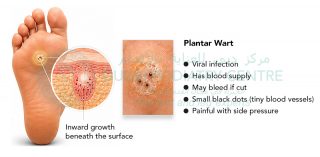
The tiny black dots often seen within a plantar wart are small blood vessels that have become altered by the wart tissue. These blood vessels are part of the body’s normal circulation and immune surveillance system.
Why We Use Vitamin A
Vitamin A helps regulate normal skin cell turnover and supports healthy skin function.
We recommend applying Vitamin A cream to the plantar wart each evening and covering it with a non-absorbent dressing overnight.
Treatment is usually continued for approximately three skin cycles.
A skin cycle lasts around 28 days, meaning treatment is typically continued for 12–14 weeks.
During this period, the thick overlying skin gradually softens and normalises, allowing the body’s immune system to recognise and clear the viral tissue more effectively.
Many patients notice significant improvement during this timeframe.
What Is Dermojet Treatment?
For stubborn or longstanding plantar warts, we often combine Vitamin A therapy with Dermojet treatment.
The Dermojet uses a high-pressure microjet of local anaesthetic delivered through an opening smaller than a conventional needle.
The medication passes through the skin and disperses within the deeper tissue layers without the need for a traditional injection.
This creates a controlled healing response within the affected tissue while avoiding significant damage to the skin surface.
As healing occurs, the body’s immune system is stimulated within the wart tissue, helping to clear the virus.
In our clinical experience, the combination of Vitamin A therapy and Dermojet treatment provides some of the most successful outcomes for difficult plantar warts.
Why We Do Not Routinely Cut Out Plantar Warts
Many people assume that simply cutting out a plantar wart would solve the problem.
Unfortunately, plantar warts often extend beyond what is visible on the surface.
To completely remove all affected tissue surgically, a large and deep section of skin may need to be excised.
On the sole of the foot, this can result in:
- Significant scar tissue formation
- Persistent discomfort when walking
- Hard callus formation
- Long-term pressure-related problems
For these reasons, surgical excision is generally not our preferred treatment option.
Why We Do Not Routinely Use Cryotherapy on the Sole of the Foot
Cryotherapy can be effective for some types of warts, particularly those located on thinner skin.
However, on the sole of the foot it often requires multiple treatments and can be quite painful.
In our experience, the success rate is often lower than patients expect, particularly for deeply embedded plantar warts.
We are also cautious when considering cryotherapy around the toes because freezing treatments affect local blood circulation and can occasionally cause unnecessary tissue injury.
Our Recommended Treatment Plan
For most plantar warts, we recommend:
1. Daily Vitamin A application.
2. Occlusion with a non-absorbent dressing overnight.
3. Treatment continued for approximately 12–14 weeks.
4. Dermojet therapy for persistent or resistant lesions.
By helping the skin return to a healthier state and stimulating the body’s natural healing response, many plantar warts can be cleared without aggressive surgery or repeated freezing treatments.
If you are struggling with a plantar wart that simply won’t go away, a consultation with a podiatrist can help determine the most appropriate treatment plan for your particular case.
For more information or to book an appointment please call our clinic +971 4 3435390 or WhatsApp +971 50 3553024
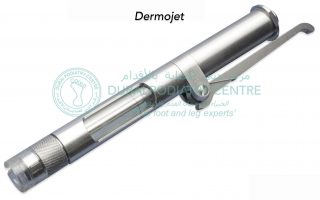 At Dubai Podiatry Centre, our highest success rate for plantar warts comes from our Dermojet treatment.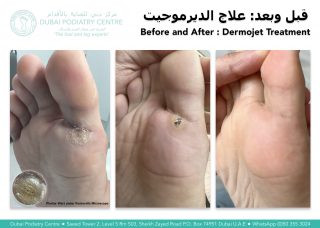
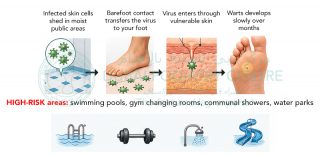 The condition is caused by a virus that is spread through contact with infected skin cells. This typically occurs in high-risk environments where people walk barefoot, such as swimming pools, gym changing rooms, and water parks. An infected skin cell from another person can be shed onto the floor, and if you walk over that area within a short time frame, the virus may transfer to your foot.
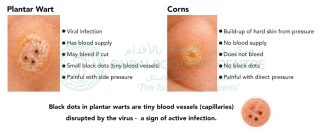 Plantar warts are sometimes confused with corns, but they are very different. A corn is a build-up of hard skin caused by pressure and friction. It can often be reduced without bleeding, although it may feel like walking on a sharp point. A plantar wart, however, is a living viral lesion. If disturbed or cut, it will bleed because it has developed its own blood supply within the skin.