
fbpx

Please wait...


BLOG

No more posts

Flat feet in children are common, but parents may become concerned when a child’s feet or ankles roll inward while standing or walking. This inward movement is known as overpronation and may affect foot posture, ankle stability, balance and walking comfort.

At Dubai Podiatry Centre, our podiatrists assess children’s flat feet and walking patterns to determine whether additional support, such as custom-made orthotics, may be beneficial.
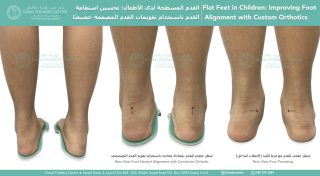
 

Child’s flat feet showing overpronation and improved neutral foot alignment with custom orthotics in Dubai

What Are Flat Feet in Children?

Flat feet occur when the arches of the feet appear lowered or make increased contact with the ground. In some children, the heels and ankles may also lean inward, causing the feet to overpronate.

Although flat feet do not always cause problems, a podiatry assessment may be recommended if your child experiences:

  • Foot, heel, ankle or knee pain
  • Tired or aching legs
  • Frequent tripping or poor balance
  • Difficulty walking or participating in sports
  • Uneven or excessive shoe wear
  • Ankles that visibly roll inward
  • Changes in posture or walking pattern

Recognising these signs early allows the child’s foot posture, movement and support requirements to be professionally evaluated.

How Overpronation Can Affect Foot Alignment

When a child’s feet overpronate, the heels and ankles lean inward instead of remaining in a more neutral position. This may change how pressure is distributed across the feet and influence the alignment of the lower limbs.

The comparison image demonstrates the rear view of pronating feet and the improved neutral alignment achieved while standing on corrective orthotics. The orthotics provide support beneath the feet and help stabilise the heels and ankles.

Custom Orthotics for Children’s Flat Feet

Custom orthotics are individually made to match the shape, posture and biomechanical needs of each child’s feet. Unlike standard insoles, they are created following a professional foot and walking assessment.

Corrective orthotics may help to:

  • Support the arches of the feet
  • Reduce excessive inward rolling
  • Stabilise the heels and ankles
  • Improve foot and lower-limb alignment
  • Distribute pressure more evenly
  • Support balance and walking comfort
  • Reduce strain on the feet and legs

Every child’s feet are different, which is why orthotics should be designed according to their individual assessment rather than selected as a one-size-fits-all solution.

Children’s Biomechanical Foot Assessment in Dubai

At Dubai Podiatry Centre, a children’s biomechanical assessment examines foot posture, ankle alignment, lower-limb movement and walking pattern. The podiatrist will determine whether custom orthotics are appropriate and explain the recommended treatment plan.

Regular reviews may also be advised to monitor the child’s progress, comfort and changing needs as they grow.

Book a Children’s Flat Feet Assessment in Dubai

If your child’s feet roll inward or you have concerns about flat feet, foot pain, balance or walking, professional assessment can help identify their individual support requirements.

Book a children’s flat feet and overpronation assessment with Dubai Podiatry Centre on Sheikh Zayed Road. Our podiatrists provide personalised foot assessments and custom orthotics for children in Dubai.


For more information or to book an appointment please call our clinic +971 4 3435390 or WhatsApp +971 50 3553024


A mother recently brought her young son to Dubai Podiatry Centre because the family had noticed something unusual about the way he was walking.

His mother had noticed that he frequently walked with his feet pointing outwards, while his grandfather had spotted something different: the child’s fourth and fifth toes appeared to be curling and gripping.

When we watched him walking in the clinic, we could see why.

The child alternated between two very distinctive walking patterns. At times he walked with his feet turned considerably outwards. At other times, he went up onto his tiptoes and toe walked.

When he tried to put his whole foot onto the ground and walk in a conventional heel-to-toe pattern, it was surprisingly difficult for him.

The “Slapping” Sound When He Walked

When the child attempted to walk with his feet facing forwards, his feet tended to come down quite flat onto the floor, producing a noticeable slapping sound.

Instead of smoothly contacting the ground with the heel and progressing through the foot towards the toes, he lifted his knees higher and almost marched.

His mother encouraged him to try walking normally from heel to toe, but he found this difficult.

Interestingly, his walking became much easier when he either:

  • turned his feet outwards, or
  • lifted his heels and walked on his toes.

These were not simply habits. His body was finding alternative ways to move around a mechanical difficulty at his feet and ankles.


Why Were His Little Toes Curling?

His grandfather had been particularly concerned about the fourth and fifth toes curling.

This provided us with another clue.

When the child stood, his ankles and subtalar joints rolled significantly inwards. As this happened, the outside of the foot became less stable against the ground.

The smaller toes then tried to compensate by curling and gripping.

What the family could see at the toes was therefore only part of the picture.

The toes themselves were not necessarily the primary problem. They were reacting to what was happening underneath the foot and at the ankle.

His Arches Looked Normal When He Was Sitting

This is something that can surprise parents.

When the child sat on the examination chair with his legs extended in front of him, his feet looked quite different.

His ankles appeared straight and his arches were nicely formed.

But when we asked him to stand and put his body weight through his feet, the picture changed dramatically.

His ankles rolled inwards, his feet flattened and his little toes began to curl.

This distinction between a child’s non-weight-bearing foot and their weight-bearing foot can be extremely important.

A child can have a perfectly good arch while sitting and yet demonstrate significant hyperpronation when standing and walking.

What Is Hyperpronation of the Subtalar Joint?

The subtalar joint sits underneath the ankle and plays an important role in allowing the foot to adapt to the ground.

Some children have softer, more flexible ligaments, allowing considerably more movement through this area.

When excessive inward movement occurs under body weight, we describe this as hyperpronation.

In this child’s case, the inward movement was significant enough to affect the way he was choosing to walk.

Walking on his toes gave him another way of generating momentum and moving forwards.

Turning his feet outwards and adopting a wider stance also gave him another way to negotiate the excessive movement occurring around his feet and ankles.

Rather than repeatedly telling him to “put your heels down” or “keep your feet straight”, we needed to address why he found those positions difficult in the first place.

Correcting the Foundation

We recommended corrective orthotics designed specifically for his feet.

The purpose was to support the foot and ankle in a more neutral position and reduce the excessive inward movement occurring when he stood and walked.

His orthotics were manufactured and fitted into both his school shoes and sports shoes.

Then we asked him to walk again.

The difference was immediate.

With his feet and ankles better supported, he began walking much more easily and naturally. Most noticeably, he no longer felt the same need to rise onto his tiptoes to move forwards.

Don’t Look Only at the Arch

Parents often associate flat feet with simply looking at whether their child has an arch.

But children’s foot mechanics are more complicated than that.

We also look at:

  • the position of the heel and ankle
  • movement through the subtalar joint
  • whether the arch changes significantly under body weight
  • the position of the toes
  • whether the toes grip the ground
  • whether the feet turn inwards or outwards
  • whether the child toe walks
  • how the heel contacts the ground
  • whether the child can comfortably achieve a smooth heel-to-toe walking pattern

Sometimes the smallest observations can be extremely useful.

In this child’s case, his grandfather noticing those curling little toes was an important clue to what was happening throughout the foot.


When Should Parents Have Their Child’s Walking Checked?

Children naturally have considerable variation in the way they learn to stand, walk and run, and not every flat-looking foot or unusual movement requires treatment.

However, if a child consistently walks on their toes, turns their feet markedly outwards, has difficulty walking heel-to-toe, produces a noticeable foot slap, curls or grips their toes, frequently trips, complains of discomfort, or simply appears to be working unusually hard to walk, it can be worthwhile having their gait and lower-limb mechanics assessed.

Sometimes what appears to be a habit is actually the child’s clever way of finding the easiest way to move with the mechanics they currently have.

At Dubai Podiatry Centre, we assess not simply how a child’s feet look while they are sitting, but what happens to those feet when the child stands, walks and moves.

Because ultimately, feet are designed for movement — and that is where their true function can be seen.

This article is for general educational information. Toe walking and altered gait can have a number of causes, including musculoskeletal and neurological causes. Persistent, new, asymmetric or otherwise concerning gait changes should be appropriately assessed rather than assumed to result from flat feet or hyperpronation alone.


For more information or to book an appointment please call our clinic +971 4 3435390 or WhatsApp +971 50 3553024


Flat feet in children are commonly caused by hereditary ligament laxity (stretchy ligaments), where the ankle joints are soft and roll inward excessively. This inward ankle movement, known as pronation, causes the foot arch to collapse and the feet to appear flat. In many children, an inward ankle tilt of more than 5 degrees is enough to flatten the arch completely.

When left untreated, flat feet can affect a child’s walking pattern, posture, balance, and overall foot development. Excessive pronation may also place additional strain on the ankles, knees, hips, and lower back as the child grows.

يحدث تسطّح القدمين لدى الأطفال غالبًا بسبب ارتخاء الأربطة الوراثي (الأربطة المرنة أو المتمددة بشكل زائد)، حيث تكون مفاصل الكاحل أكثر ليونة وتميل إلى الانحراف نحو الداخل بشكل مفرط. ويُعرف هذا الانحراف الداخلي للكاحل باسم الكبّ الزائد للقدم (Pronation)، وهو يؤدي إلى انهيار قوس القدم وجعل القدم تبدو مسطحة.

وفي كثير من الأطفال، قد يكون ميل الكاحل إلى الداخل بأكثر من 5 درجات كافيًا للتسبب في اختفاء قوس القدم بالكامل.

وعند ترك هذه الحالة دون علاج، يمكن أن تؤثر في طريقة مشي الطفل، ووضعية الجسم، والتوازن، والتطور الطبيعي للقدمين. كما أن الكبّ الزائد للقدم قد يفرض ضغطًا إضافيًا على الكاحلين والركبتين والوركين وأسفل الظهر مع نمو الطفل، مما يزيد من احتمالية حدوث مشكلات في الجهاز العضلي الهيكلي مستقبلًا.


How Corrective Orthotics Help Flat Feet

Corrective orthotics are custom-made medical devices designed specifically for the child’s feet. They are carefully shaped and angled to match the exact degree of foot and ankle misalignment. The purpose of treatment is to gradually guide the ankles back toward a neutral 0° position, allowing healthy arch development during growth.

Unlike standard insoles, corrective orthotics are individually prescribed based on the severity of the child’s pronation. Each stage of correction is designed to improve ankle alignment progressively, typically by around 5 degrees at a time.

For example, if a child’s ankles roll inward by 15 degrees, treatment may involve a gradual correction plan using multiple orthotics to guide the feet step-by-step into proper alignment. Children with more severe flat feet may require additional stages of correction over time.

كيف تساعد التقويمات التصحيحية في علاج تسطّح القدمين؟

التقويمات التصحيحية للقدم (Corrective Orthotics) هي أجهزة طبية تُصنع خصيصًا لتناسب قدمي الطفل. ويتم تصميمها بعناية وفقًا لدرجة انحراف القدم والكاحل لدى كل طفل، بحيث تكون الزوايا والدعامات متوافقة تمامًا مع احتياجاته الفردية.

يهدف العلاج إلى توجيه الكاحلين تدريجيًا نحو الوضعية المحايدة الطبيعية (0°)، مما يتيح لقوس القدم أن يتطور بشكل صحي أثناء مراحل النمو.

وعلى عكس النعال الجاهزة أو التقليدية، يتم وصف التقويمات التصحيحية بشكل فردي بناءً على شدة الكبّ الزائد للقدم (Pronation) لدى الطفل. وتُصمم كل مرحلة من مراحل العلاج لتحسين محاذاة الكاحل بشكل تدريجي، وعادةً بمعدل يقارب 5 درجات في كل مرحلة.

فعلى سبيل المثال، إذا كان كاحلا الطفل يميلان إلى الداخل بمقدار 15 درجة، فقد تتضمن الخطة العلاجية تصحيحًا تدريجيًا باستخدام عدة تقويمات مختلفة تُستخدم على مراحل لتوجيه القدمين خطوة بخطوة نحو المحاذاة الصحيحة. أما الأطفال الذين يعانون من درجات أشد من تسطّح القدمين، فقد يحتاجون إلى مراحل إضافية من التصحيح على مدى فترة أطول.

Why Early Treatment Matters

Children’s bones, joints, and ligaments are still developing, making early intervention extremely important. Correcting foot alignment during childhood can help support normal walking mechanics, improve posture and balance, reduce stress on the joints, and encourage natural arch formation.

Early treatment with custom orthotics may also help prevent long-term foot and lower limb problems associated with excessive pronation and unstable foot posture.

لماذا يُعدّ العلاج المبكر مهمًا؟

تكون عظام الأطفال ومفاصلهم وأربطتهم لا تزال في مرحلة النمو والتطور، مما يجعل التدخل المبكر ذا أهمية كبيرة. فتصحيح محاذاة القدم خلال سنوات الطفولة يمكن أن يساعد على دعم آلية المشي الطبيعية، وتحسين القوام والتوازن، وتقليل الضغط على المفاصل، وتشجيع التكوّن الطبيعي لقوس القدم.

كما أن العلاج المبكر باستخدام التقويمات الطبية المخصصة للقدم قد يساعد في الوقاية من المشكلات طويلة الأمد التي قد تصيب القدمين والأطراف السفلية نتيجة الكبّ الزائد للقدم (Pronation) وعدم استقرار وضعية القدم. وهذا يساهم في تعزيز نمو صحي وسليم للجهاز العضلي الهيكلي مع تقدم الطفل في العمر.


For more information or to book an appointment please call our clinic +971 4 3435390 or WhatsApp +971 50 3553024


Flat feet in young children are a common condition where the arch of the foot has not fully developed. While many children outgrow it, some may experience poor foot alignment, ankle instability, and changes in walking patterns.

This before-and-after video demonstrates how corrective orthotics can play a vital role in early intervention. By providing proper arch support and stabilizing the ankle, orthotics help guide the foot into a more natural position. This not only improves posture and balance but also reduces the risk of future musculoskeletal issues.

Early diagnosis and treatment are key. If your child shows signs such as inward rolling ankles, frequent tripping, or uneven shoe wear, a professional assessment is recommended.

Corrective orthotics are customized to each child’s needs, ensuring comfort while supporting healthy growth and development.


يُعدّ تسطّح القدمين لدى الأطفال الصغار حالة شائعة يحدث فيها عدم اكتمال تطور قوس القدم بشكل كامل. وبينما يتجاوز العديد من الأطفال هذه الحالة مع النمو، قد يعاني بعضهم من ضعف في محاذاة القدم، وعدم استقرار في الكاحل، وتغيرات في طريقة المشي.

يوضح هذا الفيديو الذي يعرض الحالة قبل وبعد العلاج كيف يمكن للتقويمات التصحيحية للقدم (Orthotics) أن تلعب دورًا مهمًا في التدخل المبكر. فمن خلال توفير الدعم المناسب لقوس القدم وتثبيت الكاحل، تساعد هذه التقويمات على توجيه القدم إلى وضعية أكثر طبيعية. ولا يقتصر تأثير ذلك على تحسين القوام والتوازن فحسب، بل يساهم أيضًا في تقليل خطر حدوث مشكلات عضلية هيكلية مستقبلية.

يُعد التشخيص والعلاج المبكران عاملين أساسيين لتحقيق أفضل النتائج. فإذا ظهرت على طفلك علامات مثل انحراف الكاحلين إلى الداخل، أو التعثر المتكرر أثناء المشي، أو تآكل الأحذية بشكل غير متساوٍ، فمن المستحسن إجراء تقييم متخصص.

ويتم تصميم التقويمات التصحيحية خصيصًا وفقًا لاحتياجات كل طفل، مما يضمن الراحة مع توفير الدعم اللازم للنمو والتطور الصحي للقدمين.

For more information or to book an appointment please call our clinic +971 4 3435390 or WhatsApp +971 50 3553024


Young children with flat feet.
.الأطفال الصغار بأقدام مسطحة

It is quite normal for babies and little children to have flat feet.
.من الطبيعي جدًا أن يكون لدى الرضع والأطفال الصغار أقدام مسطحة

They have extra fatty padding in the sole of their foot and as they grow a little bit older the fatty padding disperses.
.لديهم بطانة دهنية إضافية في باطن أقدامهم، وعندما يكبرون قليلاً تختفي البطانة الدهنية

However, if you think there is a problematic flat foot you might notice the child is walking with their feet turned outwards.
.ومع ذلك، إذا كنت تعتقد أن هناك مشكلة في القدم المسطحة، فقد تلاحظ أن الطفل يمشي وأقدامه متجهة إلى الخارج

When they are running you might notice their feet turned outwards and the legs are quite wide.
.عندما يركضون، قد تلاحظ أن أقدامهم متجهة إلى الخارج وأرجلهم واسعة جدًا

When they are standing they might have to stand with their feet quite wide apart with their feet turned outwards as well.
.عندما يقفون، قد يضطرون إلى الوقوف وأقدامهم متباعدة تمامًا مع توجيه أقدامهم إلى الخارج أيضًا

That type of flat foot requires treatment.
.هذا النوع من القدم المسطحة يتطلب العلاج

The treatment we would propose to do is put an insole inside the shoes that lifts the arches up and gets the ankles and the legs aligned.
.العلاج الذي نقترح القيام به هو وضع نعل داخل الحذاء يعمل على رفع الأقواس للأعلى ومحاذاة الكاحلين والساقين


For more information or to book an appointment please call our clinic +971 4 3435390 or WhatsApp +971 50 3553024
‎لمزيد من المعلومات أو لحجز موعد يرجى الإتصال بعيادتنا على الرقم : ٠٠٩٧١٤٣٤٣٥٣٩٠ أو التواصل على الواتساب على الرقم  ٠٠٩٧١٥٠٣٥٥٣٠٢٤


These are some of the effects that flat feet can have on a growing child.

When a child is very young, 2 years old, it is quite normal for them to have flat feet.

As the child grows to 4 years old, the arches of the feet normally develop quite nicely and they grow out of flat feet.

If you notice your young child is having difficulty walking, falling down too easily and they become tired, it could be because the ankles are leaning-in. This makes the feet look flat and that is very tiresome for the child.

Without treatment when the child gets to 10 years old you might notice the feet are even more flat, the feet turn outwards and they are beginning to get a slouched posture.


Illustration of a 2-year-old child with feet turned outward and a wide stance, highlighting delayed walking, frequent falls, and balance concerns Rear-view illustration of a 10-year-old child with feet turned outward, with captions noting possible difficulty running, jumping, and sprinting Rear-view illustration of a 16-year-old with outward-facing feet and a slouched posture, highlighting possible difficulty running


Without treatment the child grows to 16 years old and may have feet turned out even more with very flat feet and obvious slouched position when they standing and walking.

Treatment as young as possible involves putting an insole inside the child’s school shoes and sports shoes that help to lift the arches and align the ankles. The child will have better stability and ease when it’s come to running and doing sports.


For more information or to book an appointment please call our clinic +971 4 3435390 or WhatsApp +971 50 3553024


Do you have a young person in your family that has poor posture, shoulder slouching and feet turning out as they walk?

It could be a result of flat feet. When the feet are flat, the arches collapse, the feet turn outwards, the hips tilt forward and the shoulders roll forward.

In the clinic we would put orthotic insoles inside their shoes, under their feet, helping to lift the arches.

Turning their feet into a straighter position, tilt the pelvis, rib cage, shoulders and raising the chin.

These orthotic insoles go into school shoes and sports shoes to allow for the better posture.


For more information or to book an appointment please call our clinic +971 4 3435390 or WhatsApp +971 50 3553024


Flat feet can cause issues with running and walking in some children
يمكن أن تسبّب القدمين المسطحتين مشاكل في الركض والمشي لدى بعض الأطفال


‏If you notice when the child is running away from you that they are leaning forward and they are wiggling when they are running, it could mean that we need to put something inside their shoes that help their body alignment.

إذا لاحظت أن الطفل يميل إلى الأمام ويتمايل عندما يركض، فقد يعني ذلك أنه قد نحتاج إلى وضع شيء داخل حذائه يساعد على تحسين توازن جسمه


‏When the child is running towards you, you may notice that the feet are turned more outwards. This puts more pressure on the front of the body making it easier to fall.

عندما يركض الطفل، قد تلاحظ أن القدمين تتجهان إلى الخارج أكثر ممّا يشكل ضغطًا أكبر على الجزء الأمامي من الجسم ويزيد احتمال التعرض للسقوط


‏We would put something inside the school shoes and inside the sports shoes that lifts the arches and brings the feet in to a straighter position, putting the bodyweight further back allowing the abdominal muscles to be engaged when they are running.

سنقوم بوضع شيء داخل حذاء المدرسة وحذاء الرياضة ليرفع الأقواس ويجعل القدمين في وضع مستقيم أكثر، مما يسمح بتحميل الوزن إلى الوراء أكثر ولعضلات البطن المشاركة بعملية الركض


‏If you think your child needs something, bring them to the clinic with their school shoes and sports shoes. If there is a requirement we will put it in to their shoes making the child more efficient at running and school.

إذا كنت تعتقد أن طفلك يحتاج إلى شيء كهذا، قم بإحضاره إلى العيادة مع حذائه المدرسي وحذائه الرياضي. إذا كانت هناك حاجة، سنقوم بوضعه داخل حذائه، ليصبح الطفل أكثر فعالية خلال الركض وفي المدرسة


For more information or to book an appointment please call our clinic +971 4 3435390 or WhatsApp +971 50 3553024


Young children with flat feet tend to fall down quite easily and have difficulty running quickly

غالبًا ما يقع الأطفال ذوي الاقدام المسطحة بسهولة أو يصعب عليهم الركض بسرعة

‏The reason for that is when the arches are flat the ankles lean in and the child finds it very difficult to run and walk in that position.

وهذا لأن الأقواس مستقيمة فيميل الكاحلين ويصبح من الصعب على الطفل الركض أو المشي في هذه الوضعية

‏So, they find a better way to run with their feet pointed outwards.

لذا يصبح من الأسهل لهم الركض وأقدامهم موّجهة للخارج

‏When that happens it tends to tilt the upper body forward so in turn they can fall forward quite easily.

عند الركض بهذه الطريقة، يميل الجزء العلوي من الجسد إلى الأمام فيزداد احتمال الوقوع

‏So, we would put something inside their school and sports shoes that lifts the arches and tilts the ankles back to straight giving the child better confidence when running.

لذلك نقوم بوضع شيء داخل الحذاء المدرسي و الرياضي ليرفع الأقواس ويعيد الكاحلين للوضع المستقيم وبالتالي إعادة الثقة للطفل خلال الركض


For more information or to book an appointment please call our clinic +971 4 3435390 or WhatsApp +971 50 3553024
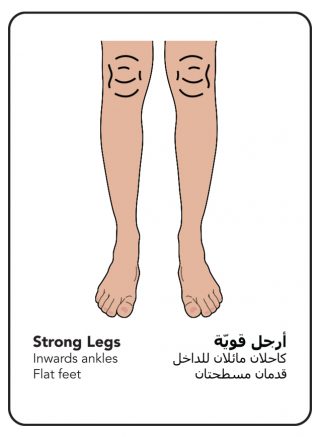


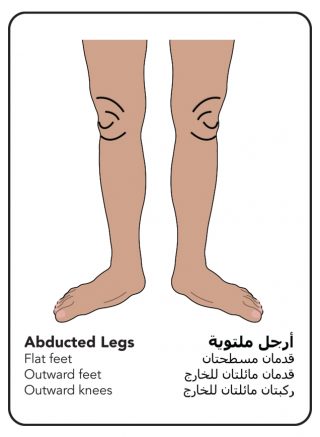
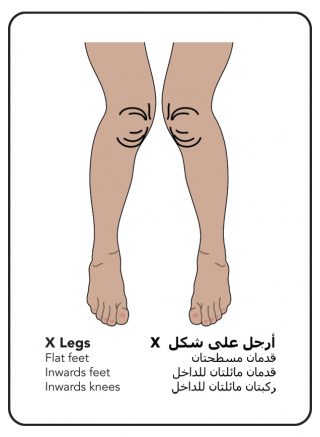
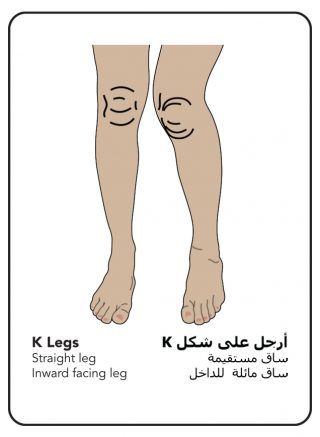
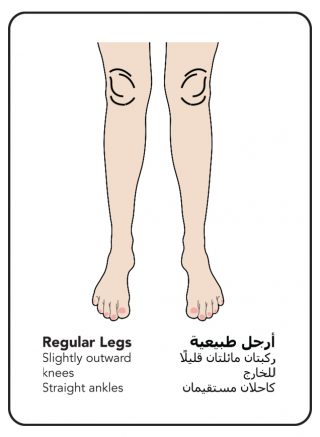
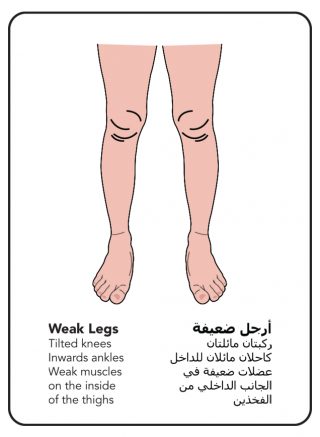
This diagram shows some of the changes that happen in the legs because of flat feet.

يُظهر هذا الرسم التوضيحي بعض التغيرات التي تحدث للساقين بسبب القدمين المسطحتين 


Illustration labelled “Abducted Legs” showing flat feet turned outward and knees angled outward, with English and Arabic labels


In this first example, the arches drop down so the person will find it difficult to walk with their feet straight. So, they abduct their feet and roll off of the inside of their feet which is why the knees are facing outwards. 

في المثال الأوّل، تهبط أقواس القدم ليصبح من الصعب على الفرد المشي بطريقة مستقيمة. لهذا السبب، يبعدون أقدامهم ويديرونها تجاه الداخل ممّا يجعل الركبتين مواجهتين للخارج


Illustration labelled “X Legs” showing knees angled inward and feet turned inward, with English and Arabic labels


If they try and walk with their feet straight this diagram shows what will happen, the knees end up pointing towards each other and we call it ‘X legs’ because the legs tend to look like the English letter ‘X’.

في حال قاموا بالمحاولة والمشي بطريقة مستقيمة، نرى من خلال هذا الرسم التوضيحي أنّه سينتهي الأمر باتجاه الركبتين نحو بعضهما البعض. هذا ما يُسمّى بالأرجل X، إذ إنّها تبدو مشابهة للحرف X في اللّغة الإنجليزية


Illustration labelled “K Legs” showing one straight leg and one leg angled inward, with English and Arabic labels


When we have one leg that is straight and the foot arch is up and the other foot arch is collapsed, that knee will face towards the other one. We call that a ‘K leg’ because it looks like the English letter ‘K.’

عندما تكون ساق واحدة مستقيمة والقوسٍ عالٍ بينما قوس القدم الأخرى هابط،  تكون الركبتين متواجهتين. نُسمّي ذلك بالساق K، إذ إنّها تبدو مشابهة للحرف k في اللّغة الإنجليزية


Illustration labelled “Regular Legs” showing knees angled slightly outward and straight ankles, with English and Arabic labels


In this example, the leg is straight and the arches are up with the knees facing away slightly. This is what we call the ‘normal position’.

في هذا المثال، الساق مستقيمة والأقواس مرتفعة مع ركبتين متباعدتين قليلًا. هذا ما يُعرف بالوضعية الطبيعيّة


Illustration labelled “Weak Legs” showing tilted knees, inward-angled ankles and weak inner thigh muscles, with English and Arabic labels


In the next case, this person has weak muscles in their legs from lack of exercise as well as flat feet and that is why the knees have dropped down to the side slightly.

في الحالة التالية، لدى هذا الشخص عضلات أرجل ضعيفة ناتجة عن قلّة التمارين وتسطّح القدمين. لهذا السبب هبطت الركبتين قليلًا نحو الطرف 


Illustration labelled “Strong Legs” showing flat feet and inward-angled ankles, with English and Arabic labels


For the last case, this is an athlete that has flat feet. They are still able to perform and their thigh muscles are strong and that is why they are able to maintain the position of their knees.

أمّا بالنّسبة للحالة الأخيرة، يتمتّع هذا الرياضيّ بقدمين مسطحتين. لا يزال بإمكانه ممارسة الرياضة بسبب قوّة عضلات الفخذ التّي تحافظ على هذه الوضعية للركبتين 


For more information or to book an appointment please call our clinic +971 4 3435390 or WhatsApp +971 50 3553024
لمزيد من المعلومات أو لحجز موعد يرجى الإتصال بعيادتنا على الرقم : ٠٠٩٧١٤٣٤٣٥٣٩٠ أو التواصل على الواتساب على الرقم  ٠٠٩٧١٥٠٣٥٥٣٠٢٤


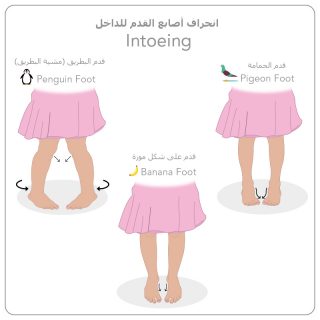
If you want to learn more about intoeing you can read more here 


Copyright Dubai Podiatry 2026. All rights reserved.

WhatsApp us